

There is a point in the life of almost every marketing team when somebody looks at the calendar, notices sales are not quite where they should be and reaches for the apparently obvious solution.
We need more content.
More TikToks. More LinkedIn posts. More Reels. More emails. More creator collaborations. More thought leadership. More behind-the-scenes footage. More “always-on” assets. Perhaps a podcast nobody had previously expressed any desire to make. Before long there is a spreadsheet involving 47 deliverables, six channels and several colleagues quietly wondering when the business became a publishing company.
Then the content gets made.
Some of it receives likes. A video does quite well. Engagement goes up 18% on Tuesday. A carousel achieves a pleasing number of saves. Someone screenshots the dashboard for the monthly marketing meeting.
And sales remain more or less where they were.
This is not an argument against content. Content can explain products, build familiarity, improve search visibility, create community, support sales teams, help existing customers and keep a brand culturally present between major campaigns. Creativepool itself has explored how branded content can become something audiences genuinely want to watch, and there are plenty of businesses for whom an intelligent content programme is commercially valuable.
The problem begins when output becomes the strategy.
That problem is becoming harder to ignore because producing marketing material has never been easier. Generative AI, templates, inexpensive production tools and increasingly automated media systems allow brands to manufacture an extraordinary volume of assets without requiring an extraordinary increase in budget.
WARC highlighted the consequences in July 2026: analysis of more than 633,000 advertisements found average media support per ad had fallen by roughly 15%, while 93% of the ads analysed received less than $10,000 in media investment. We are getting significantly better at making things, while becoming less certain that enough people will ever meaningfully encounter each thing we make.
The uncomfortable question for marketing, then, is no longer whether you can produce more content.
It is whether producing it will persuade anybody to become a customer.
That moves us into rather more useful territory, because creative advertising has never really been about filling channels. At its best, creative exists to alter behaviour: to make more people notice a business, understand its value, remember it when a buying situation arrives, prefer it to an alternative and, eventually, hand over some money.
Sometimes that happens tomorrow.
Sometimes it happens six months from now.
But unless the work is connected somehow to commercial movement, “more content” can become an extremely sophisticated way of keeping a marketing department busy.
Why More Content Doesn't Necessarily Bring More Customers

Pinch Creative
The content economy has created an odd inversion in marketing. For most of advertising history, making things was expensive, which forced organisations to decide quite carefully what deserved to exist. Now production is cheap enough that the answer can increasingly be: everything.
Three ideas? Make all three.
Six edits? Why not twelve?
One good social post? Turn it into a carousel, article, email, video, infographic and a slightly haunted AI-generated podcast.
There are obvious advantages to that abundance, but it also creates a dangerous illusion: because content is measurable and comparatively easy to produce, activity begins to resemble progress.
It is possible to publish every day without building meaningful demand. You can generate millions of impressions among people who have no realistic chance of buying anything. You can make someone click an advert because the headline is irresistible, then lose them immediately because the proposition underneath it is weak. You can produce content people genuinely enjoy while accidentally ensuring the brand paying for it remains almost entirely forgettable.
This is one reason the industry’s obsession with efficiency has come under renewed scrutiny. Les Binet and Will Davis’s 2026 IPA work, Go Big or Go Home, argues that marketers have become too focused on narrow efficiency metrics at the expense of genuine effectiveness, warning that businesses can damage profits by optimising the wrong things, underestimating the importance of adequate investment and using inefficient creative approaches.
There is an important distinction hidden in those two words.
Efficiency asks how cheaply we generated the response.
Effectiveness asks whether the response created enough business value to matter.
You can have an extraordinarily efficient campaign that efficiently delivers people who never buy anything.
A £2 click is not automatically superior to a £5 click if the latter produces customers worth ten times as much. A six-second video view is not intrinsically valuable because it was cheap. An engagement rate does not become revenue through sustained optimism.
This is where the question “Why do people click on ads but not buy?” becomes useful, because creative can only solve some of the possible answers.
Perhaps the ad promises something the landing page fails to deliver. Perhaps the targeting is attracting curiosity rather than genuine demand. Maybe the product costs more than people expected, the checkout is awful, reviews are weak, delivery takes too long or the offer simply isn’t competitive. Advertising cannot permanently compensate for a bad product or broken customer journey.
But sometimes the problem really is creative. The advert earns attention without creating desire. It makes the offer look interesting but not necessary. It explains features without giving somebody a reason to care. It attracts the wrong audience through a misleading hook. Or it drives the immediate click while doing almost nothing to make the brand preferable once the customer reaches the point of decision.
That is why good advertising effectiveness begins before the copywriter writes a headline.
It begins with understanding what needs to change.
Creativepool’s feature on turning business problems into creative opportunities makes this distinction nicely. “Sales are slowing, so produce another campaign” is a response to a symptom. Better creative problem-solving asks why sales have slowed before deciding whether another campaign is even the correct answer.
That might sound painfully obvious, yet an extraordinary amount of marketing begins with the deliverable.
“We need six films.”
“We need social.”
“We need some content for Q1.”
Fine.
What for?
What Creative Advertising Actually Has to Do Before It Can Sell
The Mission Control Communications
Creative does not sell because it is “creative”.
What creative does is sells when creativity helps perform one or more commercially useful jobs better than a forgettable alternative.
First, the work must be noticed. There is no great virtue in a strategically impeccable advert nobody consciously registers.
Then the brand needs to be identified. Otherwise you have created entertainment on somebody else’s behalf.
The audience must understand or feel something that moves them towards choice. This might be a functional advantage, emotional benefit, reason to trust, new usage occasion, reduced anxiety, sense of popularity or simply a very strong desire for the product.
And crucially, the work must leave something behind. Most customers are not sitting around waiting for your campaign to arrive precisely thirty seconds before they need your product. Effective advertising frequently works by creating and refreshing memories that become useful later.
That is one reason memorability matters so much. The best answer to “What makes an advert memorable to customers?” is not necessarily a mascot, celebrity, catchy song or extraordinary production budget. Any of those can help. The deeper requirement is a distinctive idea attached clearly enough to the brand that the memory remains commercially usable.
There is a difference between remembering an advert and remembering whose advert it was.
There is another difference between remembering whose advert it was and subsequently having a reason to choose them.
Good creative advertising strategy closes those gaps.
Take a student seeing Quizlet for the first time. “Digital flashcards for university study” is perfectly understandable information, but it isn’t especially vivid. The Creativepool-featured Feed Your Brain campaign for Quizlet found a much stronger creative translation. Students were already wrestling with the problem of getting huge volumes of course material into their heads, so the campaign treated information like food that needed preparing into digestible portions. Books and study material were sliced, rolled, blended and prepared through surreal stop-motion films designed for TikTok, YouTube and campus screens.
The creative metaphor did several jobs simultaneously. It made the product’s value proposition understandable. It created unusual imagery capable of competing inside feeds. It translated into short formats and worked with or without sound. Most importantly, the commercial outcome moved: Creativepool’s case study reports sign-ups 19% above forecast, unaided awareness rising by almost four percentage points and app usage overtaking Duolingo among the target audience.
That is considerably more interesting than saying the campaign generated six excellent pieces of content.
The assets were outputs.
The result was the point.
Creativepool Campaigns That Moved Something More Valuable Than Engagement
Advertising case studies naturally gravitate towards spectacular numbers. Billions of impressions have become so common that apparently every other campaign has reached the population of Earth several times before breakfast. There is nothing inherently wrong with reach; advertising generally needs people to encounter it. But for an article about selling, the more instructive Creativepool examples are the ones where something recognisably commercial happened at the other end.
The Cake Wing turned conversation into sales

The Cake Wing by The Romans for Jaffa Cakes is particularly useful because the brief explicitly connected brand saliency with sales. Jaffa Cakes already possessed one of British marketing’s most famous arguments – cake or biscuit? – but familiarity had gradually stripped the debate of surprise. The creative challenge was not to create more posts about the question. It was to restart the cultural argument in a way people would actively carry themselves.
The Romans did that by apparently allowing the nation’s Biscuit Museum to classify Jaffa Cakes incorrectly as biscuits. Outrage followed; McVitie’s issued a deliberately theatrical cease-and-desist, then eventually resolved matters by building the museum a new “Cake Wing” containing one correctly categorised Jaffa Cake. The story unfolded through press, broadcast and social reaction rather than appearing as a conventional stack of campaign assets.
The Creativepool case study reports 122 pieces of top-tier coverage within 48 hours and 17 broadcast segments across the campaign period. Those are impressive media numbers, but the more important line appears afterwards: sales increased 17%, delivering Jaffa Cakes’ strongest-performing month since July 2022.
The campaign did not sell because the brand produced more content about an old debate.
It sold because the agency found a new behaviour for an existing brand asset.
Skinny made the business model into the creative model
Colenso BBDO’s Phone It In for Skinny is an equally useful example because the creative idea emerges directly from the product proposition. Skinny is a low-cost New Zealand mobile network. Instead of spending money on expensive celebrities to voice its radio advertising, the brand placed scripts on billboards, beer mats, posters and other surfaces and invited ordinary members of the public to telephone a number and record them. Those recordings became the radio campaign.
That is not merely an amusing production device. It turns cost-consciousness into brand behaviour. The campaign sounds cheaper because being cheaper is part of what Skinny sells. The public participation makes the communication more distinctive while simultaneously proving the brand is unwilling to spend customers’ money on unnecessary frills.
Creativepool’s coverage reports a 34% increase in network sign-ups.
The useful lesson is not “get customers to record your radio ads”.
It is to ask whether the commercial proposition can shape the creative mechanism itself.
When those two things line up, the advertising becomes harder for a competitor to copy because the idea belongs naturally to the business rather than merely to the format.
A commuter campaign converted an existing benefit into behaviour
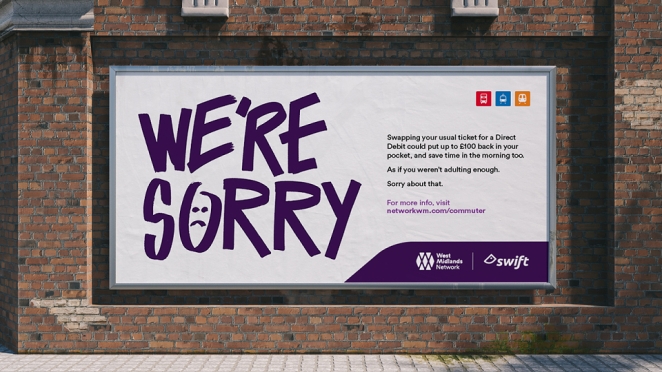
Big Cat Agency’s WMCA Commuter Campaign demonstrates something rather less glamorous and perhaps even more commercially instructive. West Midlands Combined Authority wanted more commuters to move to direct debit, which could save some users more than £100 while also removing the friction of repeatedly purchasing tickets. [10]
The agency began by distinguishing different audience mindsets rather than producing one generic message. Some commuters did not know the direct-debit option existed; others knew but had never got around to switching; less-frequent travellers were unconvinced the financial saving applied to them. The resulting campaign borrowed the visual language of transport service announcements – communications commuters were already conditioned to notice – and used humour to apologise for the supposed “inconvenience” of having more money and time.
Direct-debit sign-ups increased 21% versus the same period a year earlier.
Again, there is no magic format to copy here. The useful bit is what happened before the artwork: the agency separated the audience according to behavioural barriers and identified which benefit could move each group.
That is customer insight doing commercial work.
Old Spice shows why participation matters only when the product moves too
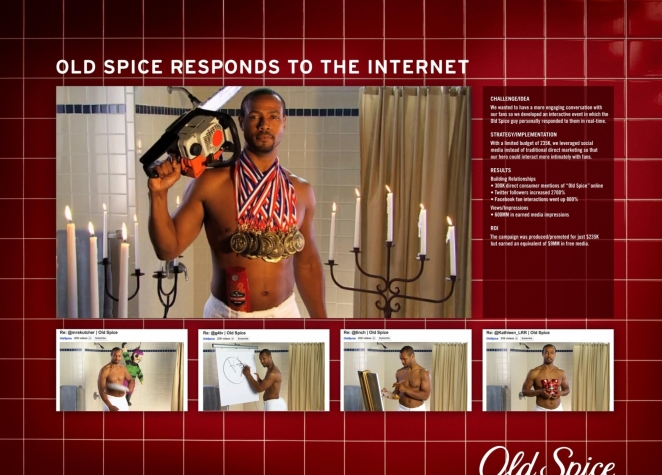
Creativepool’s feature on successful social media campaigns revisits Old Spice’s famous personalised response videos, where Isaiah Mustafa replied directly to users, celebrities and online comments through rapidly produced films. The project is often remembered as an early masterpiece of social engagement, but the commercial context matters: Creativepool notes Wieden+Kennedy’s reporting that Red Zone Body Wash sales rose 60% by May 2010 and had doubled by July.
That distinction is worth preserving whenever somebody proposes an “engagement idea”.
Participation can be strategically valuable. Comments can spread a campaign. Shares extend reach. User-generated content can create advocacy. Communities can supply social proof.
But engagement is the mechanism, not necessarily the outcome.
A customer leaving a fire emoji beneath your video is not financially equivalent to buying the product.
Treating those two behaviours as though they belong on the same line of the effectiveness report is how marketing dashboards become fiction.
What Brands and Agencies Should Prioritise When the Job Is to Sell

BRIKMAN
There is no universal formula for effective advertising, because businesses sell different things under different competitive conditions. An impulse-purchase snack, enterprise software contract, insurance renewal and new car operate on wildly different decision cycles.
But when the brief genuinely is “we need more customers”, the creative conversation becomes considerably sharper. A few principles deserve priority over simply feeding the content machine:
- Start with the commercial behaviour, not the format. “We need more first-time buyers” is a brief. “We need some TikToks” is a deliverable. Establish the behaviour you need to change before deciding what should be made.
- Find the barrier between interest and purchase. Customers may not understand the offer, believe the claim, remember the brand, see enough difference, trust the company or feel sufficient urgency. Each requires different creative work.
- Give the customer a reason to care, not merely information to process. Product features matter when they become advantages people recognise. The creative task is frequently to translate what the business makes into what changes for the buyer.
- Make the brand easy to identify and remember. An amusing, beautiful or culturally relevant execution becomes commercially weaker if attribution is poor. Distinctive assets should be part of the creative mechanism wherever possible.
- Design the idea for the buying journey rather than the content calendar. Some creative needs to create demand; other work should reduce uncertainty or make action easier. One piece of content does not need to perform every job, but the pieces should know which jobs they perform.
- Judge the campaign against business outcomes agreed before launch. Sales, incremental revenue, qualified leads, sign-ups, acquisition cost, penetration, profit or another meaningful behaviour should sit alongside diagnostic measures such as reach, clicks and engagement.
- Keep building future demand while harvesting present demand. Performance creative matters, but an organisation that only communicates to people already shopping risks becoming increasingly dependent on paying to convert existing intent.
The last point is probably the most important, because the title of this article could otherwise sound like an invitation to turn every piece of creative into a direct-response advert covered in promotional stickers.
That would be a mistake.
Should Creative Prioritise Immediate Sales or Long-Term Brand Growth?
BrandOpus
Imagine two campaigns.
Campaign A produces a burst of cheap purchases among people already searching for your category. It looks fantastic in a weekly dashboard.
Campaign B increases familiarity, perceived quality and consideration among a much larger audience who will enter the market gradually over the following year. Its immediate conversion rate looks unimpressive.
Which sold more?
That depends entirely on when you stop measuring.
The 2024 Profit Ability 2 study, based on econometric analysis of 141 brands, £1.8 billion of UK media spend, ten media channels and fourteen sectors, found that advertising’s contribution looks materially stronger when its sustained effects are included rather than restricting analysis to immediate payback. The research concluded that advertising is a profitable driver of business growth across the channels examined, while emphasising that profitability and saturation vary considerably by medium and category.
That does not mean every SME should immediately buy a national television campaign. It means a click occurring today is much easier to observe than a preference created today and monetised next February.
The ease of measurement can distort investment.
Creative teams therefore need to understand whether they are being asked to capture demand or create demand.
Capture work helps somebody already leaning towards purchase complete the movement. It can clarify a product, answer an objection, demonstrate value, highlight a price, provide proof or make the desired action exceptionally obvious.
Demand-creating work enlarges the future pool. It makes more people know, remember, like, trust or think about the brand before they are ready to buy.
Strong marketing systems do both.
The dangerous situation is when “we need more customers” is interpreted as “everything has to convert immediately”, because that can gradually remove the very activity responsible for creating future customers in the first place.
The equally dangerous opposite is advertising that insists every disappointing commercial result is merely “long-term brand building” and will presumably become profitable at some magnificent but unspecified point in the future.
Good advertising effectiveness requires more intellectual honesty than either position.
Know what each piece of work is meant to do.
Measure accordingly.
How Can You Test Creative Before Spending More Money?

Big Spaceship
This is where performance culture has actually given creative departments something extremely valuable: the ability to learn.
The old caricature presents creativity and measurement as natural enemies. Creative people apparently want to make a beautiful thing based on instinct; performance marketers want seventeen variants of the button because one shade produced 0.06% more clicks in Delaware.
Neither extreme is particularly useful.
Testing becomes powerful when it answers a meaningful creative question rather than simply optimising increasingly microscopic details.
If you have two genuinely different propositions, test them.
If you are unsure whether the product demonstration makes the benefit clearer, test it.
If one concept relies on humour and another on direct utility, compare them.
If the campaign is substantial enough to justify pre-testing, use research to understand whether people notice the brand, understand the message and feel what the strategy intended.
Then, once the work is live, treat results as evidence rather than a verdict from the gods.
Even Meta’s own A/B testing guidance stresses the importance of beginning with a measurable hypothesis, making the assets sufficiently different to generate a useful comparison, controlling confounding factors where possible and continuing to test based on what has been learned.
The principle travels far beyond any particular platform.
Testing “red button versus blue button” can tell you something about buttons.
Testing “saving time versus saving money” can tell you something about motivation.
The latter is usually more strategically valuable.
The important caveat is that short-term testing naturally favours responses visible in the short term. Creative designed to generate immediate clicks can be compared relatively quickly. Brand-building work cannot always be judged responsibly after a 72-hour media run.
The metric has to match the intended effect.
That means building an effectiveness framework before launch rather than allowing the marketing team to choose whichever number looks happiest afterwards. Creativepool has previously argued in Campaign Ideas That Actually Work that campaigns should link measures to the actual objective: purchases and ROI for direct response, but appropriate awareness, search, recall or consideration measures where the work is operating higher up the decision process.
There are also practical ways to reduce risk before scaling:
Run geographically controlled pilots where the business permits it. Use matched audiences or holdouts. Track search behaviour alongside conversion. Compare exposed and unexposed groups. Watch what happens to branded as well as generic demand. Test whether the proposition survives when the media spend increases.
And perhaps most importantly, know what you are prepared to change.
There is little point testing creative if the organisation has already emotionally committed to the answer.
From Content Calendar to Customer Strategy
Futures For All
The irony in all this is that the businesses most obsessed with producing content often have no shortage of things to say.
What they lack is hierarchy.
Every product feature wants a post. Every internal initiative deserves a video. Every awareness day appears on the calendar. Every platform has to be fed because going quiet feels vaguely irresponsible.
The result is a marketing operation optimised for production rather than persuasion.
WARC’s “media investment gap” is especially revealing here because the problem is not simply creative quality. It is allocation. If brands produce ever more advertisements while the media support available to each falls, they risk spending production resource creating assets that will never be given a meaningful chance to influence enough people.
AI will intensify that temptation because it makes variation nearly free.
The sensible response is not to reject the technology. It is to become much more demanding about what earns the right to be multiplied.
One genuinely effective campaign idea can produce dozens of executions.
Dozens of executions do not automatically produce one effective campaign idea.
Creativepool made a similar argument recently in The Constraint Is the Idea, noting that audiences now face more content, more platforms and more opportunities to ignore all of it while brands possess more tools for adding to that volume. Under those conditions, mere competence becomes less valuable because competence itself is abundant.
That changes what creative people are really being paid for.
Not output.
Judgement.
Knowing which customer problem deserves attention.
Knowing which product truth could become a proposition.
Knowing which proposition can become an idea.
Knowing whether that idea belongs on television, TikTok, a train platform, a search result or somewhere nobody has thought to put it yet.
Knowing when something should be a campaign and when it should simply be a better landing page.
Knowing when a client’s “content problem” is actually a pricing problem, trust problem, product problem or positioning problem.
And knowing what not to make.
That final skill may become increasingly valuable as making things gets cheaper.
What Creative Actually Helps Sell?

Amblr Studio
The answer, frustratingly for anyone hoping for a convenient checklist of formats, is not “video”, “social”, “influencer content” or “performance ads”.
- Creative helps sell when it makes buying more likely.
- Sometimes it does that by generating desire.
- Sometimes by making a complicated value proposition obvious.
- Sometimes by providing social proof, lowering perceived risk or making an unfamiliar brand seem trustworthy.
- Sometimes by creating fame on a scale paid media could never afford alone.
- Sometimes by making the product benefit impossible to forget.
- Sometimes by taking an old conversation, as Jaffa Cakes did, and finding a new way to make it culturally alive.
- Sometimes by doing what Skinny did and making the very production of the advertising prove the brand proposition.
- Sometimes it is as modest as understanding commuters well enough to turn a saving they already knew about into an action they had previously postponed.
That is why there will never be one perfect piece of creative advertising that “converts”. The useful creative decision depends on what currently prevents conversion.
But there are a few questions worth asking before adding anything else to the content calendar.
- What business behaviour are we trying to change?
- Who specifically needs to change it?
- Why aren’t they doing it already?
- What can creativity communicate, demonstrate or dramatise that ordinary information cannot?
- What do we need people to remember when they eventually enter the market?
- How will we know whether any of this actually happened?
Only then does it become useful to discuss formats.
Because the problem with “we need more content” isn’t really the word content.
It’s the word more.
More can be seductive because it is visible. You can count the assets, fill the grid, populate the dashboard and demonstrate that an enormous amount of marketing has occurred.
Customers remain irritatingly unimpressed by effort.
They do not buy because the content calendar was delivered on schedule.
They buy because something convinced them.
The job of creative is to find out what that something might be, give it a form people notice and remember, then make sure the business measures the consequence rather than applauding the output.
That is the difference between content production and effective advertising.
One fills channels.
The other fills tills.