
In a creative industry shaped by rapidly changing trends and emerging technologies, finding a distinctive voice has never been more important. For brand designer, art director and packaging designer Kamilla Obscura, great creative work begins with something deeper than aesthetics. It is about discovering a brand’s “soul” and bringing together philosophy, strategy and visual expression to create work with meaning.
Working internationally as a freelance designer, Kamilla specialises in premium branding, art direction and packaging across beauty, wellness, fragrance, fashion and artisan products. Her approach combines her background in architecture and art with an interest in philosophy, mythology, fashion and culture. In this interview, she shares how she found her way into branding, the creative influences that shape her work, how AI has changed her process, and why authenticity and individuality will remain essential to the future of creativity.
How did you first get into the industry?
 I thought I could fulfill my potential as an architect, but my university education led me to become disillusioned with the profession (due to the predominance of technical aspects) and opened up a new path for me, which I followed, guided solely by intuition—I focused on what I enjoyed most—developing concepts and translating meanings and ideas into visuals—and began participating in graphic design competitions, drawing on my natural talents and acquired skills. Over time, I became fully immersed in the field of branding as an area where philosophy, strategy, and artistic self-expression converge.
Where are you based now and who do you work for?
For the past 5 years, I've lived in different countries, so you could say I'm on planet Earth :D Right now, I'm in Asia. I’ve been lucky that my career started right away on the international stage, so I’m not tied to any one place and can work remotely. I work as a freelance brand designer, collaborating with authentic brands (most often founded by women) that strive to speak the language of depth and beauty and seek individual self-expression. I specialize in premium branding, art direction, and packaging for brands, particularly in the beauty, wellness, fragrance, fashion, and artisan product sectors.
What is your personal background and what role did it play in your career?
I am grateful that my parents encouraged my artistic potential from childhood and helped me attend art school, where I developed a deep artistic vision, an understanding of composition and atmosphere, and a sense of harmony and form—all of which help me create original illustrations for my projects.
My background in architecture helped me acquire structural skills, which guide every stage of the process and help transform an ephemeral concept into a final result and give it form.
As I worked in design (logos and later packaging), I became increasingly interested not only in creating commercially viable visual images, but also in understanding how aesthetics convey emotions, meaning, and individuality, and its ability to tell stories. And for me, branding currently combines this space for depth and philosophy, strategic “down-to-earth” solutions, and an artistic, expressive form that borders on art.
If you weren’t in your current industry, what would you be doing?
 I would pursue painting, developing as an artist, as well as photography and designing my own clothing brand—all of which involve the same process of generating and bringing ideas to life as branding does, but through different forms of expression.
Can you explain your creative process? What makes it unique?
“Finding your brand's soul and expressing it as trinity: philosophy, strategy, and aesthetics.”
At the heart of my creative process lies the ability to delve deeply in search of hidden treasures and unique gems, artistic expressiveness and vision (the skills of a artist ), my “devil is in the details”, and a desire to add a philosophical and conceptual layer to branding (which, it would seem, is meant to solve business problems).
How would you describe your style?
Poetic, conceptual, expressive, with depth and an eye for detail. Sensual, with a rich history and distinct character. My experience in design allows me to be flexible and choose the most suitable form of expression for a project, but my natal ascendant in Scorpio and Venus in Leo (if you know what I mean), combined with my interest in astrology, loves a theatrical, mystical, intellectually vampish, and hedonistic atmosphere, so I would be thrilled to work on a project with a similar aesthetic.
Which individuals do you gain inspiration from? Do you have any heroes in the industry?
 I draw inspiration from creators in various industries, and I believe this helps me come up with more creative ideas. Here are some of them:
Writer Viktor Pelevin—for the blend of Buddhism, virtual reality, and sharp satire in his intellectual novels.
Fashion designer Ann Demeulemeester—for her gothic aesthetic, rebellious spirit, and poetic sensibility.
Photographer Yana Strizh—for her depiction of archetypal shadows and aesthetics.
Jim Jarmusch and his film Only Lovers Left Alive.
What tips would you give to aspiring creatives looking for work?
Develop your unique perspective and artistic vision by trusting your inner calling and compass. Don’t look back at trends or try to conform to every market—it’s far more valuable to find people who share your values. And only if you stay true to yourself will they be able to find you.
What tips would you give to other professionals to get more clients?
Try to delve deep into the project and read between the lines so that the final result reflects what the client couldn’t even articulate themselves. Build long-term relationships by creating a collaborative process that makes them want to come back to you specifically, share the joy of working with you with their circle, and recommend you as an invaluable professional.
Finally, I believe that the quality of your clients is far more important than their quantity, so don’t be afraid to turn down projects that don’t align with your values.
Can you share a memorable experience from your career journey that shaped your approach to creativity?
 Looking back, I realize that every project throughout my entire career has consistently taught me valuable lessons, deepened my understanding, and shaped the approach I take today.
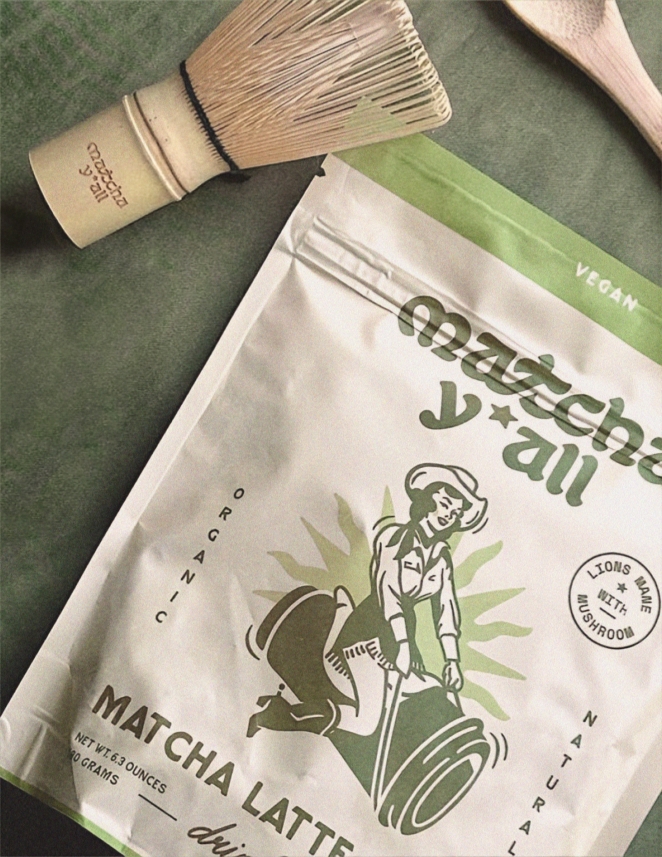
For example, recently, I was creating branding and packaging design for Japanese style mushroom coffee — during the immersion phase, I explored the concept of wabi-sabi and the philosophy of coffee in the Japanese world, and it turned out to be completely different from what it is elsewhere — for them, it’s about a moment of calm and silence, an immersion into one’s inner world, rather than about energy. It’s for these discoveries and insights into the world that I love what I do!
What kind of tools/kit/software could you not do without?
My favorite laptop, which has become an extension of myself with its graphic programs, Pinterest for endless inspiration—a place where I can lose myself—and headphones for total immersion in another world.
What’s your secret to staying inspired and motivated?
Music. Exploration and broadening horizons. Travel, painting, photography, fashion, film, literature (especially mythology, archetypes, astrology, and philosophy). Understanding not only the external world of forms, but also the inner world.
What’s the work achievement you’re most proud of?
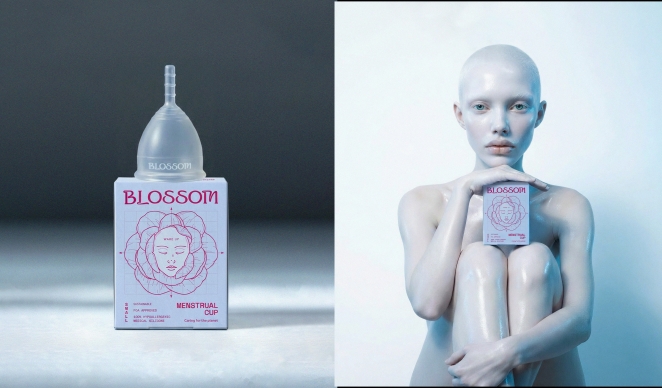
 The BLOSSOM conceptual project, which carries a philosophical dimension and has become a true manifesto of my approach—from a deep conceptual foundation to a sensory visual realization.
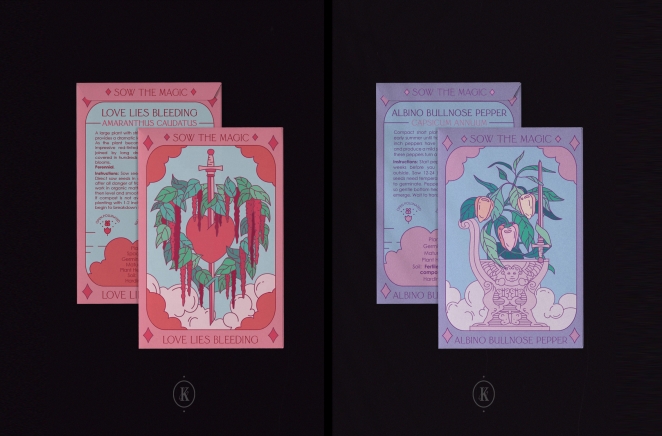
I also worked on a project involving packaging design and illustrations for an entire collection of mystical-themed seeds, where plants are combined with tarot card motifs and take center stage.
As someone with experience in the industry, what trends do you foresee shaping the future of creativity?
A deeper need for authenticity and individuality, coupled with the integration of technology (AI as a tool, not a replacement). A return to sensuality, tactility, and sincere human stories amid the digital noise. The development of brands that contribute to the development and evolution of humanity, as well as promote noble ideas and values.
What do you think sets apart truly exceptional creatives from the rest of the pack?
The ability to see and convey depth: not just solving business problems, but creating emotionally resonant, conceptually strong work with soul and meaning, bordering on art. The constant development of artistic vision and the courage to add a personal, philosophical layer.
How do you think technology has influenced the creative industries and how have you adapted to these changes?
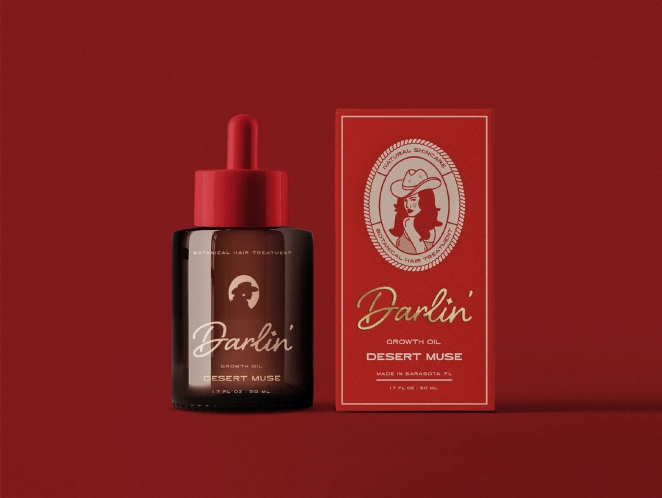 Technology has radically transformed the creative industry. For those who previously performed mainly functional tasks, this has become both a serious challenge and a motivation to develop their own artistic language and a deeper conceptual approach. For everyone else, this significantly expanded the opportunities for them to express their creativity.
For me personally, AI has allowed me to bring to life more conceptual ideas that were previously out of reach and existed only in my head. Thanks to this, I can devote more time to my role as an art director and conceptualist, and less to execution-oriented design. As a result, projects become more profound and unconventional, and the process becomes freer and more creative.
What is the one thing that you would change about the industry?
More focus on individuality, expressiveness, and depth, rather than superficial trends and imitation.
Any websites, books or resources you would recommend?
Although I mostly read books that aren’t directly related to design, one of my recent recommendations on this topic is "Aesthetic Intelligence" by Pauline Brown.