

Your next opportunity may be found by a person, a search engine or an AI-assisted hiring tool. Here’s how to build a creative profile that works for all three without sanding away the human being behind it.
There was a time when a creative portfolio had a fairly contained job. You put your best work in a handsome case, carried it into a room and watched somebody turn the pages while trying not to interpret every pause as a professional emergency.
Then the case became a website. The website became a profile. The profile became a collection of projects, biographies, CVs, social accounts, recommendations, moving images, searchable skills and half-finished thoughts about personal branding. Somewhere along the way, creative people acquired the additional unpaid role of being their own archivist, publicist, editor, SEO department and mildly reluctant content strategist.
By 2030, that profile will have to work harder still.
It may be read by a creative director deciding whether your instincts suit a brief. It may be skimmed by a recruiter trying to establish your level and availability in under a minute. It may be indexed by a search engine, summarised by an AI tool or surfaced because somebody searched for a particular combination of discipline, sector and skill.
None of that means your profile should be engineered into a joyless block of keywords for the benefit of machines. It means clarity will matter. Context will matter. Authorship will matter. And as polished output becomes easier to generate, the evidence of judgement behind that output will matter even more.
The important distinction is between a portfolio and a profile. Your portfolio shows selected work. Your creative profile explains the professional behind it: what you do, how you think, where you add value, what part you played, how you work with other people and what you might be capable of next.
That last point is the difficult one. A professional creative portfolio is built from the past, but its commercial purpose is to create confidence in the future. It shouldn’t merely prove that you once made something impressive for a recognisable client. It should help a stranger imagine what will happen if they give you a new problem.
So, if you’re wondering how to build a creative portfolio that won’t feel obsolete before 2030 actually arrives, don’t begin by predicting the dominant platform, file format or fashionable typeface of the next four years. Nobody knows, and anyone who claims otherwise is probably preparing to sell you a course.
Build something more durable: a clear argument about your value, supported by work, decisions, outcomes and enough personality to make the person behind it memorable.
What Will a Creative Career Look Like in 2030?

Zara Picken
The safest prediction is that creative careers will be less tidy than the job titles used to describe them.
More people will work across disciplines, platforms and employment models. A designer may move between identity systems, motion, generative production and creative technology. A copywriter may define voice, train language tools, write scripts and edit machine-assisted content. A photographer may direct hybrid shoots involving capture, CGI and synthetic imagery. A strategist may combine cultural research, data interpretation and workshop facilitation without ever becoming the person who enjoys being called a “thought leader”.
This doesn’t mean every creative will become a generalist carrying 14 software subscriptions and a permanent expression of technical concern. Deep craft will still matter. In fact, it may matter more because somebody needs to recognise whether an apparently accomplished output is actually any good.
What will change is the combination of skills around that craft. The World Economic Forum’s 2025 jobs research found employers expect 39% of workers’ core skills to change by 2030. LinkedIn’s Work Change Report, meanwhile, projects that 70% of the skills used in most jobs will change over the same broad period, with AI acting as a major catalyst.
Those figures measure different things, but neither encourages a profile built entirely around a frozen list of tools. If the first sentence of your biography is essentially a software inventory, you’re making your professional identity depend on products whose interfaces may have changed before the sentence has finished loading.
The more durable skills are the ones that help you use changing tools well: creative judgement, problem-framing, storytelling, collaboration, curiosity, commercial understanding and the ability to learn without requiring a ceremonial relaunch every time you acquire a new capability.
PwC’s 2026 AI Jobs Barometer makes the useful point that the new tasks appearing in AI-exposed roles are 2.5 times more likely to rely on empathy, judgement and creativity. Automation doesn’t necessarily remove the human part of creative work. It often moves the value towards it.
Your profile should make those qualities visible. “Adobe Creative Suite” may help somebody find you. It won’t explain whether you can tell a good idea from an attractive accident.
What Will Make a Creative Profile Stand Out?

Simina Ardelean
Most profiles don’t suffer from a lack of decoration. They suffer from a lack of a decision.
The visitor arrives and finds an impressive variety of things: a campaign, an app, a music video, three logos, a speculative poster series, some generative experiments and a photograph of the creator looking thoughtfully away from the camera. What they don’t find is a clear answer to the question, “Why should I hire this person?”
Standing out doesn’t mean being louder than everybody else. It means becoming easier to understand.
A useful creative profile should establish four things quickly: what kind of creative you are, which problems you’re good at solving, what level of responsibility you can handle and what evidence supports the claim. The answer can contain range, but it needs a centre.
“I’m a multidisciplinary creative” is rarely enough. Multidisciplinary in what way? Do you connect brand strategy with design systems? Direct live action and motion? Turn technical products into clear stories? Build campaigns that can survive 40 formats without becoming 40 unrelated ideas?
Specificity is not a prison sentence. You can describe a durable core while showing how it travels. For example: “I’m a brand designer who turns complex propositions into clear identity systems, from early strategy through launch.” That leaves room for many sectors, media and tools while telling the reader what value to expect.
It also gives your work a selection principle. Every project doesn’t need to look the same, but each should strengthen the argument. If a piece is excellent yet completely unrelated to the work you want, it may belong in a secondary archive rather than the opening sequence.
Creativepool’s guide to what makes a digital portfolio stand out reaches a similar conclusion: the strongest portfolios are easy to skim, hard to misunderstand and rich enough in context to support a proper conversation.
Your aim isn’t to make every visitor say, “This person can do anything.” It’s to make the right visitor say, “This person understands the kind of problem I have.”
What Should a Creative Portfolio Include?
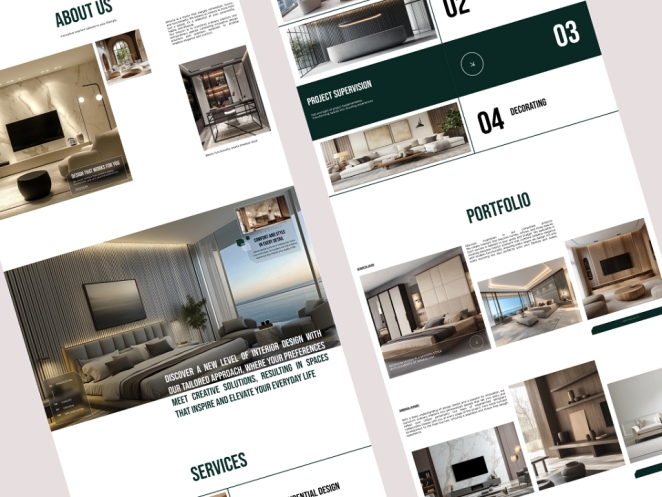
KHALINA LIUDMILA
There isn’t a universal number of projects, because an experienced director and a graduate illustrator aren’t proving the same thing. A sensible starting point is six to ten strong pieces, with fewer if each case study is substantial and more only when the range genuinely helps the reader.
The first pieces should be your strongest and most relevant. Don’t save the good work as a reward for somebody who has patiently navigated your professional adolescence. Portfolio reviewers aren’t judging a talent show. There is no dramatic reveal after the adverts.
Each important project needs more than an image and a client logo. Explain the brief, the relevant constraint, your role, the key decision and the result. That doesn’t require 1,500 words of process archaeology. A compact structure often works perfectly well:
Problem. What needed to change, and for whom?
Approach. What did you do, and why did you choose that route?
Contribution. Which parts were yours, and who else was involved?
Outcome. What happened as a result, using evidence where it exists?
The outcome doesn’t always need to be a dramatic percentage. You may not have access to commercial data, particularly when working through an agency. You can still describe what was delivered, adopted, launched, improved, approved or learned. Just don’t invent certainty because a case study looks lonely without a graph.
Your wider profile should include a concise biography, relevant skills, employment or freelance history, location or working arrangements, current availability where useful, contact details and links to the places where your work or professional activity continues. Recommendations can help too, provided they say something more illuminating than “great to work with”.
Include personal work when it reveals ambition, taste or a capability that paid briefs haven’t yet allowed you to demonstrate. Creativepool’s role-by-role guide to creating your best portfolio specifically recommends passion projects and self-directed learning as evidence of commitment and growth.
What shouldn’t a creative portfolio include? Weaker work added for volume, unexplained group projects, confidential information, obsolete contact details and pieces you can no longer discuss without apologising for them. Creativepool’s recent list of things to remove from your portfolio is useful here. Addition feels productive, but subtraction is often the more professional edit.
Finally, include a clear next step. If the reader wants to speak to you, don’t make them solve a small navigation puzzle or remember that your email address appeared briefly during the closing credits of a showreel.
Build Around What You Can Do, Not Just What You’ve Made

Natalie Nicklin
Finished work is evidence, but it isn’t a complete description of your capability.
Two designers may show equally polished identity projects while having contributed in completely different ways. One may have interpreted a finished strategy and developed the visual system. The other may have led discovery, challenged the positioning, sold the idea to the board, directed specialists and helped implement the work across a global organisation. The images alone won’t tell you that.
By 2030, this distinction will become even more important. High-quality output will be abundant. The ability to navigate ambiguity, make decisions and take responsibility for consequences will remain considerably less common.
Organise your profile around capabilities as well as formats. Don’t only show that you’ve made websites, campaigns or films. Show that you can clarify a proposition, build a coherent system, direct a team, simplify complex information, create emotional pace, protect an idea across channels or turn research into a useful creative decision.
This also helps when your career changes direction. A person who defines themselves entirely through past deliverables can look trapped by them. A person who understands the transferable capability behind those deliverables can explain why they’re relevant to a new sector, role or medium.
The trick is to remain concrete. “I solve problems” is not positioning; it’s the minimum condition of being allowed near a brief. Name the kind of problem. Show the decision. Provide the evidence.
A creative profile should answer not only “What have you made?” but “What becomes easier, clearer or more effective when you’re involved?”
Show How You Think, Not Just What You Create

Tony Swaby
“Show your process” has become such common portfolio advice that some case studies now contain more sticky notes than actual thought.
Process isn’t valuable because it proves you held a workshop or drew 30 thumbnails. It’s valuable because it reveals how you reached a decision. A wall of every route you rejected may demonstrate activity. It doesn’t automatically demonstrate judgement.
Choose the moments that changed the work.
What did you learn from the audience or market? Which assumption in the brief did you question? What constraint shaped the idea? Which route looked appealing but failed the actual objective? How did feedback improve the work? What did you simplify, and what did you refuse to lose?
This is especially important when the final result appears effortless. Good design often hides the complexity it resolved. Good editing removes the scaffolding. Good strategy becomes a sentence that sounds as if it was obvious all along. Without a little context, the reader can’t see the intelligence compressed into the outcome.
You don’t need to turn every project into a heroic narrative in which you alone identified the problem, defeated three stakeholders and returned with a 46% uplift. Real creative work is collaborative, compromised and occasionally approved for reasons nobody completely understands.
Honesty is more persuasive. Explain what changed. Acknowledge the limitation. Describe what you’d improve with more time or evidence. A thoughtful reflection can reveal more professional maturity than a case study written as though every project followed a perfect double diamond and ended with the client applauding in a sunlit boardroom.
The best way to make a creative portfolio stand out is often to show a better quality of attention. Anybody can publish the finished frame. Fewer people can explain why it deserved to exist.
Make Your Contribution Impossible to Misunderstand
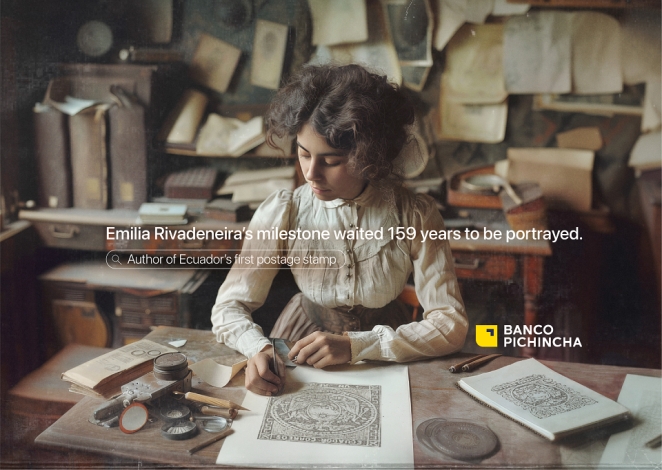
Alexandra Vaca
Creative work is full of collective nouns. “We created.” “We developed.” “We launched.” They sound generous and collaborative until the reader has to decide which member of “we” they might actually be hiring.
Be precise about your role. Say whether you led, directed, designed, wrote, animated, photographed, produced, researched, edited or contributed to the work. Name collaborators and agencies where appropriate. If the concept existed before you arrived, say so. If you developed it from the beginning, make that clear too.
This isn’t modesty versus self-promotion. It’s basic authorship.
As projects become more hybrid, the credits become more important. A campaign may involve an agency, in-house team, production company, independent specialists, AI tools and a client who contributed more creatively than the industry’s case-study conventions usually acknowledge. A single glossy image can conceal an entire temporary organisation.
Clear credits protect everybody. They stop you claiming work that wasn’t yours, prevent your genuine contribution disappearing into collective language and help a potential client understand the exact capability they’d be commissioning.
Keep your working files, approved credits and a private record of the brief, dates, collaborators and results. By 2030, proving provenance may be as ordinary as supplying a high-resolution image is now. Waiting until a project has been reposted 200 times under somebody else’s name is a poor moment to begin reconstructing its history.
How Is AI Changing Creative Work and What Should Your Profile Say About It?
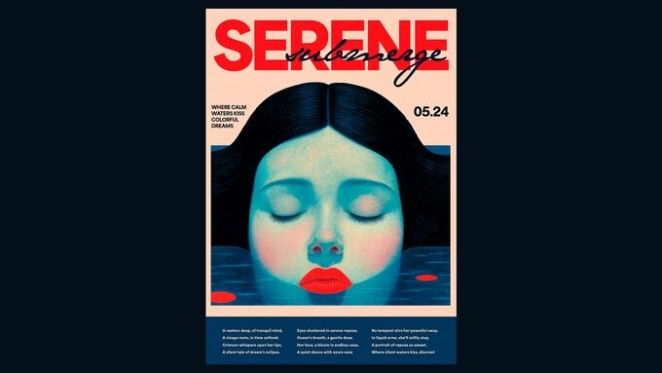
Gabi Gonzalez
AI is making production faster, experimentation cheaper and authorship more complicated. All three facts need to fit inside the same grown-up conversation.
You don’t need to turn your profile into a confessional list of every time a generative tool touched a pixel, sentence or research document. You do need to describe its use when it materially affects how the work was created, what you’re claiming and what a client would reasonably want to know.
If AI helped generate visual routes, say what you directed, selected, refined and finished. If it supported research, explain how you verified the material. If you built a workflow, trained a model, used licensed assets or developed a human-led system for producing variations, that may be a meaningful part of the case study rather than an embarrassing footnote.
Avoid the two most common performances. The first is pretending the tool did everything while you merely entered a prompt and awaited professional recognition. The second is pretending it did nothing because you fear any disclosure will reduce the perceived value of the work.
Your value is not measured by the number of manual clicks involved. It lies in the idea, direction, judgement, craft, responsibility and outcome. Explain those honestly.
Provenance tools will make this easier. The open C2PA Content Credentials standard is designed to attach information about a digital asset’s origin and editing history. Adobe describes Content Credentials as a kind of digital nutrition label for creative work, including whether content was captured, edited or generated with AI.
These systems aren’t magical proof of truth or ownership, and adoption will remain uneven. They do signal the direction of travel: attribution and process information are becoming part of the asset rather than something added after the argument begins.
For your own profile, retain original files, iterations, prompts where relevant, source licences, release forms and a plain-English description of the workflow. If a client has an AI policy, record how you complied with it. If you don’t know whether confidential material was allowed inside a tool, don’t upload it and hope the future becomes vague.
The creatives who benefit most from AI won’t necessarily be those who use the largest number of platforms. They’ll be those who can show that the technology extended their thinking or delivery without replacing their responsibility.
Make Your Creative Profile Work Beyond Your Portfolio
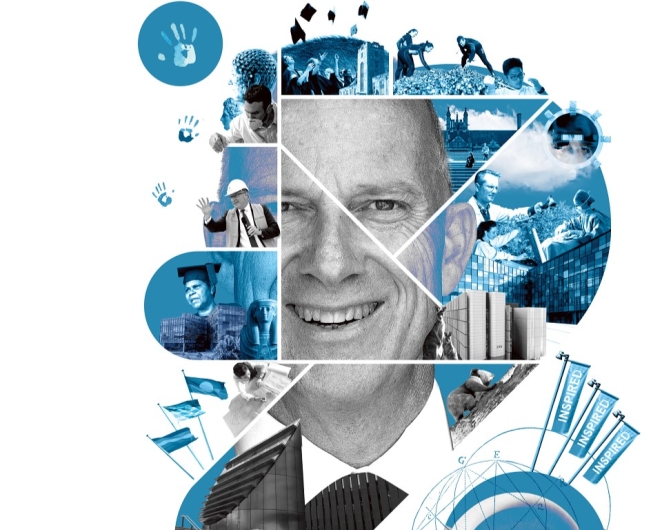
Fabio Dias
Your portfolio is only one place where somebody may encounter you.
A recommendation might begin on Creativepool, a search result, a talk, a social post, an award credit, an article or a project shared by somebody else. The interested person may then move between several surfaces before deciding whether to make contact. Your profile has to remain recognisably yours across that journey.
That doesn’t require identical biographies pasted everywhere until the internet resembles a corporate press pack. It requires a consistent centre: role, specialism, level, location, contact route and the kind of work you want.
Use a stable professional name. Keep titles and dates broadly aligned. Link profiles back to a canonical home. Maintain an offline archive of your case-study text, images, credits and source files so your career history doesn’t depend entirely on a platform’s continued enthusiasm for hosting it.
Make your expertise searchable in ordinary language. If you’re a motion designer specialising in identity systems for technology brands, those words should appear somewhere a person and a search engine can read. Don’t hide the entire proposition inside a showreel, a cryptic headline or an image of beautifully kerned text.
Google recommend descriptive filenames, titles, captions and alt text. That’s not an invitation to cram “creative portfolio design London best designer” into every image description. It’s a reminder that relevant text helps both people and systems understand visual work.
Your profile should also work when forwarded. Each case study needs a stable link, a useful title and enough context to survive outside the sequence you designed. A recruiter may send one project to a hiring manager. A client may save a PDF. An AI assistant may summarise a single page. Design each part so it still makes sense when separated from the whole.
Creative Portfolio Design Still Matters, but Usability Matters More
Lewis Ellerby
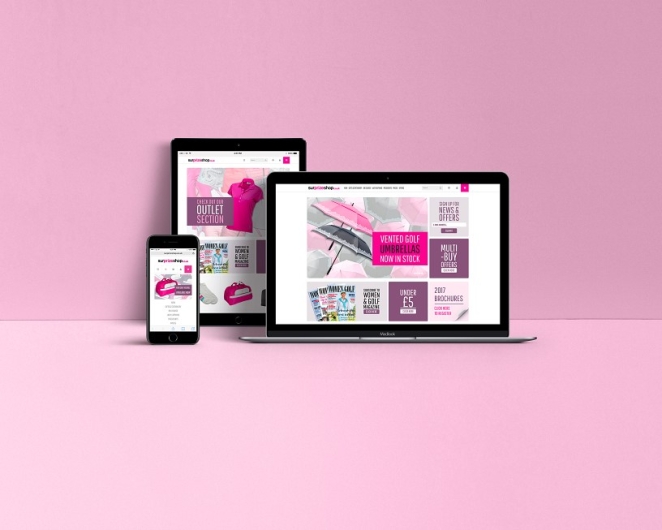
Creative portfolio design is itself a piece of evidence. It shows hierarchy, judgement, editing and respect for the audience. Unfortunately, it can also show that you discovered an experimental navigation pattern on Thursday and made it everybody else’s problem by Sunday.
The design should support the work. Use clear typography, visible navigation, sensible contrast, restrained motion and layouts that behave properly on a phone. Compress media so pages load quickly. Provide captions or transcripts for relevant audio and video. Make contact details easy to find.
Accessibility isn’t a decorative badge for the footer. The Web Content Accessibility Guidelines recommend text alternatives for non-text content, keyboard access, readable structure and other practices that make digital experiences usable by more people. A portfolio that excludes part of its audience is not demonstrating unusually advanced design judgement.
Don’t make every project open with a full-screen video, particularly if the reader is on mobile data or a company laptop behaving as though 2014 never ended. Don’t replace familiar interface language with clever symbols whose meaning must be discovered through experimentation. And don’t make somebody rotate a digital cube to locate your email address. They have other candidates.
For most creative disciplines, a good system is simple: an opening statement, selected projects, an about section, relevant experience and an obvious contact route. The originality should live in the work and voice, not in making the back button feel like a moral failure.
If you use a portfolio platform, customise the parts that help your positioning but don’t fight the conventions that make it usable. If you build your own site, test it with people who haven’t watched you construct it. Ask them what you do, which project felt most relevant and how they’d contact you. Their confusion is data, however personally unreasonable it may feel.
Make Your Profile Adaptable to Whatever Comes Next

Pretesh Mistry
A profile that lasts isn’t one you finish in 2026 and leave untouched until 2030. It’s one built so change doesn’t require complete demolition.
Separate the durable parts from the temporary ones. Your durable core might be the type of problem you solve, your underlying craft and the way you work. Temporary layers include current tools, sectors, availability, recent clients and the specific services you’re developing.
Use a modular case-study structure so projects can be added, reordered or shortened without redesigning the entire site. Keep source content outside the platform in a simple archive. Maintain versions of images and text for different contexts. A recruiter may need a concise PDF, a client may want a relevant project link and an interview panel may appreciate a more detailed walkthrough.
Your profile should have range without becoming shapeless. A useful approach is to show three types of evidence: work you’re already known for, work that demonstrates adjacent capability and one or two pieces pointing towards where you want to go.
That creates a visible trajectory. It tells the reader not only where you’ve been, but which direction you’re moving.
Don’t rush to add every new tool to your headline. Try it, use it on something meaningful and decide whether it changes the value you offer. Professional identities become exhausting when rebuilt around every product announcement.
Your profile needs to evolve. It doesn’t need to panic.
How Often Should You Update a Creative Portfolio?

Rod Hunt
Update factual information whenever it changes. Availability, role, location, contact details and important links shouldn’t wait for an annual ceremony involving tea, regret and 43 browser tabs.
For the work itself, a light quarterly review and a deeper audit twice a year is usually realistic. The quarterly check can add a strong new project, repair links, refresh the opening selection and remove anything that has clearly stopped helping. The deeper review should ask whether the whole profile still supports the work you want next.
Look at it as a stranger would. Is the first project still your strongest? Does your biography describe your current level? Are you displaying five examples of the same capability and none of the one you’re trying to develop? Do recent projects explain more responsibility while older ones make you look permanently midweight?
Pay attention to signals outside the portfolio too. Which pages do people mention? What do prospective clients misunderstand? Which project attracts the wrong enquiries? What questions recur in interviews? The profile may be beautiful and still be communicating the wrong thing with remarkable efficiency.
When you finish a project, record the information while it’s available. Save credits, outcomes, testimonials, approved imagery and a private account of the decisions. Months later, everybody will remember that the project was “a huge success” and nobody will remember who has the performance report.
Treat maintenance as part of professional practice, not an emergency response to unemployment. A profile is far easier to improve while you’re calmly choosing evidence than when next month’s income is personally supervising the homepage.
Using Creativepool to Build a Profile People Can Actually Find

Charlie Loft
Creativepool profiles combine several parts of a professional identity in one place: portfolio projects, biography, experience, skills, credits, recommendations and a route for people to discover or contact you.
That makes the platform more useful when you treat it as an active creative profile rather than somewhere to deposit work after launch and then visit only when you’ve forgotten a former colleague’s surname.
Creativepool’s guide to creating the perfect portfolio recommends completing the biography, experience, CV, skills, sector knowledge, clients and project information that help a profile function as a small professional website. Those details also improve the chance of appearing in a relevant talent search.
Use the role names and skills that clients and employers are likely to search, while keeping the language accurate. Tag projects properly. Explain your contribution. Credit collaborators. Add a representative selection rather than every file you’ve exported since university.
The Creativepool talent directory allows hirers to search by role and other relevant criteria, so completeness matters. A beautiful project without context may earn admiration. A complete profile helps that admiration become a shortlist, message or brief.
Recommendations are particularly useful when they describe behaviour a finished piece can’t show: how you handled feedback, led a team, rescued a difficult delivery or improved the original problem. Ask collaborators for specific observations rather than a ceremonial paragraph about your general brilliance.
Keep the profile linked to your broader professional presence and update it when your direction changes. You don’t have to choose between an independent website and a platform. One can provide a highly controlled home while the other provides discovery, community and evidence in a format hirers already understand.
The principle is the same everywhere: make it easy for the right person to find you, understand you and trust the work enough to start a conversation.
Your Creative Profile Isn’t Finished Yet
Jamie Watson
By 2030, the tools will have changed. Some job titles will have stretched beyond recognition. AI will have absorbed parts of the process that currently feel inseparable from creative work, while creating new responsibilities nobody has yet managed to name without using a slash.
Your profile doesn’t need to predict all of it.
It needs to show the parts of your value that can travel: the craft that lets you recognise quality, the judgement that helps you choose, the curiosity that keeps you learning, the commercial understanding that connects creativity to a real objective and the human skill required to make good work with other people.
Build the portfolio around selected evidence, not accumulated volume. Explain the problem, your contribution, the decision and the outcome. Be honest about collaboration and AI. Make the design accessible, fast and easy to navigate. Use clear language so people and systems can understand what you do. Keep your files, credits and provenance. Review the whole thing often enough that it describes the professional you are now rather than the one who first registered the domain.
Most importantly, remember what the profile is for.
It isn’t a museum, a personality test or a digital shrine to everything you’ve ever made. It’s a working argument about why your experience matters to the next brief.
That argument will never be completely finished, because neither are you.
Good.
That’s how it stays relevant.