
The creative industries are a growth engine. As of 2025, the UK creative sector is worth £125 billion (almost 6% of the national economy) and exported £46 billion of services each year. Between 2020 and 2022 it grew more than 19%, adding 175,000 jobs.
Much of this growth has been powered by people who are self‑employed. Indeed self‑employed workers make up 28% of the cultural and creative industries workforce (double the 14% share in the wider UK workforce) and 30% of the creative and cultural workforce and around 70% of the theatre workforce are freelancers.
Creative businesses therefore routinely face a strategic decision: should they bring in freelance talent or hire full‑time staff?
The appeal of freelancers: agility, cost and specialist skills
Flexibility and cost‑efficiency. Companies often hire freelancers because freelancers are paid only for their services and do not require benefits. Unlike permanent employees, freelancers usually work from their own premises and provide their own equipment, so employers save on office space, equipment, and insurance while using Employee Performance Software to track productivity and outcomes remotely.
As a result, freelancers are ideal for project‑based work, especially when tasks are one‑off assignments such as designing a logo or developing an app. They also provide hiring flexibility, allowing businesses to scale up or down quickly without severance costs.
Access to specialist expertise. The digital economy has opened a global talent pool. Companies can hire freelancers with diverse skills from around the world and save on salaries, benefits and equipment.
Specialists such as filmmakers, motion designers or UX researchers can be engaged temporarily for a high‑quality project without committing to a full‑time salary. Freelancers enable businesses to tap into the expertise and skills of seasoned professionals without a long‑term commitment, an advantage for start‑ups or agencies that cannot afford a permanent expert.
Shorter lead times. Hiring a full-time employee often involves a recruitment period of 1–3 months plus onboarding of at least three months—a process that can be streamlined with modern employee onboarding software, as Charlie Rudd of Liberty Marketing points out in his interview.. Freelancers can be engaged almost immediately and typically require less onboarding, helping agencies respond quickly to a surge in work or a client’s urgent need.
The disadvantages of freelancing: risk, integration and oversight

Valena Tzvetanska
Although freelancing gives creative businesses agility, there are real trade‑offs.
- Less control and reliability. There is no formal structure with freelancing. Freelancers may work from home, set their own hours and juggle multiple clients. This independence means they can disappear mid‑project, miss deadlines or submit low‑quality work. Vetting, contract negotiation and milestone planning are essential to mitigate these risks.
- Divided attention. Because freelancers usually juggle multiple projects, your work may not always receive priority. Turnaround times can vary, and communication may be slower, particularly across time zones.
- Confidentiality and culture. For work that involves proprietary knowledge, confidential information or innovative concepts, hiring full‑time employees is safer because the company can control access to sensitive data and maintain in‑house knowledge. Agencies that rely on a cohesive culture may also struggle to integrate freelancers, since even the most aligned freelancer cannot fully adopt a company’s values.
The value of full‑time employees: security, continuity and team cohesion
A full‑time creative hire brings different advantages:
- Stability and benefits. Full‑time employment comes with employer‑provided benefits such as health insurance, retirement plans, paid leave and sick days. Employees also enjoy regular paychecks, which provide financial security and are essential for budgeting and saving. Freelancers, by contrast, must handle their own taxes and retirement contributions and may face unpredictable income.
- Continuity and institutional knowledge. Permanent staff develop deep familiarity with a brand’s voice, workflow and clients. This continuity is crucial for daily tasks or roles central to the business, such as managing an active social media presence or maintaining a client relationship. Full‑time creatives are also more likely to be available when urgent issues arise and can be embedded in multi‑year strategy or brand development.
- Teamwork and culture. Full‑time roles offer greater opportunities for collaboration and mentorship. Full‑time positions often provide structured opportunities for career progression and skill development through teamwork. They also encourage regular professional networking and a sense of belonging. Freelancers, who often work alone, may face isolation and miss the daily interaction of an office.
Voices from the industry: Charlie Rudd of Liberty Marketing

Creative agencies need to deliver on time while preserving creativity. Charlie Rudd, Operations Director at Liberty Marketing, describes how her agency decides between freelancers and full‑time hires:
“As a general rule of thumb, freelance = short term, hires = long term. We tend to freelance when we have an influx in project work; retained we will always aim to keep in house.
We will freelance if it’s a specialism we currently don’t have and a short‑term project we will go that way; if it’s something we need to build into our teams that can take several months so is important as a stop gap.
Hiring is great, we love new people but we also have to consider the recruitment period (anything from 1–3 months) and then there’s onboarding to consider (3 months +).”
Her comments encapsulate the strategic calculus faced by many creative businesses. Freelancers help agencies plug short‑term gaps or deliver specialised services quickly. However, when the service becomes a core offer (such as video editing for a content‑first agency or UX research for a product studio) it may justify a permanent hire.
Factors to consider when choosing between freelancers and employees
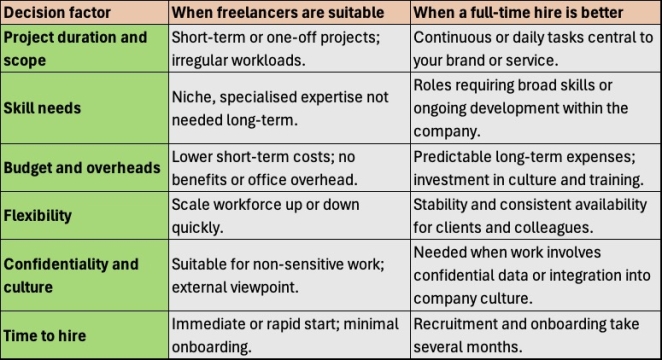
The decision hinges on assessing the project’s scope, duration and strategic importance. The table below summarises key factors to guide creative businesses (phrases are kept short to avoid oversimplifying complex decisions):
Making the choice in 2025
The freelance economy continues to expand. Upwork’s research (cited by Investopedia) found that about 38% of the U.S. workforce performed freelance work in 2022, and Bristol Creative Industries reports that creative freelancers are poised to be “top earners in 2025” as brands seek fresh ideas and day rates rise. Meanwhile, the creative sector’s rapid growth means that businesses will need both permanent teams and flexible talent.
A balanced approach often yields the best results. Agencies may build a core team of strategists, art directors and account managers who embody their brand and culture, while maintaining a trusted network of freelancers who provide specialised skills or surge capacity. Effective communication, clear contracts and fair payment terms (including prompt payment codes) are essential to sustain these relationships.
Ultimately, the choice hinges on how core the work is to your creative vision. For innovative projects, bringing in an outsider can inject fresh perspectives; for everyday brand guardianship, a full‑time creative may be indispensable.
By understanding the strengths and trade‑offs of each model, creative leaders can design teams that are both nimble and resilient, ensuring that the sector’s extraordinary growth continues to be powered by people who are valued and fairly compensated.