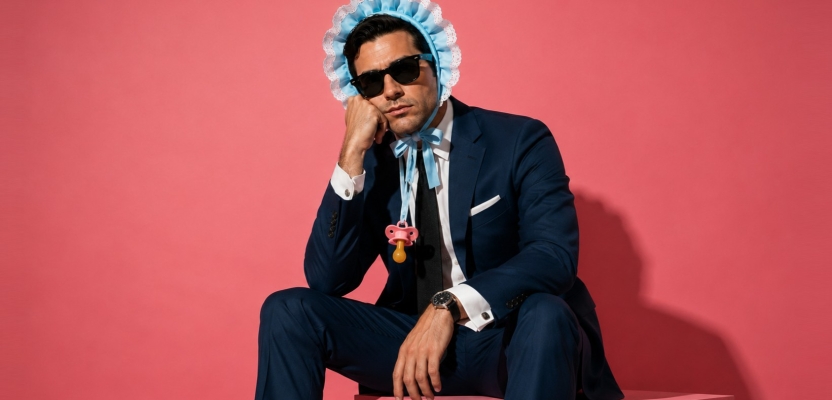

On artificial intelligence, creativity, fear, and the art of starting over
For decades, the creative industry turned a handful of words into a religion.
Disruption.
Innovation.
Transformation.
Break the rules.
Challenge everything.
Think different.
We loved disruption.
Until it started happening to us.
Then it stopped sounding quite so sexy.
Suddenly, conversations about tradition, process, craft, authorship, and the value of the work itself began to feel urgent. Important conversations, by the way.
But revealing ones too.
Because a profession whose raw material is, in large part, imagining what does not yet exist is having a surprisingly uncomfortable relationship with something it still does not fully understand.
And perhaps that is where this conversation really begins.
Not with artificial intelligence.
With us.
THE FEAR OF NOT KNOWING ANYMORE
I do not find it strange to be afraid of AI.
I would find it stranger to feel nothing.
Tools, processes, professions, and entire business models are changing at a speed that is difficult to absorb.
But there is another fear we talk about less.
The fear of no longer knowing.
When you are starting out, there is relatively little to protect. There are no twenty years of experience behind you. No methodology that has become part of your identity. No reputation built around knowing exactly what you are doing.
So you try things. You ask questions. You get things wrong. You make terrible work. You start again.
Then the years pass.
You learn. You improve. You become good at something.
And along with experience, you begin to accumulate things you can lose: authority, recognition, confidence, a familiar way of working and, perhaps most delicately, a stable explanation of who you are.
This is what I do.
This is what I know.
This is where my value is.
Research on professional identity and automation has observed something interesting: people with more experience can feel a greater threat when technology begins to take over tasks that sit close to the centre of their profession.
It makes a certain kind of sense.
The beginner has a lot to learn.
The expert has a lot to lose.
Teresa Amabile has spent decades studying creativity, and she has never reduced it to expertise alone. Knowledge matters. But so do openness, flexibility, motivation, and the willingness to leave familiar paths.
Which creates an uncomfortable paradox:
you can become better and better at your craft while becoming less and less willing to step outside it.
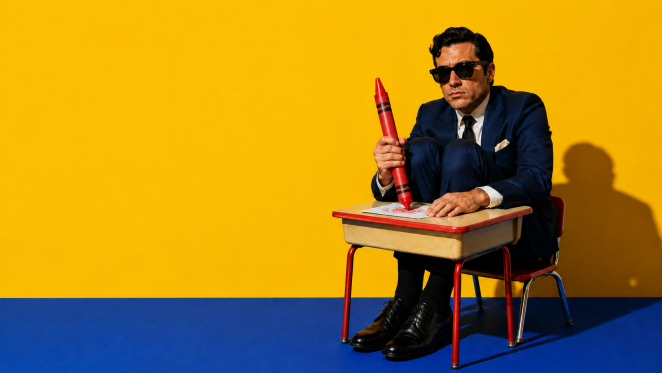
And then something new arrives and returns you to a place you knew very well when you first began: the place of the beginner.
Where you ask questions. Where you fail. Where someone twenty years younger may know something you do not. Where you no longer have all the answers.
We spend much of our youth trying to stop being beginners.
Perhaps staying creative requires keeping the ability to become one again.
Because when we face something unfamiliar, we can ask ourselves two questions:
What can I do with this?
or
What is this going to do to me?
They sound similar.
They are not.
THE COMFORT OF BEING RIGHT
Decades ago, psychologist Ziva Kunda studied what she called motivated reasoning.
In simple terms: we do not always use our intelligence only to discover what is true. We are also remarkably good at finding arguments for what we want to be true.
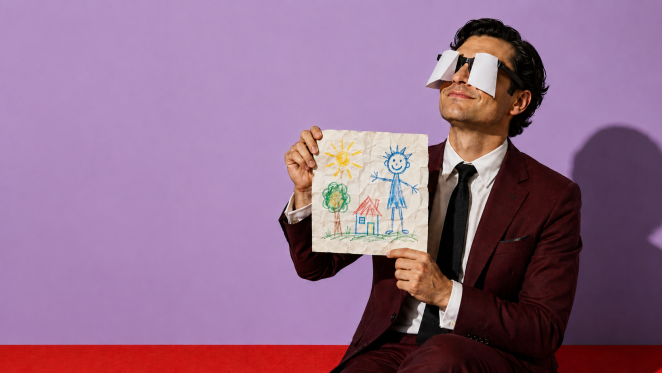
And then the flyer appears.
That flyer.
Lots of rendering.
Lots of effects.
Lots of “wow”.
Very little idea.
Someone posts it:
“See? This is what AI thinks creativity is.”
And yes.
It is bad.
But I am becoming less interested in the flyer than in what it produces.
Relief.
Because the bad example restores a familiar order. The machine is mediocre again. We know where we stand.
What is curious is that the work that makes us uncomfortable rarely circulates with the same enthusiasm. The work that makes you look twice. The work you cannot dismiss immediately.
You do not have to admire it. You do not have to use AI. You do not even have to agree with how it was made.
But if, in order to understand a technology, we look only at the examples that confirm what we already believed, perhaps we are learning very little about it.
Sometimes a bad AI flyer is not evidence. It is relief.
And then a slightly more uncomfortable question appears.
The portfolio.
I have heard, many times, that artificial intelligence will never be capable of real creativity.
Then I look at some portfolios.
Not all of them.
Some.
Impeccable work. Professional. Extremely well executed.
And also visual results that current AI systems can reproduce with unsettling plausibility.
That does not invalidate the talent of the person who made them.
But it does open a question:
How much of our value depended on very few people being able to do what we knew how to do?
Perhaps the machine is not destroying our talent.
Perhaps it is making some of the signals we used to prove we had it less visible.
FEAR CAN ALSO BE RIGHT
I do not want to romanticise technological transformation either.
Some jobs will disappear. Some rates will fall. Some skills that took years to acquire will probably lose economic value.
And real people will pay that cost.
Technological history has never been clean.
When sound arrived in cinema, thousands of musicians who had worked in theatres lost their jobs.
Their fear was real.
The mistake would have been to conclude that music itself was disappearing.
A fear can be economically justified and culturally wrong at the same time.
Photography was once a suspicious machine. So was the synthesiser. So was sampling.
They are not equivalent to artificial intelligence.
But something repeats: we tend to judge a new technology by how well it reproduces what we already know.
A photograph was expected to behave like a painting. A synthesiser was expected to behave like an orchestra. Now AI is expected to behave like a photographer.
Perhaps we are still asking a new technology an old question.
Perhaps we are still using the future to imitate the past.
Perhaps we have barely begun.
NEITHER DEMON NOR GOD
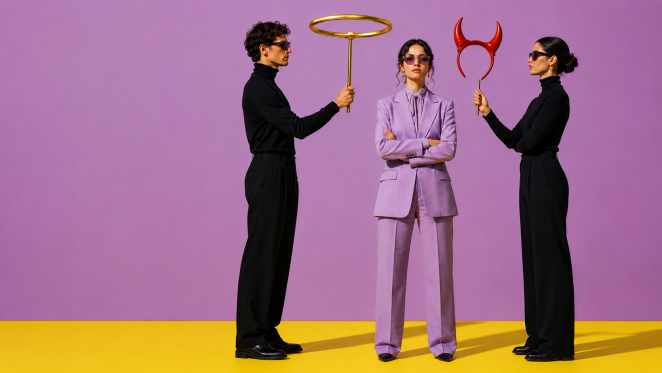
But I am not interested in turning AI into the hero of this story either.
Generating five hundred images in a day does not automatically make anyone an artist.
AI can repeat. It can homogenise. It can produce garbage at extraordinary scale. It can turn a mediocre intuition into a visually dazzling image.
Decades of creativity research have pointed to something fairly basic:
being new is not enough.
Novelty without meaning is still noise.
And it has never been easier to make extraordinarily beautiful noise.
The wow is suffering from inflation.
When everything can look extraordinary, looking extraordinary begins to feel ordinary.
That is why the “Human vs AI” debate interests me less and less.
Some believe the machine can destroy creativity. Others seem to believe it can hand creativity to you.
Perhaps both sides are giving the tool too much power.
The tool can change.
Curiosity should not.
And every now and then, it helps to widen the frame.
While we argue about a flyer, the same transformation is moving through biology, medicine, weather forecasting, programming, and entire areas of knowledge.
Not because our problems are insignificant.
But because our window is only one of many.
The flyer is not the revolution. It is simply where the revolution touched us.
I CAN FEEL THE FEAR
I originally thought about calling this article:
“I Can Feel the Fear Running Through Your Veins.”
I liked it.
It had provocation.
But it also had a problem.
It made it sound as though I were standing outside the fear.
Watching other people experience it.
I am not.
I recognise it because I have felt it too.
I have spent much of my professional life behind a camera.
I know what it means to become highly competent at certain things.
And I also know the feeling of discovering that the rules are beginning to move.
To ask again. To get things wrong again. To stop knowing again.
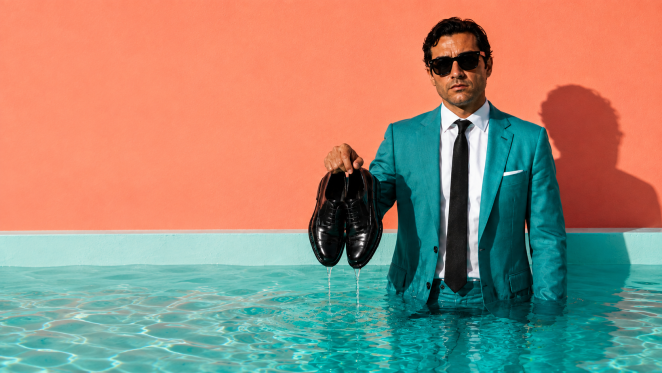
David Bowie once said that if you feel completely safe in the area you are working in, you are probably not working in the right area.
His image was even better.
Go a little further out into the water.
Until your feet no longer comfortably touch the bottom.
Almost two centuries earlier, John Keats called it Negative Capability: the ability to remain among uncertainties, mysteries, and doubts without desperately reaching for certainty.
It is difficult to think of two images more relevant to this moment.
Because we want answers too.
We want to know what will happen. Which jobs will disappear. What will count as art. What authorship will mean. What a machine will be able to do five or ten years from now.
We do not know.
I certainly do not.
And perhaps our need for an immediate answer is less interesting than our capacity to remain, for a while, inside that uncertainty.
I do not need to prove that artificial intelligence is garbage.
I do not need to prove that it is wonderful either.
I can accept something far less comfortable:
I still do not know how far this goes.
And look. Try. Get things wrong. Change my mind.
Because perhaps we have spent too long asking a question we still do not know how to answer:
Can artificial intelligence be creative?
Maybe.
Maybe not.
Maybe, a few years from now, we will frame the question in an entirely different way.
But there is another question we can ask today.
One that is not about the machine.
It is about us.
What does our reaction to it reveal about our own relationship with creativity?
Perhaps the more interesting divide is not between humans and machines.
Perhaps it is between curiosity and self-protection.
Because, in the end, the truly unsettling thing for a creative person should not be discovering that a machine can learn.
It should be discovering that we no longer want to.