
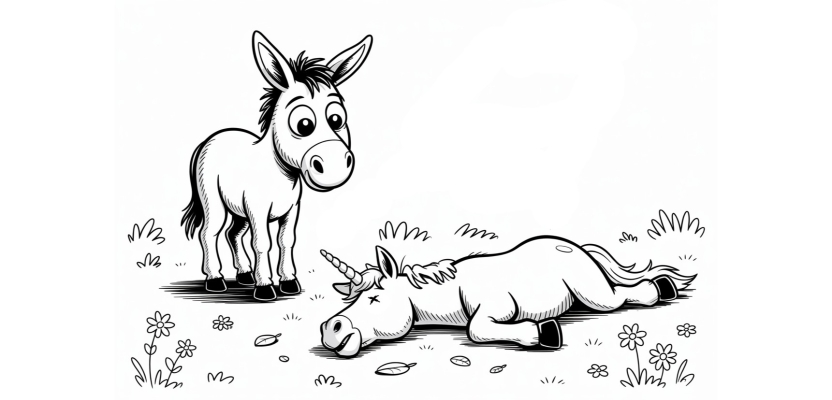

You see it every day: job listings seeking magic unicorns and rock stars. Putting aside the fact that a large, incontinent mammal probably isn’t the best creature to put together your Q4 campaign (and let’s face it, that description applies equally to both camps), it’s intriguing that those listings often appear adjacent to articles and posts warning about how AI is taking jobs away from people and speculating about which industry sector will be hit next.
So far, so normal. But there's less discussion around a more alarming trend: the fact that AI is actively preventing people (and unicorns and, yes, rock stars) from securing jobs in the first place.
It’s no secret that AI is being routinely used to screen CVs and applications. Recruiters and businesses increasingly rely on algorithms to parse resumes, detect keywords, and score applications based on previous hiring data. But let’s look at the active word in that sentence: 'previous'. Because the hiring landscape is not and never has been static. New skills emerge constantly while others become less relevant; trends can emerge overnight. What was essential yesterday may not be tomorrow.
And this is one of AI’s biggest problems. AI cannot innovate. There’s a lot misplaced trust being put in AI’s analytical capabilities. While it (arguably) excels at recognising patterns from historical data, it can’t assess potential, creativity, or innovative thinking; the qualities that are often required for the very jobs it's filtering for.
The result is that a visionary candidate who doesn’t fit a statistical norm or who expresses their creative skills in creative ways may be overlooked. Not because they’re unqualified, but because the machine lacks the contextual understanding to see their value.
A darker side is the potential to introduce a new layer of bias. Because AI is trained on past decisions (which are often rife with human bias) it simply perpetuates and amplifies those same patterns.
And of course, this bias is deniable; if challenged, companies can simply point to the algorithm rather than acknowledge human prejudice. It's interesting to note how so many 'optional' diversity forms aren't optional at all – they won't let you proceed with your application without entering dates of birth, sexual alignment and even religious beliefs.
This adds up to the absurd situation where qualified candidates who don’t fit the historical mould are silently excluded without knowing why (and, given the prevalance of ghosting in the industry, they likely never will).
Adding insult to injury – as if that’s really needed at this point – many job listings are not even real. Job listing sites are bulging with ghost jobs. These are either roles that either have already been alread filled or that never existed in the first place – they're there for the sole purpose of harvesting data.
These applications feed into the organisation’s AI systems, training them to understand (don’t laugh) 'human responses'. Ever seen a job application where you’re asked to complete a lengthy personality quiz or answer obscure psychometric questions before you’ve spoken to a human being? Yep.
But this charade isn’t going unnoticed. Talented candidates, particularly those who are experienced and innovative, recognise these tactics for what they are and disengage. They’ve already walked away many times from one-way video interviews and take-home tasks that ask them to effectively produce free consulting work or creative assets (which is another story altogether). They’re not going to invest their time feeding an AI model that’s actively seeking to damage their market.
Ironically, more and more candidates are now using AI tools to rejig their applications and CVs on the fly, incorporating keywords from the job listing or the company’s website. So the AI ends up being trained on… AI. That’s going to pan out well, isn’t it?
The whole situation is damaging for all concerned, but it remains a huge blind spot for the hiring sector. On more than a few occasions I’ve been told by a recruiter that they didn’t have time to conduct five-minute phone calls with qualified candidates. I had to stop myself asking: isn’t that your actual job?
Maybe not for much longer. Because when you ponder just how they were somehow going to find the time to go through all those 20-minute one-way video interviews... well, you can probably guess how that was going to work. I've dropped enough hints.
It all comes back to the same old adage that gets repeatedly forgotten or ignored: recruitment is a two-way street. Of course, businesses want to get the best candidates; but those candidates also want to invest their time and talent in a business that benefits them. When hiring becomes opaque, inhuman and exploitative, it drives away the very people companies should be trying hardest to attract.
In other words, if you really want to attract unicorns… stop placing your faith in donkeys.





Stephen ONeill June 9th, 2025, at noon
V good!!