
Daniel Guiu’s route into the creative industry was anything but conventional. After studying Management and starting his career in banking, a seemingly insignificant moment involving a coworker and an origami banknote made him question whether creativity had a bigger role to play in his life. He eventually left behind the security of finance to pursue a career in advertising, moving between Madrid, Miami, Hamburg and Düsseldorf and building experience as a Senior Copywriter at HeimatTBWA.
Today, Guiu approaches creativity through a combination of humour, human insight and a willingness to pursue ideas that initially seem unconventional. From building culturally relevant campaigns and finding local insights with global potential, to navigating AI and the changing expectations of the creative industry, he believes the best work comes from curiosity, obsession and strong relationships between creatives and clients. In this interview, Guiu shares his creative process, career lessons, advice for aspiring creatives and his vision for the future of advertising and copywriting.
How did you first get into the industry?
 My story starts very far away from the world of creativity. I studied Management and ended up working in a bank, spending my days watching investments go up and down while my own mental stability did exactly the same.
One day, during my very uncreative finance life, I saw a coworker making origami with a banknote. Weirdly enough, that tiny paper swan triggered something in me. I realized there was a creative side of myself slowly suffocating between suits, stock charts, and people saying things like “let’s circle back on that.”
So I made a very bold (and slightly terrifying) decision: I left the comfort of a stable bank salary to jump into the creative industry. My mum panicked. Which honestly made the whole thing feel even more exciting.
Where are you based now and who do you work for?
I'm currently based in Düsseldorf, Germany. But I've basically followed creativity around like a backpacker: Madrid, Miami, Hamburg, and now Düsseldorf.
I've spent the last few years at HeimatTBWA, working in the Innovation Team and on the Fiskars account. So yes, my career somehow went from investments and market fluctuations to creative innovation... and scissors. Life is weird.
What is your personal background and what role did it play in your career?
As I mentioned before, I come from a very different background. And while for many it might seem like a disadvantage, and even for me it felt like that at the beginning, over time I’ve become a strong believer that everyone can be creative.
Each background brings a unique way of seeing the world, and that’s ultimately what shapes and enriches creativity.
If you weren’t in your current industry, what would you be doing?
 If I weren't working in the creative industry, I think I'd enjoy a role in project management or at a production company.
Can you explain your creative process? What makes it unique?
Before jumping into a brainstorm, I like to really get to know the client. Not just their campaigns, but their sense of humor, their place in pop culture, and how they behave as a brand. Then I start throwing ideas around.
One rule I try to follow is never to kill an idea too early, especially the weird ones. Sometimes the dumbest idea in the room just needs one more twist to become the best one.
How would you describe your style?
I'd say humor is a big part of my style, but it doesn't define it entirely. I like building ideas rooted in genuine human insights, ideas that feel authentic while also having the potential to spark conversations and earn PR.
Which individuals do you gain inspiration from? Do you have any heroes in the industry?
 I'm not sure I have a specific hero in the industry. I probably admire agencies more than individuals. Agencies like Uncommon, PS21, Fuego Camina Conmigo, and LOLA keep putting out the kind of work that makes me wish I'd thought of it first.
And honestly, clients deserve more credit too. Brands like KFC Spain or Jumpers prove that great work only happens when someone is brave enough to buy the idea. As creatives, we love to celebrate the campaigns, but none of them would exist without clients willing to take a risk.
What tips would you give to aspiring creatives looking for work?
Talk to the people you'd love to work with. It sounds like a stupid tip, but it opens doors. Don't reach out just to ask for a job; be genuinely interested in their perspective on creativity, their career, and the personal projects they pursue outside the industry.
Seeing the bigger picture helps you understand what makes them stand out and why they're the kind of people the best agencies want to work with. You'll learn far more from those conversations than from simply asking for a referral.
And above all, stay curious.
What tips would you give to other professionals to get more clients?
Have a coffee. Or at least a real phone call. We've become so used to endless email threads that we've forgotten how relationships are actually built.
Get outside, meet your clients, and understand their world. People buy from people.
Can you share a memorable experience from your career journey that shaped your approach to creativity?
 I still remember something one of my teachers told me: "Think of local insights that are so interesting they become global ideas."
That really stuck with me. Not every idea works that way, but if you look at a lot of the best PR campaigns from recent years, they often start with something very specific to a place, a culture, or a community. The insight is local, but it's so interesting that people everywhere want to talk about it. That's the kind of thinking I always try to aim for.
What’s your secret to staying inspired and motivated?
This might sound a bit extreme, but experience has taught me that there aren't good ideas and bad ideas, there are ideas that get sold and ideas that don't.
So I focus on finding the right client, the right moment, and doing everything I can to make the idea happen. And once it's sold, that's when the real work starts: obsess over the craft and make it as good as it can possibly be.
What’s the work achievement you’re most proud of?
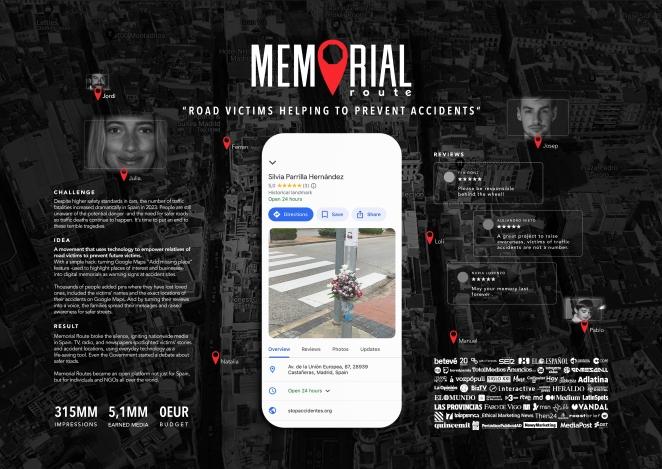
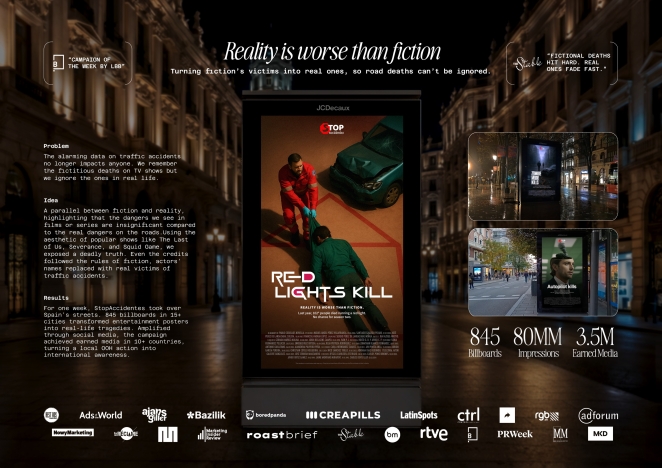
One of the work achievements I'm most proud of isn't necessarily my biggest project, but it's definitely one of the most meaningful. I had the opportunity to help the NGO StopAccidentes launch its Memorial Route campaign.
The idea was to transform the way people experience Google Maps by replacing ordinary business pins with memorials dedicated to real people. Real road accident victims at the exact locations where the crashes happened. We also turned Google reviews into messages of hope and road safety awareness, add our website, and used real photos of the victims to give a human face to the statistics.
Despite having no media budget, the campaign generated millions of views, sparked conversations across Spain and internationally, and helped raise awareness about the devastating impact of road accidents. Knowing that our work gave visibility to the victims and encouraged people to reflect on road safety is what makes this project so special to me.
As someone with experience in the industry, what trends do you foresee shaping the future of creativity?
 We're moving away from campaigns that simply interrupt people toward ideas that people genuinely want to engage with, share, and become part of. Creativity will be increasingly measured by its ability to create cultural relevance, not just impressions.
What do you think sets apart truly exceptional creatives from the rest of the pack?
I think it's obsession, in the best possible way. Truly exceptional creatives genuinely care about every stage of the process. When you're invested in an idea, you keep pushing it, refining it, and making it better. That level of passion and commitment is what often turns a good idea into a great one.
How do you think technology has influenced the creative industries and how have you adapted to these changes?
I think the biggest shift isn't that AI will replace creativity, it's that it will raise the bar for what creativity means. As AI makes execution faster and more accessible, the real differentiators will be original thinking and a deep understanding of human behavior.
I see AI as an opportunity to automate the less creative parts of the process so we can spend more time where we add the most value: developing ideas, building concepts, and solving problems.
AI is here to stay, just as digital design tools replaced the days when every layout and storyboard had to be drawn by hand. Those tools didn't eliminate creatives, they changed the way we work and allowed us to focus on higher-value thinking. I believe AI will have the same impact: it will become another tool in our toolkit, but the best ideas will always come from people.
What is the one thing that you would change about the industry?
 I would change the lack of opportunities for people with fewer resources to get into the industry. In Spain, for example, not everyone can afford to move to Madrid or Barcelona and spend a year working as an intern. Because of that, we're missing out on a lot of great talent.
Any websites, books or resources you would recommend?
I would recommend checking award websites like The One Show and D&AD to see some of the best ideas, not just from this year, but from the last decade.
I also think it's worth looking at student award winners, something many people in the industry overlook. It's refreshing to see how the next generation of creatives approaches problems and showcases their talent.