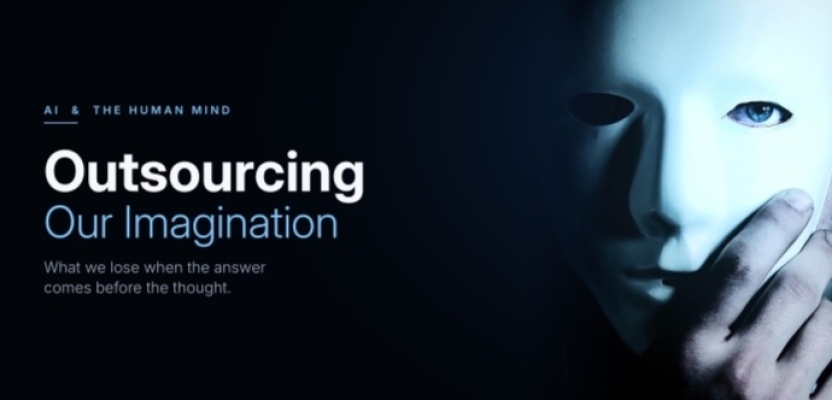

AI does not make us less capable by itself. The harm comes when we use it instead of thinking rather than alongside thinking, because the mental muscles we stop using get weaker.

The instant-answer habit
A generation ago, solving a problem meant sitting with it: sketching, picturing a route, turning an idea over in the mind. Today the answer arrives a second after the question. That speed is a real gift, but it removes the struggle (imagining, guessing, getting it wrong, trying again), and the struggle is how the brain builds the ability to think and visualise.

What happens to the mind
Psychologists call this cognitive offloading, which means handing mental work to an outside tool. We have always done it with notes and calculators, but AI offloads reasoning, imagination and judgement too.
-
Critical thinking: In a study of 666 people, cognitive offloading was strongly correlated with AI tool usage and inversely related to critical thinking, and younger participants showed higher dependence on AI and lower critical thinking scores.
-
Trust replaces checking: In a survey of knowledge workers, the more people trusted the AI's output, the less critical thinking they reported applying.
-
Brain activity: In an MIT EEG study, former AI users continued to show reduced brain activity even after switching to solo writing.
Visualisation is especially at risk. When AI produces the design or the plan, we skip the inner sketching, much as heavy sat-nav users can struggle to picture a city's map in their heads. These studies show links and short-term effects rather than proof of permanent damage, but they all point the same way

Effects on society
-
Sameness: When millions ask similar tools similar questions, they get similar answers, and original ideas become rarer.
-
Easier to mislead: People who stop questioning answers are easier to manipulate.
-
A new divide: Higher education was associated with better critical thinking regardless of AI use, which risks a gap between people who use AI and people who are used by it.
-
Real gains: AI also gives anyone real expert-level help, speeds up science and medicine, and supports people with disabilities.

Possible futures
-
Dependence: AI becomes everyone's first step, and human judgement and imagination fade.
-
Divide: A few people use AI to sharpen their thinking while most use it to replace thinking.
-
Partnership: People think first and then use AI to test and extend their ideas, so human ability grows.
Verdict: more drawbacks than benefits?
Not inherently, but by default, yes. Used passively, AI trades long-term ability for short-term convenience, and the cost is invisible in any single use. Used actively, it is one of the most powerful thinking aids ever built.

A few habits keep the balance on our side:
-
Think or sketch before you ask.
-
Treat AI answers as drafts to check.
-
Do some drawing, navigating and writing unaided.
-
Have schools reward reasoning, not just finished answers.
AI should be a ladder that lifts our thinking higher, not an escalator that lets our own legs forget how to climb.