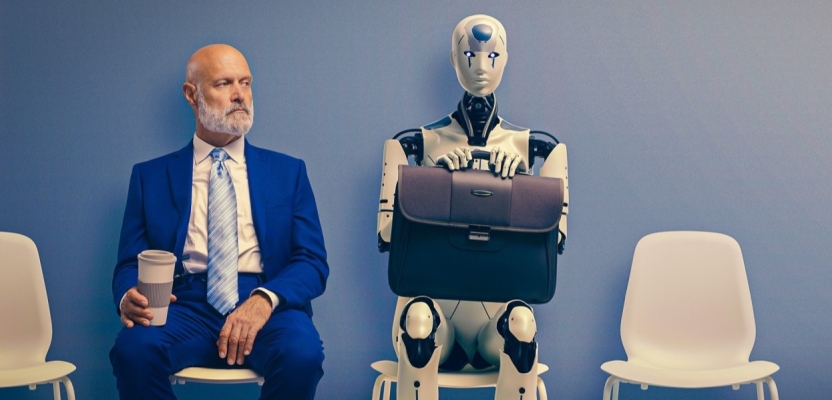

There’s a comforting sentence that’s been doing the rounds since generative AI first became impossible to ignore: “AI won’t take your job. Someone using AI will.”
It’s neat, reassuring and eminently shareable, which is probably why it’s appeared on approximately four million LinkedIn posts accompanied by pictures of people staring thoughtfully out of office windows. It also feels increasingly inadequate. Because what happens when you are the person using AI and the machine can still do an increasingly uncomfortable amount of what you’ve spent your career learning to do?
If you’re a copywriter, you can now watch a model produce 50 headline routes in the time it takes to make a coffee. If you’re a designer, you can turn a written thought into half a dozen convincing visual territories before you’ve properly decided whether the thought is any good. Strategists can interrogate research, map competitors, summarise interviews and generate the bones of a presentation. Developers can generate working code. Editors can restructure, shorten and rewrite. Creative directors can enter a meeting with more raw material than their teams could realistically have produced across an entire week ten years ago. Not all of it will be good, obviously, and a fair proportion will have the distinct whiff of something technically competent that nobody would remember five minutes later. The awkward part is that quite a lot of it will be good enough.
That’s the bit we need to get much more comfortable talking about. The interesting question around AI replacing jobs is no longer whether artificial intelligence can produce things that once required highly skilled human labour. It very clearly can. Nor is it enough to retreat into the reassuring idea that humans remain more empathetic, culturally aware, experienced or capable of judgement. Those things matter enormously, but repeating them defensively doesn’t make the economic pressure on the work disappear.
The more useful question, particularly for experienced creatives, is what happens to the value of your role when AI can perform a meaningful proportion of it. If execution becomes faster, cheaper and more abundant, where does the premium move? Which parts of your experience become more valuable, which become less defensible and which need to evolve altogether?
That’s a much harder conversation than telling everyone to “learn AI”. Most senior creatives already have. They’ve been using generative tools somewhere in their workflow for months or years. They’ve already experienced the strange temporal compression of watching something that used to occupy half a day happen in fifteen minutes. The challenge now is working out what becomes important when the fact that you can make the thing is no longer, by itself, the most impressive part of the proposition.
Is AI Really Replacing Jobs, or Just Changing Them?
Anna Afzal-Gould
One of the problems with the AI and jobs debate is that we tend to talk about occupations as though they arrive as sealed units. Copywriter. Designer. Strategist. Creative director. Developer. Producer. Marketing director. We then ask whether AI can replace each one as though some enormous machine is slowly working its way down a list, placing a green tick beside every profession it has successfully mastered.
Actual jobs are considerably messier. They’re collections of activities, some repetitive, some highly technical, some administrative, some social, some political and some so specific to a particular organisation that explaining them to an outsider would require a PowerPoint presentation and several biscuits. A creative director might spend part of the day evaluating ideas, part understanding a client’s anxieties, part rewriting a presentation, part negotiating with production, part protecting a good idea from committee death and part trying to discover why a supposedly final deck now exists in fourteen subtly different versions. AI capability doesn’t arrive evenly across that bundle.
That distinction matters because much of the serious research into AI automation jobs increasingly points towards task-level disruption before wholesale occupational replacement. The International Labour Organization’s 2025 assessmentexamined nearly 30,000 tasks and found that around one in four workers globally were employed in occupations with some degree of generative-AI exposure. Its more important conclusion was that transformation remained more likely than outright redundancy for most occupations because significant parts of jobs still require human involvement.
Looking at skills represented across millions of US job advertisements, it’s estimated that 46% of the skills contained in a typical job posting had the potential for significant generative-AI transformation, but only a very small proportion sat in a category where AI could plausibly act entirely independently. Marketing, media, software, data and other knowledge-heavy occupations were among those with particularly high transformational potential. Again, the important word there is potential. The research measures what might be technically possible under significant adoption, not what every company has already implemented.
That is a much more useful way to think about the future of creative work than waiting to discover whether “creative director” eventually appears on a list of professions scheduled for extinction. Your title may remain perfectly intact while the economics underneath it change significantly. A senior writer might remain a senior writer while the commercial value of producing a competent first draft collapses. A strategist can remain a strategist while research synthesis that once consumed a day becomes almost instantaneous. A designer can remain a designer while visualising early routes becomes dramatically cheaper. A creative director can remain a creative director while the volume of plausible material arriving for review multiplies beyond anything a traditional team could have generated.
Same title, different job.
Same job, different value structure.
A business doesn’t need AI to replace 100% of what somebody does before it starts asking difficult questions about headcount, fees, turnaround times or team shape. If technology cuts the time required for an activity by half, enables one person to produce what previously required three or makes an acceptable version of a formerly specialist output available almost everywhere, the commercial effect arrives long before “full automation”. That’s why the most immediate disruption may not look like replacement at all. It may look like repricing.
Creative businesses are already feeling this because so much of the industry historically charged, directly or indirectly, for scarce execution. Clients needed copywriters because writing well was difficult. They needed designers because professional design required training, time and specialist tools. They needed photographers because high-end imagery involved equipment, craft and production. They needed developers because software creation was technically inaccessible to most people. Agencies bundled all of that expertise into a proposition based partly on the fact that clients couldn’t easily reproduce it themselves.
AI hasn’t eliminated the need for those skills. What it has done is raise the baseline at alarming speed. We’ve already explored this in our examination of how AI is commoditising average creative output. When acceptable copy, plausible imagery, functional layouts and endless variations are widely available, simply being able to produce something competent carries less distinction than it once did.
For senior creatives, that’s where this gets interesting, because the answer can’t simply be to become even more efficient at producing the thing that’s becoming cheaper.
Seniority Is Not a Force Field

Christopher Charles Perry
There’s another comforting idea worth retiring: that automation happens somewhere lower down the ladder and stops politely when it reaches experienced people. Routine jobs go first, the theory suggests, followed by basic production and administrative work, while senior strategic and creative roles remain safely above the waterline because they involve too much judgement, context and human complexity.
There is some truth in the distinction, but not enough to build a career strategy around it. The OECD’s 2026 work on occupational AI exposure found that current systems are closest to occupations involving codifiable information processing and furthest from work heavily dependent on contextual judgement, interpersonal understanding, complex decision-making and responsibility. That provides some support for the idea that genuinely senior skills matter more as automation grows. But exposure itself reaches far into professional and managerial work because modern AI is unusually well suited to manipulating the raw materials knowledge workers spend their days manipulating: language, documents, data, patterns, reports, presentations, analysis and recommendations.
That’s why senior creative professionals shouldn’t define their safety by the apparent sophistication of the artefacts they produce. AI is getting very good at artefacts. It can produce treatments, presentations, reports, visual routes, strategies, mood boards, scripts, campaign variations, research summaries and prototype experiences that look extraordinarily finished. The fact that an output once required experience does not automatically mean producing that output will continue to command the same premium.
Experience still matters enormously, but increasingly it needs to show up somewhere other than simply in the production of the deliverable.
This is uncomfortable because creative seniority has traditionally been demonstrated partly through superior execution. You became a senior writer because you could write better and solve harder communications problems. A senior designer developed stronger craft, judgement and systems thinking. A senior strategist could extract more useful meaning from ambiguity. A creative director could generate, recognise and improve ideas at a level others couldn’t. None of those capabilities suddenly disappears because a machine can create a presentation. In fact, some may become more important. But if AI begins performing more of the visible production, seniority has to prove itself through what happens around that production.
PwC’s 2026 Global AI Jobs Barometer offers an interesting way to think about this. Analysing more than a billion job advertisements across six continents, PwC describes a split between jobs being “democratised” by AI, where expertise becomes easier for non-specialists to access, and those being “professionalised”, where AI absorbs more routine activity and makes human expertise, judgement and leadership more important. The latter category has, according to PwC’s analysis, experienced stronger growth and wage performance, while new tasks being added to highly AI-exposed roles are disproportionately likely to involve capabilities such as judgement, creativity and empathy.
It would be foolish to interpret that as proof that every experienced creative is about to become more valuable. Markets aren’t that generous and creative budgets rarely operate according to the nicest available interpretation of a PwC report. What it does suggest is that AI exposure does not automatically push human value towards zero. In some roles, it appears to change where that value sits.
That is probably the most useful way for senior creatives to approach what happens next.
If AI Can Do More of the Work, What Is Your Value?
Kasia Kozakiewicz
For decades, a lot of creative value sat in the middle of the process: making the thing. Take a problem, apply specialised expertise and produce an output. A campaign. A brand identity. A website. A script. A piece of film. A strategy deck. A social system. That middle remains important, but AI is making it extraordinarily productive, which means value can start migrating towards the areas on either side of it.
Upstream sits framing. What is the problem we should actually be solving? Why does it matter? What is the brief missing? Which audience behaviour deserves attention? Where does the business have an advantage? What is culturally interesting here? Which assumptions should be challenged? What should we refuse to do? Which parts of the problem are genuinely creative and which require the organisation itself to change?
These questions are easy to underestimate because they don’t always produce something tangible at the end of the day. Yet the quality of the answer determines whether all the extraordinarily efficient activity that follows is useful or merely productive. AI is exceptionally powerful when you give it a well-framed problem. That makes the ability to frame the problem more valuable, not less.
Then there is the downstream side: consequence. Does the idea survive production? Can it survive the client? Can you persuade somebody to spend serious money backing it? Can you retain the interesting part after legal, procurement and seventeen stakeholders have touched it? Does it work beyond the immaculate case-study mock-up? Can you connect the creative decision to a commercial outcome? Can you diagnose failure rather than merely produce another version? Can you take responsibility for the recommendation when it turns out to be wrong?
This is where the casual claim that AI can “do strategy” or “do creative direction” becomes less straightforward. It can perform many activities involved in both, increasingly well. It can analyse research, map competitors, generate hypotheses, produce routes, critique ideas, compare executions and recommend options. What it doesn’t inhabit is the organisational reality in which those recommendations have consequences.
There’s a world of difference between asking a model which of three campaign territories appears strongest and sitting opposite a board arguing that they should put £8 million behind the strangest one. One is evaluation. The other is judgement with skin in the game.
That distinction matters because much of senior creative value has always been less visible than the industry’s mythology suggests. Creative directors aren’t only there to have brilliant ideas. Strategists aren’t only there to write clever propositions. Agency leaders aren’t only there to make presentations. Experienced people are frequently paid to make decisions in situations where the information is incomplete, the incentives conflict, multiple answers look plausible and somebody has to be prepared to say, “We should do this one.”
As generation becomes easier, that act of commitment matters more. Our feature on curation versus creation makes the wider point neatly: when more material can be generated than anybody could reasonably absorb, selection itself becomes increasingly valuable. The creative director’s role may therefore become less defined by being the person capable of producing the greatest quantity of ideas and more by being the person capable of recognising which of those ideas deserves to exist, what is missing from it and why the organisation should commit to it.
That doesn’t diminish the creative role. It clarifies it.
The same is true of craft. There’s a temptation in discussions about AI and seniority to suggest that everyone should retreat from making and become a strategic overseer of machines. That would be a terrible outcome, not least because judgement without continued exposure to craft tends to become theoretical surprisingly quickly. The writer who no longer writes can lose their ear. The designer who stops designing can become overly impressed by surface polish. The director who never gets close to production can forget which ideas survive contact with reality. The developer who no longer understands the underlying code may become very efficient at shipping problems they can no longer diagnose.
Deep expertise is useful precisely because AI raises the baseline. A person who understands typography notices the supposedly polished layout that is subtly wrong. A great writer recognises the perfectly grammatical paragraph that nobody would willingly finish. A photographer can tell when generated lighting looks superficially impressive but physically nonsensical. A strategist with two decades of experience can spot the “insight” that is really just a nicely formatted observation everybody in the category already knows.
As we’ve argued elsewhere, one consequence of AI making average creative output cheaper could be that genuinely distinctive human creativity becomes more valuable. The gap is no longer simply between people who can execute and people who can’t. Increasingly, it is between people who can recognise, shape and push exceptional work and those who are satisfied with whatever looks competent on first inspection.
Can AI Replace Professional Experience and Judgement?

Gidudu Emmanuel
This is where the conversation becomes less tidy because experience itself is difficult to define. If professional experience simply meant having performed a task more times than somebody else, machines would eventually win by an almost comical margin. But experience is not just accumulated repetition. It is accumulated consequence.
It’s knowing that the beautifully ambitious idea your client has fallen in love with will become impossible the moment the regulatory team sees it. It’s recognising the campaign line that everybody finds amusing in the room but will become unbearable once consumers have heard it 40 times. It’s understanding that research participants are responding to the moderator rather than the product. It’s remembering the rebrand six years ago that failed for exactly the reason everyone is currently insisting won’t matter. It’s knowing when a client is asking for more routes because there genuinely isn’t an answer yet and when they’re asking because nobody has been brave enough to recommend one.
None of that is mystical. Much of it is pattern recognition, and pattern recognition is precisely the kind of territory in which AI will continue improving. We shouldn’t treat “human judgement” as some permanently inaccessible magical compound that technology can never reproduce. Systems already evaluate, rank, recommend, compare and critique. Their ability to do those things will become considerably better.
The stronger argument for human experience is that experienced judgement is situated. It belongs to this company, with this history, these people, this audience, this budget, this cultural context and these consequences. It includes institutional memory, tacit knowledge, relationships, timing, politics and accountability. An experienced creative knows not just what usually happens, but why this client behaves differently. They know why a particular visual asset matters even though everyone inside the organisation is bored of it. They remember which idea died three years ago and why it might now work. They know which apparently tiny production compromise will quietly hollow out the concept.
AI can be given more and more of that context, and organisations undoubtedly will. But that increases rather than reduces the need for experienced people to know what context is worth supplying.
This may be one of the more important changes to senior creative work. Expertise is no longer only what you personally know. Increasingly, it is also the ability to organise knowledge around a problem so that humans and machines can use it intelligently.
The same applies to taste. There has been a lot of romantic language about taste becoming the ultimate human differentiator, some of which makes it sound as though the creative director of the future will spend their entire working life reclining elegantly on a chaise longue saying “no” to generated images. Taste matters, but useful taste is more than preference. It is judgement informed by context. It understands what is overfamiliar, what is culturally loaded, what the category has exhausted, what the brand can credibly own and which apparently imperfect choice contains more potential than the beautifully finished one beside it.
That ability is becoming more important because AI is exceptionally good at making a mediocre idea feel resolved. The visualisation is beautiful. The language is polished. The deck looks finished. Everything about the output whispers that a decision has already been made.
Experienced creatives need to become even better at resisting that seduction.
Will AI Create More Jobs Than It Replaces?

Millie Davies
This is one of the most searched questions in the whole AI and jobs conversation, and there is a temptation to answer it with whichever enormous number best suits your existing worldview. The World Economic Forum’s 2025 Future of Jobs Report, for example, forecasts considerable labour-market churn by 2030, with job creation outstripping displacement across the range of technological, demographic, environmental and economic forces it models. What it does not say is that AI alone will magically create a particular net number of jobs, although those figures are frequently flattened into exactly that claim once they reach social media.
The truth is much less satisfying: nobody knows yet whether AI will ultimately create more jobs than it replaces. We know it can increase productivity. We know it can reduce the human hours required for certain tasks. We know it is creating new kinds of work while changing the skill requirements of existing work. We know adoption varies dramatically by industry and organisation.
What we don’t know is what employers will do with the productivity dividend at scale.
That last question matters far more than it tends to receive credit for.
Imagine an agency that once needed ten people to produce a given volume of work and, through AI-enabled workflows, can now deliver the same quantity with seven. There is an obvious future in which it employs seven people. But it could also keep ten and produce more. It could use the additional capacity to build new services, move into new markets, deepen strategy, invest in original IP, improve quality or spend more time on the things clients previously wouldn’t fund because too much budget disappeared into routine execution. It could lower prices. It could increase margins. It could do several of those things simultaneously.
Technology makes the options possible. Leadership decides which organisation emerges from them.
That is particularly important for senior creatives because many of them are not simply waiting to discover what AI does to their jobs. They are actively deciding what AI does to other people’s jobs. Creative directors, agency founders, department heads and senior brand leaders are determining which activities get automated, which capabilities remain in-house, what clients are charged for, where efficiencies are reinvested and what the resulting team is expected to become.
There’s a profound difference between using AI exclusively to produce the same work with fewer people and using it to expand what those people are capable of delivering. Both may be commercially rational in different situations, and pretending nobody will ever use automation to reduce cost would be childish. But organisations should at least recognise that an AI strategy built entirely around efficiency eventually produces a company designed around efficiency.
That may not be the same thing as a company designed around creativity.
PwC’s 2026 research is interesting here because the organisations achieving stronger AI-related productivity performance are not uniformly shrinking their workforces. In its dataset, companies most capable of using AI effectively also showed stronger headcount and wage growth than less AI-exposed counterparts. PwC interprets that as evidence that some organisations are using AI as a force multiplier for expertise rather than simply a labour-reduction mechanism.
That shouldn’t be treated as proof of an inevitable positive future. There will be redundancies. There will be roles that contract. There will be services that become substantially harder to sell at their previous price because technology has altered the economics underneath them. But neither should senior creatives accept a deterministic story in which the only possible application of AI is doing yesterday’s work with fewer humans.
That is a management decision masquerading as technological inevitability.
Learning AI Is Necessary. It Isn’t a Career Strategy

Ben The Illustrator
So, is learning AI enough to stay employable?
No, but refusing to learn it is increasingly difficult to defend.
A senior creative in 2026 who deliberately knows nothing about the technology reshaping their industry is making approximately the same career decision as somebody twenty years ago proudly announcing that they don’t really see what all the fuss is about with the internet. You don’t need to use every platform, become an engineer or spend every weekend listening to somebody on YouTube explain that their new autonomous agent framework has “changed everything forever” for the third time that month. You do need enough fluency to understand where the capabilities are improving, what can be accelerated, where quality collapses, what risks enter the process and how the economics of your discipline are shifting.
The mistake is assuming that AI literacy itself will become a durable competitive advantage.
Tool knowledge rarely works that way. At first it is specialist. Then it becomes useful. Then expected. Eventually it disappears into the definition of basic competence. Knowing how to use Photoshop once differentiated designers. Knowing how to search effectively differentiated researchers. Knowing PowerPoint differentiated a certain kind of office worker sometime around 1997. Nobody builds a serious senior proposition around those things now.
AI will be similar.
Knowing how to prompt effectively will matter. Knowing how to construct workflows will matter. Understanding agents, models, provenance, rights, data handling and governance will matter enormously for people making senior decisions. But the sustainable value lies in what that fluency allows you to do better.
This is why the false choice between “learn AI” and “become better at what AI can’t do” isn’t especially helpful. Experienced creatives need both. Learn enough about AI to use it intelligently, then keep deepening the expertise required to understand whether its output is actually good.
The more polished AI becomes, the more important this gets.
A bad output with seven fingers is easy to reject. A persuasive strategic recommendation built on a flawed assumption is considerably more dangerous. A beautifully written paragraph containing a factual distortion is harder to spot than obvious gibberish. Generated code that works during a demonstration but creates a serious vulnerability later is not improved by being more convincing. A visual execution that technically follows every guideline but gradually makes a brand less distinctive is harder to identify than an obviously off-brand asset.
As systems become better at looking right, professionals need to become better at knowing when they aren’t.
That is why deep craft remains important. The skills we’ve previously identified as making work distinctive in an AI-saturated market, including creative judgement, problem-solving, curiosity and an ability to push beyond obvious outputs, become more important precisely because the basic mechanics of execution are becoming widely distributed.
There’s also a danger here for senior people themselves. AI makes it remarkably easy to stop practising the skill that originally gave you authority. Writers can stop drafting. Designers can stop exploring manually. Strategists can stop wrestling with the messy research before reading the summary. Creative directors can stop making anything and become extremely efficient reviewers of machine-generated possibility.
Some delegation is obviously the point.
But outsource too much and you risk outsourcing the apprenticeship of your own judgement.
You still need friction somewhere. You need to make, edit, question, fail and occasionally stare at something that refuses to work. Not because manual labour is morally superior, but because expertise is maintained through contact