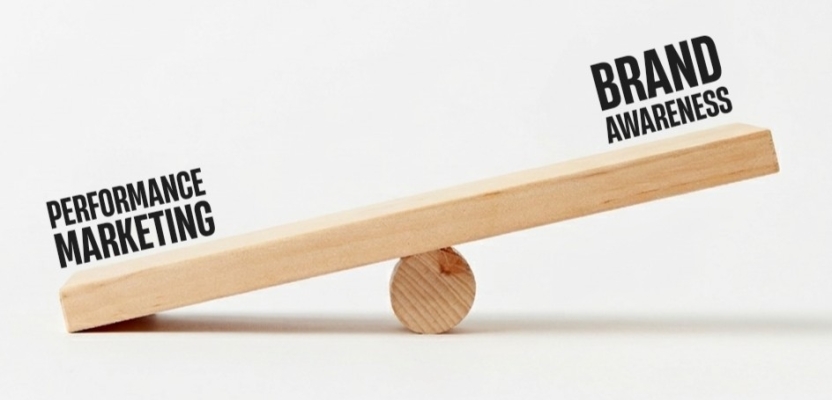

Times are tough at the minute for brands. Budgets are shrinking, targets are getting harder to hit, and the pressure to deliver more has never been higher. Everyone is looking over their shoulder at the CFO crunching the numbers who’s ready with the red pen, aimed at the marketing department.
Brand awareness is the first to get the chop, it is a tale as old as time, top of the funnel feels like an expensive luxury. Meanwhile, Google and Meta performance ads swoop in with their simple quantifiable data and become the budget that everyone feels comfortable defending.
We get it, it feels like the responsible thing to do on paper. You spend five grand on paid search, you watch forty checkouts happen on your screen, simple.
The problem is you are only ever talking to the small amount of people ready to buy right now. Research from the Ehrenberg-Bass Institute shows that in most categories, roughly 95% of buyers are out of market at any given moment.
Which means only 5% of your audience are ready with their bank accounts right now. So if you focus your marketing budget on that 5%, you are doing so at the cost of the rest of your audience. And when those buyers start searching, they have usually been primed by the people still spending on brand awareness for the last few weeks. You’re fighting a battle you can’t win.
We seem to forget this every time the market gets tough, and we understand why. Companies are set up to reward people for what is happening with the business right now, and to punish people the same way too. It becomes a vicious cycle where people try to protect the short term at the expense of the long term. In their IPA study, Les Binet and Peter Field tracked thousands of campaigns and found that businesses spending more than half their budget on short-term activation consistently saw lower commercial returns over time.

The funny thing is the right thing to do in times like these is what feels the most wrong. Pushing heavily into brand awareness actually gets cheaper because you are going against the instincts of what everyone else feels is the right decision. You get to buy the attention of the 95% at a discount rate.
We have proof of this working too. Airbnb shifted the bulk of their budget out of performance marketing and into broad brand campaigns. Their CFO publicly pointed to that exact decision as the main driver behind their record profits. Mr Red Pen made the right decision it seems.
We also have proof that doing the opposite doesn’t work too, even for legacy brands who have done years of brand awareness. Nike spent four years pouring budget into direct-to-consumer performance funnels, only to lose ground to Hoka, wipe billions off their market value, and replace their CEO in late 2024.
If you think this is just an overseas phenomenon, look at Telstra. They were trapped in a brutal 80:20 performance-to-brand spiral, fighting an expensive monthly trench war for immediate clicks. When CMO Brent Smart cut back bottom-of-funnel waste and doubled down on broad brand awareness, media-driven revenue jumped 13.4% and trading ROAS surged 39%. Turns out planting seeds makes harvesting a hell of a lot easier, and you need to have a balance between the two.
The right decisions to make regarding marketing during a tough time are not easy to make, that’s why so many don’t capitalise on the opportunity when it is presented to them. Making that decision is what will see certain brands rise to the top.
On that note, what is your favourite performance ad ever? … I think you have your answer there.
Want to get your brand out of the performance hamster wheel? Give us a shout and we’ll share how we balance the equation to grow your brand and business with the same budget.