
There are few genuine pop cultural milestones that rank on the great entertainment Richter scale anywhere close to the upcoming launch of Grand Theft Auto 6. Indeed, not since the release of Avengers: Endgame has there been almost constant mainstream media coverage surrounding something that, to all intents and purposes, shouldn’t actually be news.
The world is falling apart like wet cake and a sizeable portion of the population would rather work up into a frenzy over digital carjacking than subject ourselves to whatever fresh horrors the Trump administration has spat up this week. Is it because the game represents the zenith of creative storytelling? Is it the sheer size and scale of the world it presents? Or are we just all a little sick and tired of feeling sick and tired, and this one little shard of light represents something to truly celebrate when held up against the vast chasm of despair that is 2026?
I’m sitting here right now with one eye on the clock myself, as the moment midnight kicks in, I’ll be leaping headfirst into the glittering neon world of Vice City. But even I couldn’t really offer a solid answer. Nostalgia certainly has a part to play for men and women of a certain age who grew up with the franchise, but this is something beyond nostalgia. I know plenty of people who haven’t picked up a controller since before the pandemic who are booking time off work to immerse themselves in the experience tomorrow.
It’s not even a shared multiplayer experience at launch. Rockstar is promoting GTA 6 as a single-player game, meaning we’ll all be siloed off in our own little worlds, whatever form its future online plans might take. Maybe it’s all a case of mass FOMO brought on by a combination of memes, disappointments and a staggering thirteen-year wait since GTA V. The enormous budget estimates being flung around have certainly contributed to the mystique, although Rockstar hasn’t published a figure to settle that particular argument.
Whether it ends up being the actual ‘greatest thing of all time’ or a hopeless mess that’s a mile wide and an inch deep, I’d be amazed if it doesn’t become one of the biggest entertainment launches we’ve ever seen. But this is Creativepool, not IGN. We’re not here to discuss the financial and gameplay implications. We’re here to discuss the creative implications.
So, let’s crack on, shall we?
We seem to have found some attention after all

Actually, I should pick a small fight with my own introduction first. We can be playing alone and still be taking part in something together. The shared experience starts with the countdown and continues in the messages, screenshots, arguments and unsolicited accounts of something ridiculous that happened on the way to a mission. We’ll inhabit our own versions of Vice City and then spend an unreasonable amount of time comparing them.
The confirmed midnight release on 19 November gives all that anticipation somewhere to go. You can put it in a diary. You can arrange your evening around it. In a media environment organised around whatever happens to appear next, having something to look forward to at a particular time feels almost quaint.
This should interest an advertising industry that spends a fair amount of its working day mourning the death of attention. People who can apparently only tolerate six seconds of video have cleared space in their lives for a game they expect to play for hours. The difference is their reason for being there. We expect this thing to reward our attention with surprise, pleasure and something we can talk about afterwards. Some of us are prepared to tolerate a truly antisocial amount of downloading to get it.
An agency can take that seriously without immediately proposing a branded open world. What will someone get from spending another minute with the work? Is there a detail worth discovering, a story worth following or a payoff that justifies the setup? Those questions apply to an exhibition, a publication and a piece of film as much as they do to a game. We’ve explored the same pressure in why originality matters in a world drowning in content.
Rockstar also arrives with an advantage few other companies can buy quickly. The audience has years of memories attached to its work. That history makes people willing to give it another evening, and then another. A brand that wants a similar commitment has to consider what it has done to deserve the next five minutes.
Somebody has to design the bits you drive past

For a designer, Vice City is a particularly entertaining proposition. Someone gets to invent the visual identity of a nightclub, then consider how it appears on a building you might approach from three directions. Somebody writes an advert for a product that exists only inside the fiction. Somebody else decides which bits of the sign look cheap, where the owner would have cut corners and what happens to the lighting when it rains.
You might spend several hours making that decision and have the player drive past it at 110 miles an hour while looking over their shoulder. There’s a certain professional familiarity to that.
The accumulated effect is worldbuilding. A convincing fictional place gives its different parts relationships with each other. The expensive hotel has a view about its guests. The local shop looks as though a particular person chose the sign. A radio station has a sense of whom it’s addressing. Each encounter helps you understand where you are, even when you’re concentrating on something else.
The GTA series’ invented companies are especially relevant to people who make real ones. Their identities have to communicate what sort of business they are while contributing to the joke. You can recognise the commercial behaviour being satirised because the creative team has paid attention to its language and visual habits. Fictional branding can have the same specificity as the real thing, something we’ve looked at in Creativepool’s collection of fictional brands.
For agencies, the interesting application is consistency with enough variation to feel lived in. A retailer’s website, packaging and physical space should give customers a coherent sense of the business. Each also needs to work in the setting where people encounter it. Give a store designer or a copywriter an understanding of the world they’re working in and room to make decisions within it. The result can have character across several surfaces, including the awkward ones that never make the case study film.
There is immense creative value in noticing the details a customer half-registers. A place can feel carefully made before someone has worked out why.
Music gets to help build the place

Music gives us another way to understand what a project of this kind brings together. Rockstar has announced an adaptive original score by Justice, alongside a separate GTA VI album containing 34 original tracks. Its music site describes the score responding to the different ways players move through Jason and Lucia’s story.
That’s a sizeable invitation to musicians, composers and sound designers. They’re helping determine how a place feels across changing circumstances. The player can linger, turn around or interrupt the apparent momentum of a scene. Music has to accommodate that behaviour while retaining an identity of its own. It brings composition into a conversation with interaction, writing and technical design.
For the wider creative industries, there’s an opportunity in that way of working. Bring the sound designer into the discussion while there is still something for sound to change. Let the composer understand the intended experience before the edit has left an oddly specific gap of 27 seconds. An exhibition or a retail installation can benefit from those conversations as much as a game.
I’d also like to see commissioning teams make more room for the possibility that music can be a reason to enter an experience. It has its own audience and its own cultural meaning. A collaboration works best when the artist has something worth contributing and the production lets that contribution shape the result. Giving someone a corner of the project to make interesting takes confidence. It can also give the audience another reason to stay.
Satire has an unusually difficult day job in 2026
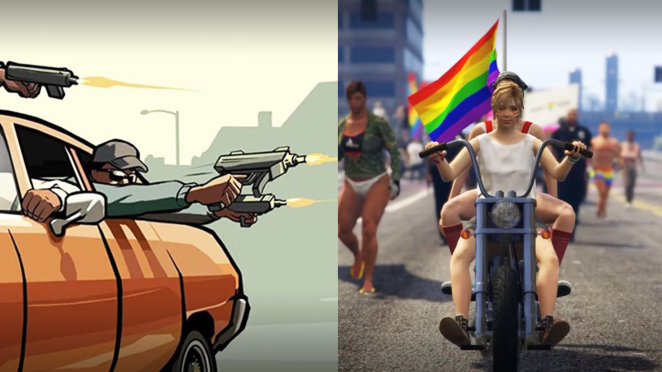
Of course, there is an awkward problem with building an exaggerated version of contemporary America. Contemporary America has shown a remarkable ability to get its own shots in first.
The challenge for GTA 6 is to find something revealing in a culture that already knows how absurd it is. Influencer performance, conspicuous wealth, manufactured outrage and the constant invitation to turn yourself into a brand are familiar territory. A recognisable reference might earn a laugh. A sharper piece of observation can make us notice our own participation in the thing being mocked.
That distinction matters to commercial creativity. A parody of a wellness advert can copy its soft colours, reassuring voice and vaguely threatening promises of self-improvement. To land properly, it needs to understand the anxiety underneath the sale. You recognise the advert and then recognise the part of yourself that considered buying the product. That’s where an uncomfortable joke can get its staying power.
GTA’s own position makes this especially interesting. A hugely anticipated consumer product gets to poke at consumer culture while people eagerly arrange their lives around buying it. I’m among them. That contradiction gives the satire something to work with if the writing is willing to follow it through.
Brands looking for something to borrow should pay attention to the quality of the observation. A cheeky font and a knowing caption will get you part of the way to a joke. Understanding why your customer recognises it gives the creative team somewhere more interesting to go. The brand also needs a believable reason to enter the conversation. Permission to make people uncomfortable comes from a relationship with the audience, and a clothing retailer can’t acquire Rockstar’s relationship by putting a flamingo on an Instagram post.
The audience will make a second version of the game

Whatever happens inside the game tomorrow, there will also be a version of GTA 6 that takes place across streams, reaction videos, group chats and edited clips. Somebody watching a favourite creator may encounter a very different Vice City from the one I’m preparing to explore. The presenter’s decisions and sense of humour become part of the experience.
That is consequential for film, publishing and advertising as well as games. A work now travels through people who interpret it for other people. Their selection, timing and commentary can change what a scene means and which details become memorable. Some audience members will know a game through a creator’s account of it before they have considered playing it themselves.
This is one reason the creator economy is competing with agencies and publishers. Creators develop a relationship around a way of seeing things. A brand commissioning one of them needs to understand what viewers come for and give the collaboration enough room to produce it. A thumbnail with the right face on it is a fairly limited interpretation of that opportunity.
There’s another useful question here for people building campaigns and experiences. What can the audience discover, reinterpret or make a story out of? Give them several worthwhile points of entry and they have choices about how to share the work. We’ve discussed how distribution has become part of the creative process. GTA makes that relationship particularly visible because a player can create an account of what happened that belongs specifically to them.
It also explains how a single-player launch can become a social occasion. The game gives us something to do on our own and then something to bring back to everybody else. With luck, the person on the receiving end will find it almost as funny as we did.
The people who make this possible deserve some attention
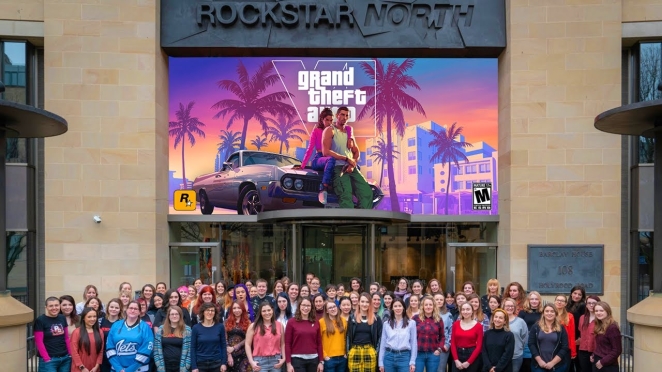
There’s a temptation, with a project this large, to talk about ‘Rockstar’ as though a particularly gifted man in a leather jacket has spent the last decade putting Vice City together in his shed.
A game of this kind depends on a web of specialisms. Writing sits alongside performance, animation, environmental design and sound. Technical artists help ideas survive contact with the machine that has to run them. Production staff coordinate work whose consequences travel across departments. A late change to a scene can become somebody else’s new problem in three different disciplines.
For anyone wondering where creative careers go next, those relationships deserve a closer look. A graphic designer who understands how a sign will be encountered in a moving environment has something valuable to contribute. A writer who understands how a player can interrupt a conversation has a different set of choices to make from someone writing a fixed scene. Creative judgement becomes more useful when it can work with the conditions in which people will experience the result.
The employment context makes that celebration complicated. In GDC’s survey of more than 2,300 game industry professionals published earlier this year, 28% of respondents said they had been laid off in the previous two years. That gives the conversation about creative ambition a human scale. People whose skills help make an experience worth buying also have rent to pay once the work is finished. The findings appear in GDC’s 2026 State of the Game Industry report summary.
An extraordinary launch can coexist with difficult conditions for the people who make creative work. If the wider industry wants to learn from the ambition on display, it should ask what allows skilled people to do work of this quality over time. Clear decisions, enough capacity to act on feedback and a realistic relationship between the brief and the schedule are all part of that conversation. So is keeping experienced people in a business long enough for the next generation to learn from them.
The case for creative craft becomes rather thin if our admiration lasts exactly as long as the launch trailer.
A world still needs somebody to decide what belongs in it
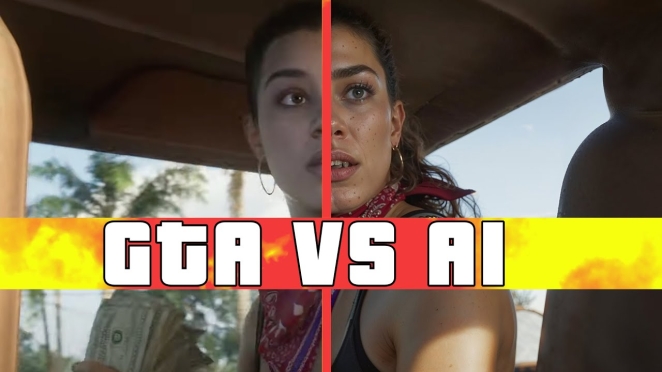
This inevitably brings us to AI, because apparently we are now contractually obliged to mention it before the end of anything longer than a restaurant menu.
I’m more interested in what the GTA proposition asks of creative judgement than in trying to turn a game launch into a verdict on every tool used to make things. Imagine generating a thousand shop signs for a fictional city. You still need to decide which businesses would exist there, what their owners believe about themselves and how each identity contributes to the place. A technically plausible sign can be completely wrong for the street it’s on.
The problem becomes richer when you bring in dialogue, sound, movement and the things people can do. Those decisions have to work together. Someone needs an opinion about the experience and enough understanding of the different crafts to know when a part is helping or getting in the way. That is a considerable amount of authorship, even in a production with many authors.
For agencies navigating faster production, the same questions remain. What are we trying to make somebody feel? Which details support that? What deserves another pass, and what should be removed? The tools can change the number of options available while making judgement about those options even more important. It’s a theme running through our look at the value of human creativity in the age of AI.
I suspect most of us are quite capable of recognising when a work has a point of view. We may struggle to explain which combination of decisions produced it, but we know when we want to spend another hour there. That response deserves to be taken seriously by the people commissioning creative work.
We can learn something without trying to build Vice City

The least practical outcome would be a client deciding their next campaign needs a comparable sense of scale on the budget already approved for a brochure. Somewhere, an account director has just felt a cold shiver without knowing why.
The more transferable ambition is to give people a place, a story or an experience that rewards the time they put into it. A small exhibition can do that through a beautifully judged sequence of discoveries. A publication can do it through an editorial voice readers want to return to. A brand can do it by making the product, service and surrounding creative feel as though the people responsible have thought about the same customer.
The launch also raises a question about how the next cultural event gets a chance to develop. GTA carries an enormous store of familiarity into this release. Commissioners can look at that and conclude that familiar names deserve the investment. Keep following that logic and the room for an unfamiliar voice becomes very small indeed. Somebody has to give a new idea its first chance, then enough support to find out whether there’s anything in it. The creative industries need people willing to do that while everyone else is occupied with the biggest thing on the calendar.
Perhaps that’s the wider reason this launch has got under my skin. For all the noise about the death of attention and the endless appetite for content, here is a piece of creative work people are actively making room for. We want to enter it. We want it to give us something. We have opinions about the radio stations before we’ve even driven the car.
The game will soon have to meet that expectation, and I’ll have plenty to say about whether it manages. Tonight, the anticipation is interesting enough. It suggests that the capacity to care about something made by other people is still there, waiting for a reason to surface.
The creative industries have a fairly substantial part to play in giving it one. That means taking the work seriously, giving the people making it a chance to do it well and occasionally remembering that pleasure is a worthwhile outcome in its own right.
Right. The world can carry on falling apart for a few hours. I’ve got a big old fake Miami to get lost in.