
For most of the last century, brands were rather keen to tell us when something had been made by a machine.
Machine-made meant consistent. Precise. Modern. Efficient. It suggested that no distracted person had wandered into the process and tightened the wrong bolt after lunch.
Now the machine can make the advert as well as the product, the language is beginning to turn back on itself.
"Made by humans" is appearing as a cultural signal, a production note and, increasingly, a point of difference. It sits in the end credits of a television programme. It hovers behind campaigns about real bodies, analogue cameras and actual friendships. It turns the names of directors, photographers, illustrators, performers, writers and craftspeople from routine credits into evidence.
The appeal is obvious. When competent images, copy, music and video can be generated in industrial quantities, human effort starts to feel scarce again. Scarcity is catnip to marketing. Put a small enough supply beside a large enough anxiety and somebody will eventually design a badge for it.
But a badge is not yet a benefit.
A human can make an appalling advert. An AI system can help make a useful, entertaining and effective one. Plenty of contemporary campaigns sit somewhere between the two, with people using generative tools for research, rough visualisation, versioning, clean-up, translation or production while retaining control of the idea and final decisions.
So the interesting question is not whether AI creativity vs human creativity produces a winner. That particular boxing match was promoted long before anybody agreed on the rules.
The more useful question is whether "Made by Humans" could become a meaningful marketing claim: something that changes how people judge a brand, reassures them about what they are seeing and perhaps gives genuinely human-led work a commercial advantage.
It might.
It could also become the creative industry's answer to a restaurant describing every ingredient as "natural": emotionally persuasive, technically elastic and in urgent need of a definition.
Why Is "Made by Humans" Suddenly Becoming Relevant?

David Riley
Because synthetic content has stopped looking like a novelty and started looking like infrastructure.
The UK's 2026 AI Adoption Plan for the Creative Industries reports that 51% of creative businesses are using AI, compared with 33% of businesses across the wider economy. It also notes that many organisations are beginning with operational tasks before moving the technology deeper into creative workflows.
That progression makes sense. Using AI to transcribe an interview, organise research, produce accessibility text or create twenty correctly sized versions of an approved asset attracts rather less philosophical drama than asking it to invent the campaign.
The distinction becomes harder to maintain as the tools move through the process, however. A moodboard influences an art director. A generated storyboard shapes the shoot. A synthetic voice helps sell an animatic. A line produced as a placeholder survives six rounds of feedback and becomes the headline because everyone is tired.
By the time the finished work appears, "Was AI used?" is often too blunt a question to explain what happened.
Kantar's 2026 review of generative AI in media and advertising captures the tension. It found that 70% of marketers already use generative AI to work more efficiently, while only 48% of consumers like seeing AI-generated images in adverts and 57% worry about fake or misleading AI advertising.
That is not a clean public rejection of the technology. It is a widening gap between how attractive AI looks inside the workflow and how comfortable it feels from outside it.
Marketers see localisation, speed, testing, adaptation and cost. Audiences are more likely to encounter an image that looks slightly wrong, a voice that belongs to nobody, a suspiciously frictionless testimonial or another festive film whose characters appear to have been assembled from memories of humans supplied by a nervous witness.
The phrase "AI slop" is rude, imprecise and increasingly useful. It does not describe all AI-assisted work. It describes the flood of material made because production is cheap rather than because the thing deserves to exist.
That flood changes the value system. When finish becomes abundant, provenance becomes interesting. When everybody can make something glossy, audiences start asking who decided what the gloss was for.
Searches for "man made advertising" point towards that instinct, even if "human-made advertising" is the less archaic and considerably more inclusive phrase. People are looking for a way to name work that carries visible intention, effort and accountability.
The claim is becoming relevant because "content" is no longer scarce. Evidence of care might be.
AI Creativity vs Human Creativity: What Are We Actually Comparing?
Marcelo Grassi
The phrase suggests two sealed production lines.
In one room, a brilliant group of people think, argue, sketch, write, shoot, edit, panic, recover and eventually make an advert. In the other, a computer receives a prompt and produces something before the kettle boils.
Real creative work has already become much messier than that.
AI is often inside a human process, while human decisions sit around every supposedly autonomous AI output. Somebody writes the brief, selects the model, chooses the references, judges the result, rejects the alarming fingers, seeks legal approval and decides whether the public should see it. Even a fully generated film has a commissioner with a budget and a brand manager with an explanation to give on Monday morning.
Equally, not everything produced by people is a majestic act of original imagination. Humans imitate category conventions, recycle familiar metaphors, follow trends and make safe work for anxious committees with extraordinary reliability. We were producing generic advertising long before a server farm offered to help.
The real comparison is therefore not magic human originality against automated imitation. It is between different concentrations of agency, experience, judgment and labour.
Generative systems are exceptionally good at producing plausible options from patterns contained in their training and instructions. They can widen a search, compress a first draft, imitate formats, create variations, recombine visual languages and help a small team attempt forms of production that would previously have been unaffordable.
What they don't possess is a stake in the outcome.
They have no client relationship to protect, no childhood memory suddenly made relevant by a brief, no embarrassment when a joke lands badly and no moral discomfort when the commercially convenient idea is also the irresponsible one. They do not understand a culture by living inside it. They model traces of culture left in data.
Human creativity can turn experience into intention. It can recognise that the audience's apparently irrational response is the important response. It can decide that the obvious solution is strategically correct but emotionally dead. It can argue that the brief is asking the wrong question.
That does not make every human decision wise. It makes the decision accountable.
Creativepool's feature on how AI is commoditising average creative output makes the crucial economic point. AI is extremely capable in the territory of "good enough": the usable layout, competent line, polished frame or familiar campaign route. Once that work becomes quicker and cheaper, the human premium moves towards discernment, distinctiveness, cultural awareness and the nerve to reject a merely adequate answer.
That is why the strongest version of "Made by Humans" should never mean "No useful technology came near this project."
It should mean that people supplied the parts that make the work worth noticing: the idea, point of view, lived understanding, taste, consent and responsibility.
Can Consumers Tell When Content Was Created by AI?
Luciano Koenig Dupont
Not reliably, and that might make the human claim more valuable rather than less.
Ipsos and Syracuse University tested ten human-produced adverts against ten fully AI-produced counterparts with 3,000 people in the US. In the resulting report, AI Ads Are Good Enough - And That's the Problem, only 25% of viewers who saw an AI advert felt at least somewhat confident it was AI-made. Another 40% were uncertain either way.
The technology passed the basic disguise test. Most people could not confidently identify the production method.
Yet the human adverts still performed better. Across the study, they were 14% stronger on Ipsos' measure of short-term effectiveness and 17% stronger on its measure of long-term brand effect. Viewers also found the human work more entertaining, unique, eye-catching and worth talking about.
That distinction matters. Detection and response are not the same thing.
An audience might not point at a frame and announce that it was generated, but it can still find the work less surprising, less emotionally involving or more forgettable. We rarely diagnose precisely why an advert has failed to move us. We simply continue making tea during it.
There is another complication. Telling people that content is AI-generated can change their judgment even when the content itself does not change.
The Nuremberg Institute for Market Decisions ran experiments in which participants saw identical adverts described as either AI-generated or human-made. Its report on consumer attitudes towards AI-generated marketing content found that the AI label led people to judge the material as less natural and useful, with lower willingness to investigate or buy the product. The effect was weaker among people who already trusted AI and when the product itself felt technologically innovative.
In other words, consumers cannot always tell how an advert was made, but their belief about its origin can still influence what they think of it.
That creates an uncomfortable marketing opportunity. A human-made label may provide a favourable frame before the work has earned it.
It also creates a responsibility. If provenance changes perception, provenance claims need to be true.
Will Marketers Be Replaced by AI, or Will Their Role Change?

Love Creative Marketing
The reassuring answer is that AI will replace tasks rather than people.
The honest answer is that organisations employ people to perform tasks, so the distinction is not quite as comforting as it sounds.
AI can already reduce the time required for research summaries, early copy routes, visual exploration, production adaptations, campaign reports, social variants and personalisation. If a team was principally paid to produce a large amount of routine material, automation will put pressure on its fees, headcount or both.
So, will marketers be replaced by AI? Some roles will shrink. Some entry-level work will disappear or change shape. Some businesses will use the language of innovation to describe a cost reduction they had already decided to make.
But "marketing" is not one repeatable task. It is a collection of commercial, cultural, analytical, creative, operational and interpersonal decisions. Automating part of the collection does not remove the need to decide which market matters, what a brand should stand for, how risk should be judged, whether an insight is real and when efficiency is quietly damaging effectiveness.
The World Economic Forum's Future of Jobs research places AI and big data among the fastest-growing skills, but it also expects creative thinking, curiosity, resilience and flexibility to become more important. The combination is more useful than the usual replacement melodrama. Marketers will need technological fluency precisely because human judgment is moving to higher-leverage parts of the work.
The UK's creative-industry adoption plan calls this an "augmentation-first" approach: AI should support human creativity rather than displace it. That is a sensible principle, although it will only mean something if budgets, training, commissioning and employment practices reflect it.
A brand cannot sack half a creative team, remove the junior roles through which future seniors learn their craft and then place "Made by Humans" beneath the work because somebody approved the final export.
That would be human-washing: using a comforting trace of human involvement to disguise a process designed mainly to eliminate it.
If the claim grows, it could create a useful commercial incentive to retain expertise. Brands might show the writers, makers, photographers, performers and directors behind a campaign because their involvement has become part of the value.
It could also create a two-tier market. Premium brand work retains visible people, craft and generous production; high-volume performance marketing becomes increasingly synthetic and anonymous.
That division already exists to some extent. AI may make it impossible to pretend otherwise.
Why Is AI Making Authenticity More Important to Marketing?

VCCP
Because authenticity tends to become fashionable whenever imitation becomes cheap.
Mass manufacturing increased the appeal of handmade goods. Digital photography revived affection for film. Streaming made a live performance feel more singular. Infinite polish has made a shaky, properly observed phone video look refreshingly alive.
AI applies the same pressure to communication. It can generate the surface signals of empathy, humour, confidence and personal attention without feeling any of them. That does not automatically make the result dishonest, but it makes the relationship between appearance and origin less dependable.
This is where discussions of AI and authenticity often become muddled. Authenticity is not a visual style. It is not a hand-drawn font, an intentional typo or a film grade that makes expensive footage resemble something found behind a pub in 1997.
Authenticity is alignment.
The thing a brand says should match what it did, how it behaves and what the audience reasonably believes. A perfectly polished campaign can be authentic. A rough-looking one can be cynical theatre.
AI-generated advertising can also feel authentic when the technology has an honest and relevant role. A brand might use it to help customers imagine product configurations, translate useful information, make content more accessible or create a deliberately synthetic world that is central to the idea. If the human team remains responsible for the truth, context and consequences, the tool does not erase authenticity.
The trouble begins when simulation is mistaken for evidence.
A synthetic customer is not a testimonial. An invented documentary image is not a photograph of an event. A generated body is not proof of how clothing fits. A cloned voice is not an endorsement. A fictional community cannot demonstrate that real people feel represented.
Those are not aesthetic objections. They concern consent, truth and the audience's ability to understand what it is being shown.
Consumer trust in AI will not be repaired by making synthetic material harder to detect. It will be repaired by giving people good reasons to believe the brands using it.
That may include disclosure. It will certainly include accountability.
Does AI-Generated Content Affect Brand Perception?
PepsiCo Design & Innovation
Yes, but not in one direction and not with the same force in every category.
An AI-assisted campaign for an AI product is unlikely to provoke the same response as a synthetic mother describing her baby's healthcare. A generated fantasy sequence in a games launch carries different expectations from an apparently documentary photograph in a charity appeal.
The audience judges fit.
The NIM experiments found that the negative effect of an AI label softened for innovative products, where the technology appeared congruent with the offer. Kantar's research, meanwhile, suggests that concern clusters around material that could be fake or misleading rather than around every instance of automation.
This helps explain why some AI campaigns feel inventive and others feel cheap even when the production quality is similar. The tool has become part of the message. If its use strengthens the idea, people can accept it. If it simply advertises that the brand found a faster way to avoid hiring people, the saving may become the most visible creative choice.
Cost is an internal benefit. It is rarely a compelling audience proposition.
The public response can also be shaped by what the brand already represents. Dove's use of synthetic women would collide with two decades of positioning around real beauty. An AI-generated world from a technology company may feel like a demonstration. A handcrafted campaign for an artisan marketplace reinforces the product promise. A handmade claim from a vast automation platform may invite further questions.
There is no universal trust penalty because there is no universal use of AI.
There is, however, a discovery penalty. If a brand hides a material use of AI and the audience later learns about it, the conversation moves away from the advert and towards the concealment. The work is no longer judged only on whether it was effective. It becomes evidence in a case about the brand's honesty.
This is why "Can AI-generated advertising feel authentic?" has a frustratingly conditional answer.
Yes, if the process supports a truthful idea, respects the people represented and fits the brand. No, if authenticity is being generated as a visual effect while inconvenient human reality is removed from the production.
Which Brands Are Already Putting Human Creativity Front and Centre?
The most convincing examples do not use humanity as a generic decoration. They connect it to something the brand has a credible reason to protect.
Dove's promise is the clearest. As part of the continuing Campaign for Real Beauty, the brand has committed to never use AI to create or distort images of women. That is specific. It applies to representation, a territory Dove has occupied for years, and explains the audience benefit: women should not be asked to compare themselves with bodies that do not exist.
The commitment is also more nuanced than declaring all AI forbidden. Dove created a prompt playbook intended to broaden representations of beauty in generative systems. It is drawing a boundary around the part of the work where real people are the point.
Etsy's 2026 Celebrate Being Human campaign makes a similarly direct connection between message and marketplace. Its brand is built around individual sellers, handmade and personalised objects, and the small life events for which people want something less generic than an algorithmic recommendation. The campaign is not merely saying that humans are charming. It is arguing that human specificity is what Etsy sells.
Polaroid's Camera for an Analog Life pushed against screen fatigue and AI while celebrating the physical unpredictability of instant photography. Again, the human quality belongs to the product experience. The photograph is valuable partly because somebody was there, pressed the shutter and received one imperfect object rather than an infinite stream of reversible possibilities.
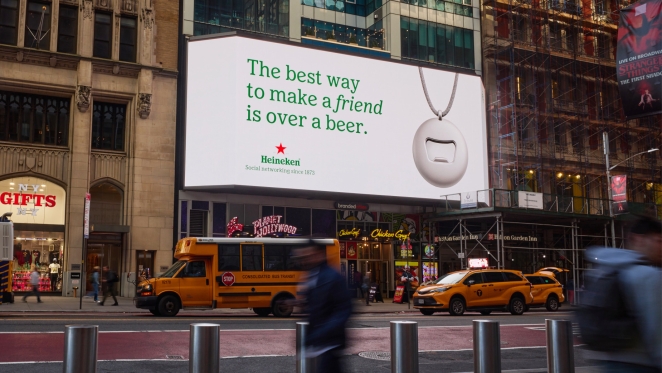
Heineken approached the territory through companionship. Its campaign responding to AI friendship devices argued that real friends are made over real beers, using a bottle-opener necklace as a joke about wearable technology. Heineken uses AI elsewhere in its business, which makes the example more representative of where many brands will land. The position is not anti-technology. It is pro-human in a context where the human interaction is the product benefit.
Then there's Apple TV's Pluribus, which placed the line "This show was made by humans" in its end credits. Apple later released a film celebrating the humans behind Apple TV productions, from performers to make-up artists and production crews. The statement carries extra weight because it comes from one of the world's most powerful technology brands. It says that technical leadership and human authorship do not have to cancel each other out.
These examples point towards a broader lesson. The strongest human-made claims are not frightened apologies for failing to automate. They are confident explanations of why people matter here.
There are counterexamples too. AI-generated holiday work from global brands including Coca-Cola and McDonald's has attracted criticism when audiences felt the production lacked warmth or used automation in a territory built on nostalgia and togetherness. McDonald's Netherlands ultimately removed its 2025 festive advert after the response became the story.
That does not prove an AI Christmas advert cannot work. It proves that emotional heritage is not a texture pack.
When a brand borrows decades of human memory, the execution needs to do more than resemble the memory from a distance.
Could "Made by Humans" Become a Premium Signal?
Fold7
Possibly, but marketers should be careful not to confuse preference with willingness to pay.
Ipsos found that two in three Americans wanted humans to create marketing and art content. That is a substantial preference. It is not automatically a business model.
Baringa's 2025 research into human and AI-generated content makes the gap uncomfortably clear. Among respondents who preferred human-created content, only 25% said they would pay more to protect human jobs, while 66% would not pay extra for content they knew had been created entirely by people.
Consumers can admire craft, support creative employment in principle and still choose the cheaper option at checkout. Anyone who has worked in sustainability marketing will recognise the terrain.
The premium is therefore unlikely to be universal. It will be strongest where human involvement changes the perceived substance of the product or service.
Luxury, fashion, hospitality, education, care, cultural work, professional advice, journalism, live performance, bespoke goods and founder-led businesses all contain forms of value linked to origin, judgment, expertise or relationship. In those categories, a human-made claim can reassure people that the experience has not been reduced to scalable simulation.
It may also matter more in high-stakes or emotionally sensitive communication. People will tolerate automation differently when choosing a background image for a playlist than when deciding whether to trust health information, financial guidance or a charity's account of somebody's life.
For routine performance assets, price comparisons or functional product demonstrations, audiences may care far more about usefulness and accuracy than creative provenance. Insisting on a human premium everywhere would be like demanding a hand-lettered receipt.
The commercial opportunity is not to charge more merely because a person touched the file.
It is to make human contribution legible when that contribution improves the thing being bought: better judgment, deeper expertise, original perspective, real representation, accountable advice, exceptional craft or an actual relationship.
That is a premium people can understand.
But What Does "Made by Humans" Actually Mean?
HAUT CGI
This is where the attractive slogan encounters the considerably less attractive production spreadsheet.
Does spellcheck count as AI? What about object removal, automated colour correction, transcription, translation, search, media optimisation or software features that quietly use machine learning without announcing themselves? Can a campaign be human-made if an early concept image was generated but never published? What if AI created the background while a real performer supplied the face and voice? What if a human wrote every word but a model decided which version each person saw?
An absolute promise becomes almost impossible to police unless its scope is deliberately narrow.
Brands need a vocabulary more useful than "AI" and "not AI".
Human-created could mean that the published creative material - its writing, images, performance, music and film - was originated and executed by people without generative AI producing those elements.
Human-led, AI-assisted could mean that people developed the strategy and idea, directed the process, selected the material and remained accountable, while AI supported defined stages such as visual exploration, adaptation, editing or localisation.
Human-performed or captured could certify that the people, voices, places, products or events shown are real, even if AI was used elsewhere in post-production.
Human-reviewed would mean that a person checked an output before release. That is useful governance, but it is far too weak to support a grand "Made by Humans" claim. A signature at the end of an automated process is not authorship.
The strongest public wording will probably be specific rather than universal: "Photographed with real customers." "Written and illustrated without generative AI." "Performed by the original artist." "Human-led, with AI used for localisation." "No synthetic bodies or voices." These claims explain what the audience may reasonably care about.
Scope matters too. Is the promise attached to one image, one film, an entire campaign or everything the company produces? A brand should not place a sweeping human-made badge on a launch if the claim applies only to the hero asset while thousands of synthetic variations circulate beneath it.
Evidence matters more than typography. Credits, production notes, behind-the-scenes material and clear AI policies can show who contributed and how. Technical provenance systems can help as well. The C2PA's Content Credentials standard records information about the origin and editing history of digital content, functioning rather like a nutrition label for media.
Provenance is not a quality score. A credential can help establish what happened without deciding whether the result is good, ethical or true. But it gives a human-made claim something sturdier than a line written by the same marketing department asking us to believe it.
The analogy with food labelling is useful. "Made by humans" may eventually work less like a romantic slogan and more like an ingredient statement. People will not need to reject every use of AI. They will need enough information to make a sensible choice.
Should Brands Disclose When They Use AI in Advertising?

Recubist
Sometimes they must. Sometimes they should. Sometimes a disclosure would add little beyond turning a routine editing tool into the main character.
In the UK, the Advertising Standards Authority says there is no blanket requirement to disclose AI use in every advert. Existing advertising rules still apply regardless of how the material was made. The ASA suggests starting with the risk of deception: would the audience be misled without a disclosure, and would the proposed label genuinely clarify the message?
That is a more useful test than compulsively attaching "AI was used" to every asset in which software improved the weather.
Prominent synthetic people, cloned voices, fabricated testimonials, invented events and materially altered product demonstrations create obvious reasons to disclose. So does content in which the audience could reasonably interpret an artificial scene as evidence.
The European position is becoming more formal. Article 50 of the EU AI Act has applied since 2 August 2026, introducing transparency requirements for certain AI systems and synthetic content. These include machine-readable marking by providers and clear information in cases including deepfakes and some AI-generated text on matters of public interest. Global campaigns will need proper legal advice rather than a cheery assumption that one label satisfies every market.
Industry guidance is already moving in the same direction. The IPA and ISBA's principles for generative AI in advertising say use should be transparent when AI features prominently and would not be obvious to consumers. They also ask advertisers to consider public trust, rights, bias, environmental impact and employment.
Disclosure alone will not create trust. The NIM experiments suggest an AI label can trigger a negative response when people already doubt the technology. But avoiding disclosure to escape that response is a remarkably short-term strategy.
The goal is not to make audiences approve of every use of AI. It is to let them understand what they are being asked to believe.
Could Human-Made Become a Genuine Brand Differentiator?

Tapestry
Yes, but only when it affects more than the campaign line.
If every competitor can write "Made by Humans" beneath a stock image, the phrase will collapse into decorative reassurance within months. The brands that turn it into an advantage will build proof around the claim.
They will show the makers. Credit the contributors. Explain the process. Commission people with recognisable points of view. Pay for lived expertise rather than asking a model to approximate it. Keep real customers, employees and communities involved when those people are central to the story.
They will also define where AI genuinely improves the work. A human-first brand does not need to become technologically performative in the opposite direction, proudly wasting three days on a task that software could complete responsibly in ten minutes.
The differentiator is not inefficiency. It is intention.
Creativepool has already explored why human creativity is becoming more valuable in the age of AI: as polished execution becomes widely available, the value moves towards taste, judgment and the people capable of making work unlike everybody else's.
Brands can make that contribution visible through the people they hire and the way projects are presented. Creativepool's creative talent directory lets commissioners look beyond a generic capability claim to portfolios, clients, recommendations, awards and recent work. Its Creative Services Directory provides the same kind of evidence for agencies, studios and production companies.
That matters because human provenance begins before the asset is finished. A case study can name the strategist who found the tension, the copywriter who shaped the voice, the director who changed the performance and the designer who refused the obvious route. It can show the roughs, wrong turns and decisions that turned production into authorship.
The human claim becomes more credible when the humans are not hidden.
It becomes stronger still when the work can withstand judgment on its own merits. Awards, peer recognition and client recommendations cannot prove that no AI was used, but they can demonstrate that somebody made decisions worth recognising. The point is not to romanticise labour for its own sake. It is to connect contribution with outcome.
If "Made by Humans" becomes a differentiator, the portfolio may become its most persuasive label.
Will "Made by Humans" Become the Next Big Marketing Claim?
Pristop Slovenia
Probably, although not in one neat and universally agreed form.
We are likely to see a family of claims: no generative AI, human-written, real people, camera-captured, human-led, artist-made, performed live, verified provenance. Each will draw a line around the part of a product, service or campaign where human origin carries meaning.
Some will be valuable. Some will be opportunistic. A few will be attached to suspiciously smooth adverts by brands whose definitions of "human" appear to include one executive pressing Enter.
Regulation and technical standards will make certain forms of AI disclosure more common, but marketing tends to move beyond compliance when a fact can become a benefit. "Contains no artificial colours" began as information and became positioning. "Handmade" turned production method into story. "Made locally" connected origin with community, freshness and responsibility.
"Made by Humans" could do something similar if it certifies qualities people actually value: real representation, accountable judgment, cultural specificity, consent, craft, employment and the glorious possibility that somebody cared enough to disagree.
It will not win simply because consumers hate AI. The evidence does not support that tidy conclusion. People appreciate convenience, personalisation and lower prices. Many cannot identify AI content, and plenty will accept it when it is useful, relevant and good.
The claim will win where automation makes the alternative feel meaningful.
That could be a luxury brand showing the hand behind an object. A broadcaster protecting the credibility of documentary images. A beauty company promising that the bodies in its adverts exist. A professional service making clear that advice comes with human accountability. An entertainment company crediting the hundreds of people whose collective judgment created something no prompt could have commissioned by itself.
The smartest brands will resist the false choice between refusing AI and surrendering to it. They will use the technology where it expands access, removes drudgery or improves delivery, then protect the human contribution where judgment, experience and trust create the value.
They will say what the people did.
They will say what the tools did.
And they will give audiences enough information to decide whether the distinction matters.
"Made by Humans" may well become a major marketing claim. But it will only remain one if the humans add something worth claiming.