

As the MD of a TV production company who has also worked as branded content partner, I’ve seen first-hand how traditional creative agencies that are masters of short form can struggle when the brief calls for something bigger. Namely, long-form storytelling that engages and retains audiences.
That’s where the broadcast experience comes in useful.
We’re seeing brands bypass traditional broadcasters entirely, commissioning long-form content for their own platforms.
We’re seeing the media landscape totally reshape itself.
Commissioning power is drifting from linear channels to brand pages, from schedulers to CMOs.
In short, if people are landing on your owned channels, you need to treat those channels like a network.
Your content isn’t simply assets in a campaign. It’s a programming slate.
The shift comes at a time when audience attention is primarily on digital platforms, streamers and YouTube – for long form high end as well as short form UGC. There is so much opportunity in that.
This shift has created a new role for production companies, not just as suppliers, but as creative partners.
We work with brands and agencies to help them develop long-form content that audiences genuinely want to watch, as well as content creators and influencers who are keen to develop their own formats in the online space.
Usually this would be the time when agencies and brands come in to work on sponsored posts for the owned channels. But the shift in focus from purely advertorial to story led content requires a very different set of tools. As we know, having just worked on a YouTube format’s Netflix adaptation, there is more demand than ever for these online formats to go on the big screen via streamers and broadcasters.
Agencies built for short-form efficiency are brilliant at the sprint.
But long-form is a different game altogether.
You need characters, arcs, payoffs, and you need to hold attention across 10, 20, sometimes 30 minutes. That’s where the craft developed in TV storytelling becomes invaluable. You also need the experience in high end – budgets are different, content needs to look a level up from UGC.
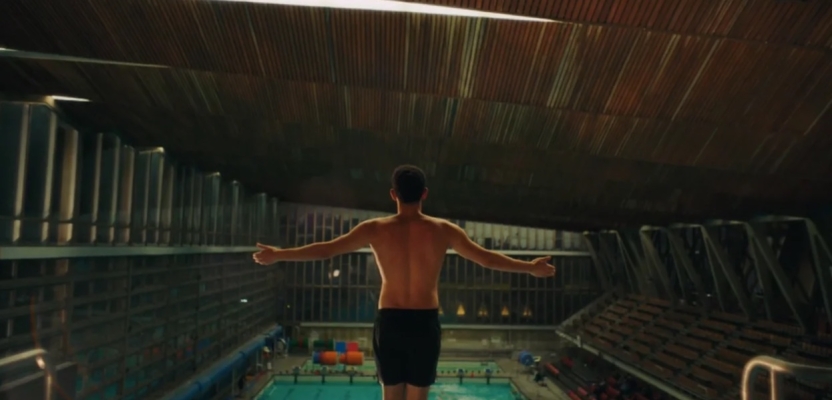
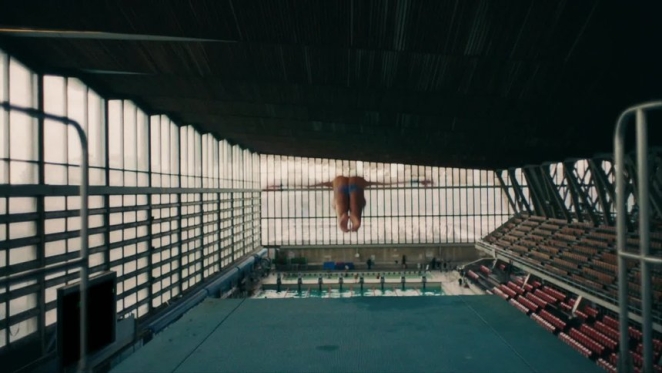
Take the branded documentary we produced for Nike and Wieden+Kennedy: a 25-minute film for Channel 4 that continues to perform online.
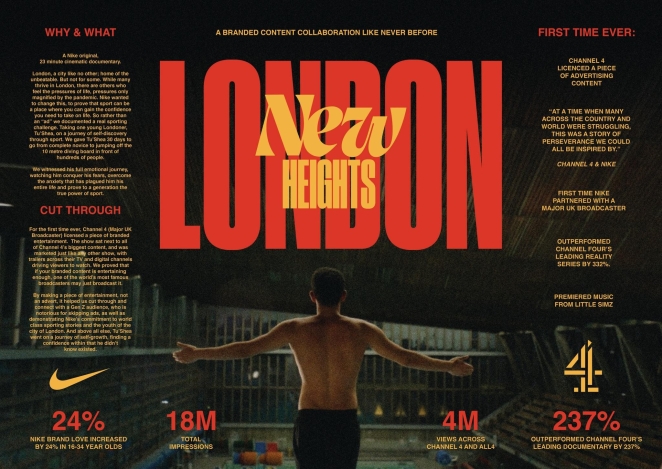
New Heights: London is an inspirational 22-minute documentary about a young carer who overcomes his self-doubt through sport – was streamed on All4, to over a million viewers.
The budget was modest, but the impact was significant.
Why?
Because the long form worked for the audience.
Nike wanted to explore long-form content to engage a younger audience. Naturally, their go-to people, Wieden+Kennedy – advertising’s largest independent agency – had all the right creative ideas. The problem was, they’d never actually made long-form content before. To fulfil Nike’s brief, W+K needed a TV production team that could provide the knowledge, the people, and the infrastructure to make a successful documentary. A team that was well-connected within the TV industry and could also help them find a home for the film.
With a long track record of working with creative minds to facilitate the making of brilliant TV, we were able to identify – and provide – the roles W+K needed to complete their team and fulfil their mission. Suddenly, W+K had a Head of Production and a Line Producer, as well as finance and legal support. A new team was born.
We created a production budget based on the financial parameters set by the client, and we drafted a Production and Edit schedule. With these two elements in place, we were able to give the W+K team regular financial overviews and filming updates through the internal reporting mechanisms we‘d set up.
Alongside that, we took care of all legal and business affairs — talent contracting, contributor contracting and ad hoc issues such as Ofcom compliance, Health & Safety, and Duty of Care – ensuring a smooth, safe, and fair production process throughout. We also made sure the production and its budget were closed down correctly, with all deliverables and assets archived appropriately.
The programme was delivered not only on time, but under budget too, with all negotiations having been handled by the Nest team, which helped secure reduced rates across the board. All savings were passed directly back to Nike, and all freelancers, crew, and suppliers were paid on time.
Above all, W+K were able to respond to the brief Nike had given them, without compromising their creative ideas or the professionalism of their output – successfully winning the hearts and minds of the audience Nike wanted in the process. And as their production partners, we were proud to be able to help them ‘just do it’.
Brands often already have audiences. Despite the 100,000+ followers on Instagram, 200,000 subscribers on YouTube the average view count can hover below 5,000.
That’s a content problem, not a reach problem.
With the right creative development, and a more TV-literate production mindset, brands can create content that drives real engagement.
So, what does this mean for agencies and marketers?
It’s time to start thinking like commissioners.
If you're building a content plan for your channels, ask yourself the same questions a broadcaster would. What’s the format? Who’s the audience? How do we keep them coming back?
We believe agencies, brands and production companies should collaborate much earlier. By that I mean coming in at the development stage, not just coming onboard for the execution.
Bring producers into the room when ideas are first forming. Their experience in structuring stories, managing talent and delivering to platform-specific briefs can help a huge amount.
As a production partnerships company, we’re now spending as much time helping agencies and brands shape long-form IP as we are producing it.
Branded content is continuing to mature and looking less and less like advertising and more like entertainment. As that happens brands need to make sure they are ahead of the curve and delivering stories that stay with people.