

Life isn’t always fair. Indeed, it rarely is. You can boast a spotless body of work and a flawless portfolio and still be stuck in the purgatory of no interview invites and the dreaded no response after interview follow‑up loop. That’s the frankly maddening part of creative hiring. It makes creative job application rejection feel personal, even when it is mostly procedural. It also makes creative portfolio rejection feel like a judgement on your talent, when it is often a judgement on something else: fit, clarity, timing, risk, or the simple fact that the hiring funnel is not designed to be kind.
This piece is a brutally honest map of what rejection usually means in 2026, why it happens to very capable people, and how to turn it into something useful. The point is not to gaslight you with “keep going” platitudes. The point is to give you leverage: sharper positioning, clearer storytelling, better targeting, and a way to interpret the silence so you stop wasting emotional energy on employers who cannot even manage basic communication.
The UK creative sector is large, varied, and competitive, with a high share of self‑employment and micro‑businesses. That creates a job market where many roles are informal, many hiring processes are stretched, and a lot of opportunities are found through networks and speculative outreach rather than neat, transparent funnels.
Creative hiring is also increasingly filtered by systems and scanning behaviour. Your application can be rejected before a human meaningfully reads it, and even when it is read, it is usually scanned. That shifts the advantage towards candidates who make relevance obvious fast, and away from candidates who rely on reviewers doing deep interpretation work.
Rejection often signals one of a few recurring realities: you look like the wrong “kind” of creative for the role, your story is unclear, your specialism is not legible, your portfolio does not reduce risk, or your timing collides with internal constraints and slow decision‑making. None of those are the same thing as “you are no good”.
Finally, ghosting and silence are systemic candidate‑experience problems, not a reliable indicator of your performance. Timely follow‑up and feedback is certainly preferred for all parties involved but the reality is that that many processes are imperfect, even with AI now doing a lot of the heavy lifting. Knowing that lets you respond professionally and move on strategically rather than spiraling into despair.
Rejection in the UK creative hiring funnel in 2026

Mariya Yeremeyev
Start with the backdrop, because context changes how you interpret the signal.
Creative work is not a niche corner of the economy. A government written ministerial statement on the Creative Industries Sector Plan describes the creative industries as a “growth engine”, citing 2.4 million jobs and £124 billion GVA in 2023, alongside an intention to invest and grow the sector over the next decade.
Creative industries contribute a significant share of UK GVA, include a large number of micro‑businesses, and have a higher‑than‑average likelihood of self‑employment and short‑term contract work. It’s also an industry in which many jobs are not formally advertised and speculative applications and networking can be particularly useful, which is where networks such as Creativepool step in to offer a hekling hand.
On the labour market mechanics, the Department for Culture, Media and Sport reports that the included DCMS sectors collectively account for 4.0 million filled jobs (11.7% of filled jobs), with London holding the highest number of filled jobs within those sectors. It also cautions that sector definitions overlap, which is a polite way of saying “do not treat these categories as neat boxes.”
Now add the hiring funnel reality.
Many employers are using applicant‑tracking systems (ATS) to sort and rank CVs. ATS tools can scan, sort, and rank large volumes of CVs, meaning missing keywords or formatting issues can cause rejections before the application reaches a hiring manager’s eyes.
Even when humans are involved, scanning is the default. People rarely read web pages word by word and instead scan for cues and relevant fragments, which is one reason portfolios and profiles need structure, signposting, and quick clarity.
If you’re wondering why this matters for rejection, here is the unglamorous answer. A modern creative application is a multi‑stage filtering exercise, not a fair audition. Each stage is looking for reasons to reduce risk quickly. If your materials force the reviewer to “work out” what you do, you are handing them friction. And friction gets screened out.
The irony is that this does not only hurt juniors. It hurts talented people who assume quality will speak for itself to the creative talent hunters out there. Quality does speak. It just does not always speak loudly enough through the noise of volume, systems, and rushed decision‑making.
There is also a candidate‑experience gap that fuels the “radio silence” feeling. UK HR guidance from CIPD emphasises that recruitment processes should set expectations, avoid unnecessary delays, and follow up in a timely manner. It warns that poor interview experience can undermine employer brand and that feedback after interviews enhances candidate experience. There’s also the everyday reality many candidates experience: delays happen, follow‑up is sometimes needed, and after a couple of attempts with no reply, it can be sensible to treat it as a rejection and move forward.
This isn’t comforting, but it is clarifying. Silence is often about capacity and process. It is sometimes about poor manners. It is rarely a precise measure of your talent.
Why am I not getting interviews?
Grey
If you are seeing no interview invites, assume you are failing one of three filters: relevance, legibility, or risk.
Relevance is the simplest. A hiring manager is not looking for “amazing work”. They are looking for “amazing work that solves my specific hiring problem.” Creativepool’s own hiring guidance frames this bluntly: talent hunters want to see how you add value, and they look for signals of potential, personality, and purpose, not only keyword matching.
This is why high‑quality portfolios still lose. They can be excellent in the abstract and still off‑brief. A common reason for rejection is misalignment with the job description. A brilliant portfolio can still miss the mark because the work shown doesn’t reflect what the role actually needs.
Legibility is the next filter. If the reviewer cannot tell what you do within a quick scan, you are asking them to interpret. In digital behaviour research, scanning is normal. In hiring, scanning is aggressive. Your responsibility is to make your specialism and level obvious quickly, not to design a treasure hunt.
This is where many creatives sabotage themselves with “multi‑disciplinary” as a shield. Multi‑disciplinary can be a strength. It can also read as “unclear”. If you do multiple things, you still need one primary promise. Otherwise, the recruiter cannot categorise you, and uncategorised candidates are easy to drop.
Risk is the final filter. Hiring teams reduce risk by choosing candidates who look easiest to slot into the work with minimal ambiguity. That risk calculation is not fair, but it is common. Clear expectations, structured assessment, and objective criteria are vital because unstructured decision‑making is vulnerable to bias and inconsistency. In practice, many employers don’t fully achieve that ideal, so candidates who reduce ambiguity tend to benefit.
Now, the mechanics behind the “why” tend to cluster into a few patterns.
One: your CV is being filtered out before your portfolio is seen. ATS tools scan and rank CVs; missing keywords and messy formatting can reduce your chance of getting through the first stage. Hays explicitly describes this dynamic and recommends matching the language of the job specification because software does not do human inference well.
Two: you have accidentally made your application look generic, especially if you use AI without enough human correction. AI can help improve readability and ATS optimisation, but fully AI‑written applications can also show “telltale signs” such as generic wording and a lack of specifics, which recruiters may treat as a red flag.
Three: your application is tailored in the wrong direction. Hiring teams respond to relevance. That means showing the right kind of thinking for the work, not simply your best work in a vacuum.
Four: your seniority signal is unclear. If the role looks mid‑weight and your work looks senior, the team may assume you will be bored, expensive, or unwilling to do the unglamorous parts. If the role looks senior and your work looks junior, they may assume you will struggle with autonomy. This is rarely written in rejection emails, but it shapes shortlists because teams are buying a “fit” against their current workload and management capacity. Employers should be using objective criteria, but it also describes how many organisations rely on interviews and multiple methods to infer capability, which inevitably includes judgement calls.
Five: you are applying too late or at the wrong moment. Roles get paused, re‑scoped, or quietly filled through networks. Many creative roles are not formally advertised, and that speculative applications and networking can be particularly useful in this sector. That’s another way of saying: the visible market is not the whole market.
If you want one practical takeaway that is not motivational fluff, make it this. Your application is a product. Your buyer is time‑poor. The value proposition must be obvious within a scan.
That also means you can test it like a product. Ask one person who does hiring, or one person who recruits, to look at your CV and portfolio for 30 seconds, then answer three questions: What role do you think I am applying for? What level do you think I am? What is the strongest evidence on the page that supports that belief? If their answers are vague, you have found the problem.
How do you stand out in a creative job market?

Beverley Luckings
Standing out is rarely about being louder. It is about being clearer and more relevant than the noise around you.
Creativepool’s guidance on what talent hunters look for insists that showing value matters more than listing tasks, and that recruiters are looking for signals of potential and purpose alongside skills. That’s a polite way of saying: people hire people whose work and thinking they can picture in their environment.
So, the standing‑out strategy is really a de‑risking strategy, built around three questions.
Can I tell what you do? Can I tell why your work matters? Can I tell you will be easy to work with?
The first is positioning. If your headline is “Designer”, you are leaving it to the employer to decide what kind of designer you are. When you do that, you become interchangeable. In a scanning environment, interchangeable is fatal.
The second is storytelling. A creative portfolio is a job application in visual form and that means it should tell a story about your journey, including clarity on what you contributed to group projects. Remember, employers are increasingly time‑poor and quickly sort portfolios into those they’ll look at again and those they won’t.
The third is the part creatives often resist because it feels less “pure”. Hiring is not only craft evaluation. It is collaboration forecasting. NN/g research on UX careers highlights advice from practitioners emphasising soft skills such as empathy, collaboration, communication, and critical thinking as central to success. Even if you are not a UX designer, the point generalises: teams are hiring how you work, not only what you make.
Standing out also has a discoverability layer.
Creativepool’s portfolio guidance is direct about this: on Creativepool, using all available fields, listing key skills and specialties, adding tags, and curating projects makes you more likely to be found by agencies searching. That is not “social media advice”. It is SEO for your career.
The uncomfortable truth is that many creatives apply like the job board is the only channel when in the creative industries, it rarely is. Speculative applications can be especially useful because many positions are not formally advertised. On a practical level, this means it is rational to build a pipeline of relationships rather than treating each application as a one‑off lottery ticket.
There is also strong evidence that networks matter in hiring generally. In a CIPD research report on the behavioural science of recruitment, the organisation discusses evidence suggesting referred applicants can be more likely to be hired and that referral programmes can be cost‑effective, while also cautioning about diversity risks if networks are homogeneous. For creatives, that translates into a strategy that is both practical and ethically important: build networks that broaden opportunity rather than reinforcing the same narrow circles.
Now, a Creativepool‑style “business hack” that creatives often ignore because it sounds too simple.
Treat your portfolio like a sales page, not an archive.
Hiring managers rarely read a portfolio in full and that scannability matters. The implication is that your portfolio should guide the reader from “what is this” to “why should I care” with minimal effort. Think of the portfolio as a deliverable and guide the reader from introduction to conclusion with “zero guesswork.”
If you want to stand out, reduce guesswork more than the other candidate does.
That includes your tone. Tone mismatch is one of the quietest reasons for rejection. The work can be strong, but if the portfolio reads like you are trying to join a different industry than the one you are applying for, the reviewer will struggle to picture you.
You do not need to change who you are to do this. You need to choose which version of your work to foreground.
A good way to operationalise this is to keep a “standard” portfolio, then build two or three targeted versions that highlight specific lanes: brand identity, social and campaign, product and UX, motion and content, illustration and editorial.
The final standing‑out lever is proof of initiative.
Self‑initiated work can act as a hiring signal because it shows who you are when nobody is assigning the brief. It recommends framing side projects around relevance and outcomes so recruiters can quickly grasp what the project is about and why it matters, which again is a scannability and relevance argument. This is especially useful for early‑career creatives who feel trapped by “no experience” narratives.
Standing out, in 2026 conditions, is the compound result of positioning, scannability, relevance, and proof. It is rarely the result of a single “wow” piece.
Why is my design portfolio keep getting rejected from jobs?
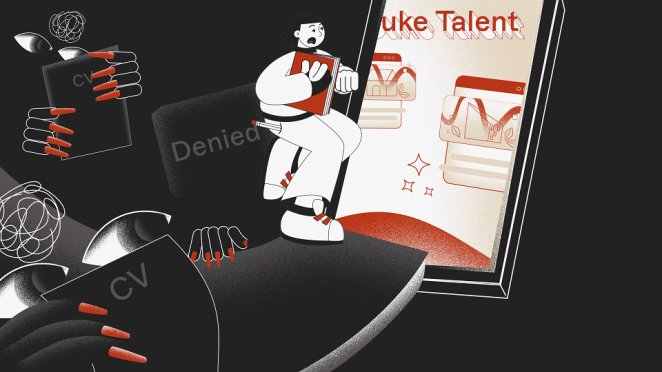
Anastasiia Zaesenok
What does “portfolio rejection” usually mean in practice?
Often it means the reviewer had to work too hard to understand what they were looking at. It is not that they are lazy. It is that hiring is one task among many, and your materials are competing with deadlines.
A portfolio is rejected when it looks like a scrapbook rather than evidence. The most common version of this is “final screens only” or “final images only.” Recruiters often reject portfolios that only show the final stage of the project so you should always make an effort to show off your decisions, drafts, and rationale so the reviewer can see why certain choices were made.
Another common failure mode is mismatched thinking. If a role is social‑first, the portfolio needs to show social‑first thinking, and more broadly, hiring managers want to see how you think, not only what you make. Strong work in the wrong category does not solve the hiring manager’s problem.
There is also a specific 2026‑era issue: your portfolio may be optimised to impress other creatives, while the first reviewer is not necessarily going to be a creative. NN/g’s 2026 recruiter insights article notes that candidates are often evaluated by recruiters or hiring managers who have not done design, which changes what “clarity” looks like. If your case study reads like a seminar, it will fail the person who is trying to hire under time pressure.
If you want a usable structure that works across disciplines, borrow from the case‑study mindset without turning every page into a thesis.
Portfolios can include preparatory work, work‑in‑progress, and final pieces, and emphasises quality over quantity. That aligns with a simple narrative arc: what was the problem, what did you do, what changed, and what did you learn.
Portfolios should show process as well as final product and candidates should be able to describe scope and their involvement clearly. Again, this is not about pleasing other designers. It is about making your work legible to someone who is trying to make a hiring decision.
Scannability is not the enemy of depth. It is the container that allows depth to be discovered. People scan. Your headings, summaries, and visual hierarchy decide what gets attention. Use that reality, do not fight it.
There are also practical portfolio killers that are more embarrassing than interesting.
Broken links, blocked sharing settings, and portfolios that are painful on mobile can knock you out before your work is evaluated. Check sharing settings and ensure employers can access files and links. If your work is good but inaccessible, the outcome is the same as if it were bad.
Another is overcomplication. Try not to be too showy or over‑complicated in format because the format should not distract from the work. Your portfolio’s job is communication, not performance art.
Finally, remember that “portfolio” is not a single artefact. It is an ecosystem.
Creativepool’s portfolio guidance explicitly recommends using skills, specialties, and tags on the platform to be found. That implies a key insight: if your Creativepool profile says one thing, your CV says another, and your portfolio exhibits a third, you will look inconsistent. Recruiters read inconsistency as risk.
You do not need to be perfect. You need to be coherent.
No response after interview and what it usually means

Nathan Smith
The phrase “no response after interview” is now so common that it has become a search query. That should tell you something. Silence is a pattern, not a personalised critique.
Giving feedback demonstrates appreciation for candidates’ time and supports the employer brand so any employer should ideally want to get back to candidates ASAP. Reality is often messier though. In smaller organisations, recruitment may sit with one person who can become unavailable or pulled into other priorities, which can delay communication.
This is why a respectful follow‑up, usually within a week unless told otherwise, might be a good shout in some situations with a second follow‑up a few days later. And don’t be afraid to move on if there is still no response! Plenty more fish in the sea.
So what does silence usually mean?
Sometimes it means you are still in the running and the organisation is slow. Sometimes it means the employer is debating between candidates, waiting on approvals, or juggling internal constraints. Sometimes it means the process is just badly run. Sometimes it even means you were rejected but they’re avoiding the discomfort of saying so.
That’s not an excuse, but it is a common behaviour in organisations that do not invest in candidate experience. ACAS explicitly states that employers do not have to give feedback or explain reasons for rejecting job applications, even though doing so can help applicants improve and can demonstrate openness. That legal and practical reality shapes a lot of silence.
The most useful approach is to treat follow‑up as a process, not an emotional event.
Follow up when you said you would. If they gave a timeline, respect it. If they did not, one week is a reasonable default, unless the employer communicated a longer timeframe. Send a short message that includes the interview date, role title, and a direct question about next steps. Then do one further follow‑up a few days later. After that, stop donating time to silence.
If you want feedback, ask for it explicitly, knowing they may refuse, as is their right.
There is also a perspective shift that can save your sanity.
Structured interviews and objective criteria can reduce bias and support fairer comparisons, and candidate experience often impacts employer brand. Hiring is a set of methods, not a moral verdict. Your job is to create an application and interview performance that works within those methods, while still protecting your self‑worth from a system that is imperfect by design.
Rejection is data. Silence is also data. Both can help you iterate.
If you keep getting no interview invites, your targeting and legibility need a reset. If you keep getting interviews but face no response after interview, you could be close enough that the issue is competition, internal constraints, or interview positioning rather than portfolio quality. Either way, the worst use of rejection is treating it as proof you should stop.
The best use is turning it into a diagnosis that produces a better version of your story.
If you are stuck in a loop of no interview invites, repeated creative job application rejection, and the particular sting of creative portfolio rejection, the answer is rarely “be less talented.” It is usually “be more legible, more relevant, and more strategic about where you spend your effort,” especially when employers are still comfortable leaving you with no response after interview and calling it a process.