
Creativity has taken Heidi Vilkman from documentary filmmaking to illustration, surface pattern design and product licensing. Originally trained as a documentary filmmaker, Heidi began her creative career making short films and documentaries before shifting towards a more home-based creative practice. Today, she works with founders and artisan brands to create bespoke designs, while licensing her intricate prints and patterns across fabric and product collections.
In this interview, the illustrator and surface pattern designer shares how her Finnish childhood, love of nature and background in visual storytelling continue to influence her work. From researching ecosystems and botanical history to creating detailed, hand-drawn illustrations, Heidi discusses her creative process, the importance of originality and craftsmanship, overcoming perfectionism, and why she believes human, story-led design will remain valuable in an increasingly AI-driven creative industry.
How did you first get into the industry?
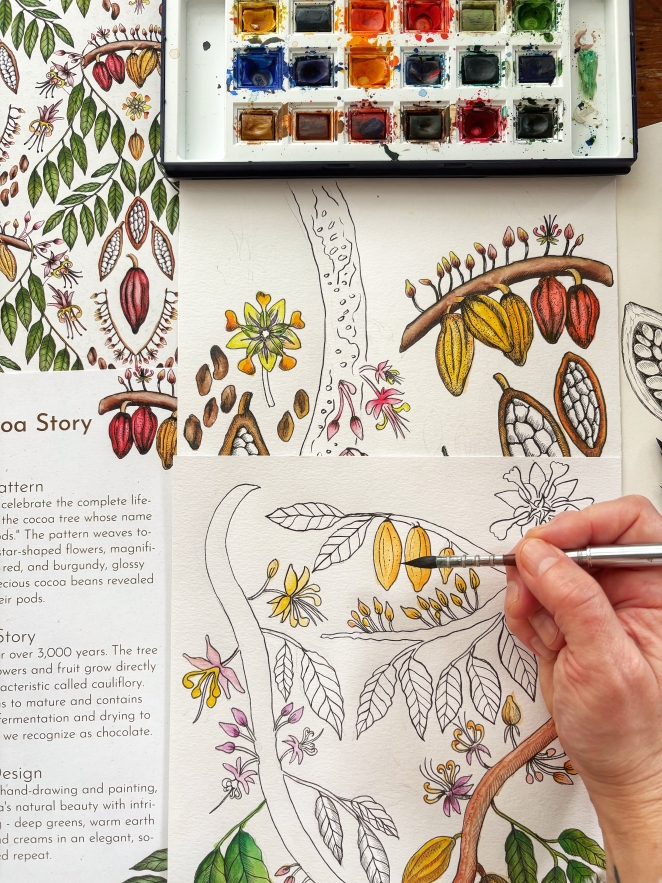 I originally trained as a documentary filmmaker, and made short films and documentaries for television and the festival circuit. When my daughter was born I needed something less intensive and home-based, so I stopped making films and started designing for products to sell on Etsy. During Covid I pivoted to surface design and learnt how to create repeating patterns in Illustrator and Photoshop. I started working for clients in design, and have been creating bespoke work and work for licensing since then.
Where are you based now and who do you work for?
I live in Hebden Bridge, North of England. I work with founders and artisan brands on bespoke design projects. I also license my prints and patterns for fabric and products from my design folio.
What is your personal background and what role did it play in your career?
I was born in Finland and grew up surrounded by nature. I was very curious and always exploring. Creativity was a big part of my life from very early age and even though I tried a few non-creative jobs, I would always come back to creative work.
If you weren’t in your current industry, what would you be doing?
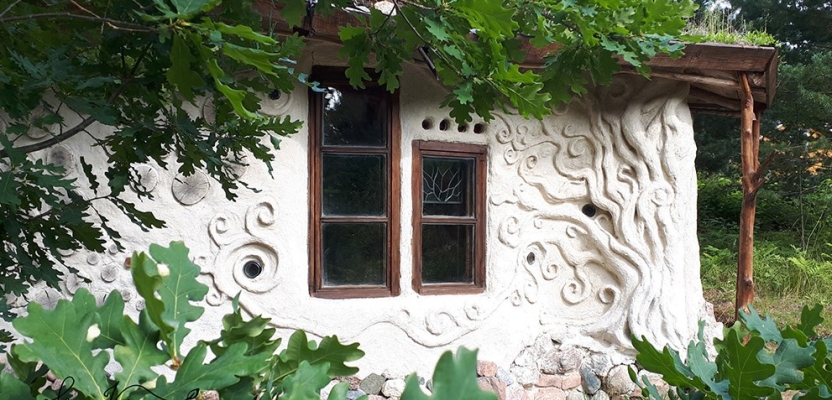
 I would be focusing on natural building industry or some other sustainable industry.
Can you explain your creative process? What makes it unique?
I am in love with storytelling. Stories connect us, they make us understand each other and the world better. I am a documentary filmmaker by training, so finding and researching stories has been part of my creative process for a long time. Now that my main focus is illustration and design, research is still the initial part of the process, it is just that the output medium has changed from moving images to printed image.
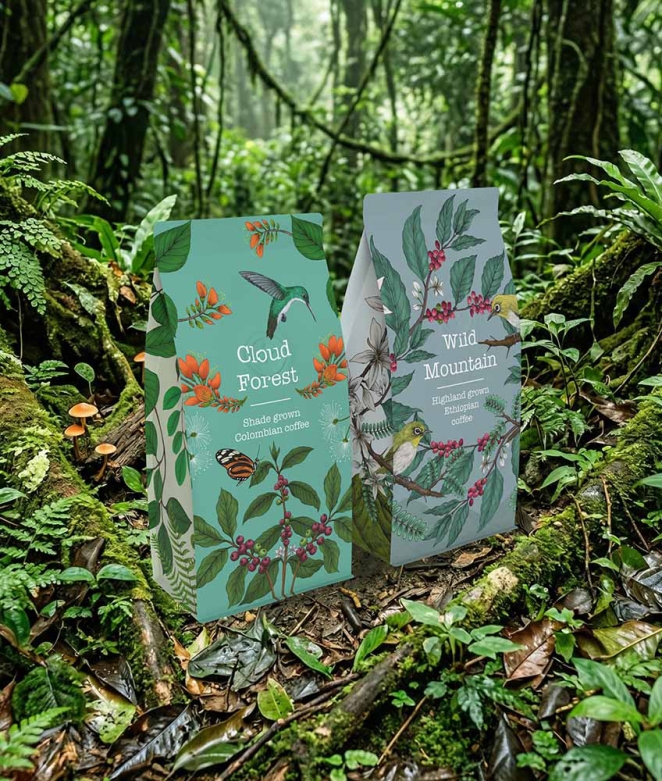
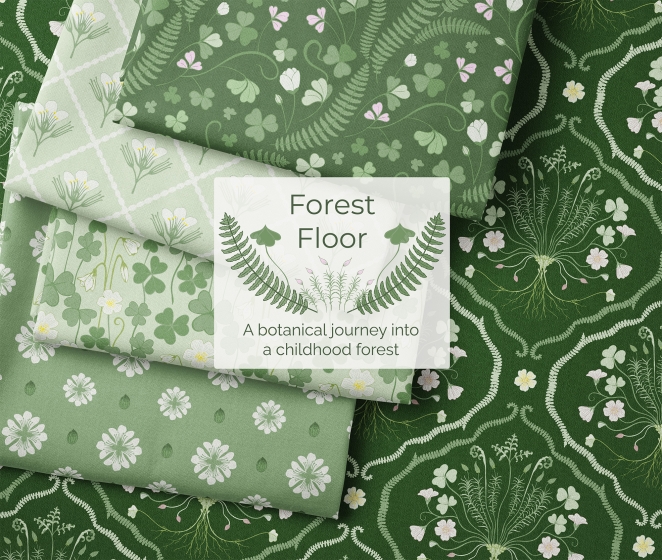
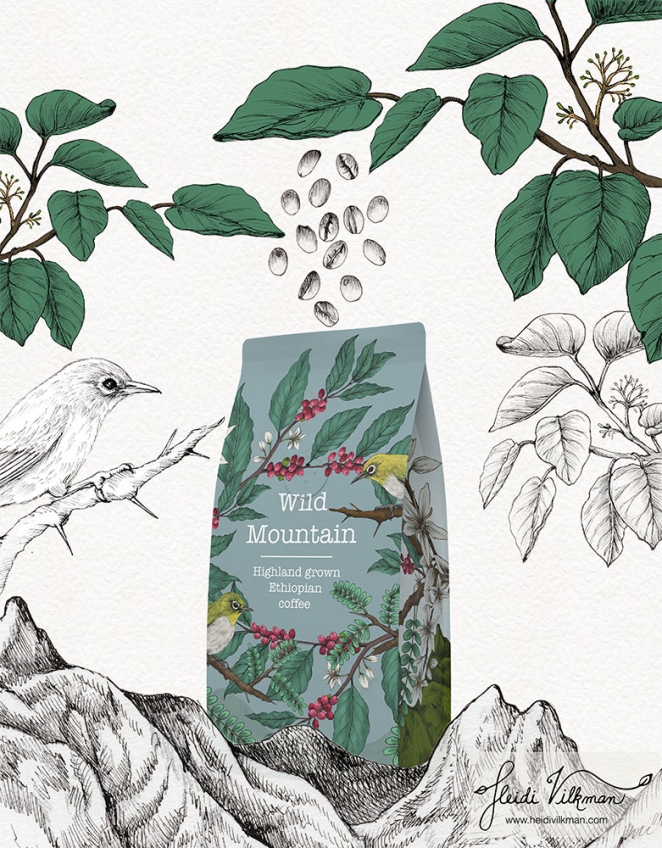
Often the story comes from my own life or background, memories or lived experiences. My print collection, Forest Floor, was inspired by my childhood memories of growing up in a forest in Finland. I then researched the plants I was going to feature through field study and reference images, including vintage botanical illustrations. In the case of Wild Brew packaging, I started with what I don't know. How is coffee produced, and more specifically, how is the most ecologically grown coffee produced? Most packaging shows nothing about the product itself. I wanted to focus on the story of the coffee.
I do a lot of research, in order to find the gold-nuggets I feel are the best vehicles to drive the story. In the case of Wild Brew, I wanted every element in the design to tell the same story, convey the ecology of the place. Not just the coffee but everything that contributes to the life of that coffee, the pollinators, the fertilisers, the location. It's a whole ecosystem. The design became as much about the things growing with and around the coffee as about the coffee plant itself. Sustainability is about a self-supporting system.
From the research, I create a lot of sketches. Not all of them end up in my design, and I make initial versions which I hone in later. In my filmmaking days I learnt not to get too precious about work, so I will get rid of sketches that are pretty but don't contribute. For Wild Brew I drew three hummingbirds, and only one is in the packaging. I make a rough visual map of the composition and alter it as I go along.
Because my work is quite intricate and detailed, and I work in multiple layers in Illustrator and Photoshop, I separate all the elements in the design so they can be altered and repositioned with ease. Even though my work is hand-drawn, my workflow is converted into a digital process after scanning, which means the output is seamless and scalable. Because I work in licensing for multiple industries, I want my designs to be usable in different ways, different compositions and colour combinations.
How would you describe your style?
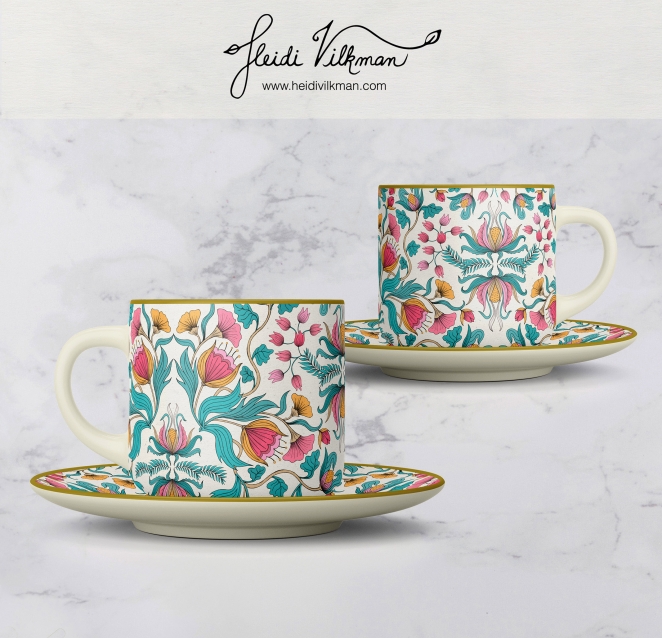
 I describe my style as a mix of nostalgic realism and intentional maximalism. Hand-drawn, rooted in real place or story but full of colour and an abundance of detail. I don't make photo-realistic botanical drawings, they are my personal interpretation of a plant in a particular context. My desire is to make designs that feel uplifting but intriguing, full of colour, full of detail, full of life.
Which individuals do you gain inspiration from? Do you have any heroes in the industry?
My heroes are women creatives, who have managed to break through the male dominated art world and found their own place in it. Women like Louise Bourgeois, Frida Kahlo, Yayoi Kusama
Can you share a memorable experience from your career journey that shaped your approach to creativity?
 I have always loved arts and design but my early career was marred by the need for perfectionism. This can be such a trap for creatives. Discovering clay and ceramics in my thirties really helped me to unravel the need to control everything and return flow to my work in the form of experimenting and play. Sometimes the best learning comes from doing something ‘wrong’. Perfection is just perception.
What kind of tools/kit/software could you not do without?
I love pencil, it was my first love. I cannot imagine working without one, I use a Faber-Castell mechanical pencil. Ink markers come second. White paper stock with slight texture, usually around 200-220gsm. Watercolour pencils and markers, Winsor and Newton and Albrecht Durer. Traditional paints including acrylic, gouache, watercolour, whatever the project needs. X-acto scalpel for paper cutting. After those comes my digital drawing tablet married with Adobe Photoshop, which is where I compile most of my work, Adobe Illustrator is second.
What’s your secret to staying inspired and motivated?
Infinite curiosity, utter stubbornness.
What’s the work achievement you’re most proud of?
 An award I won for a film I made about blind people's dreams, Dreaming Sideways. It was a short documentary about three people who had either no sight or had lost it during their life. Through dream diaries and interviews, I was interpreting the way they experienced these subconscious moments and their life in general. We constructed it backwards, building the soundtrack first and marrying images to it, including animation scratched on film stock. It was recognised with an award for technical and creative excellence. I learnt from that project that storytelling is a very strong vehicle for understanding experiences and conveying meaning. I want to use that same method in my design work, to tell compelling stories and to uplift and connect people.
As someone with experience in the industry, what trends do you foresee shaping the future of creativity?
AI is big at the moment and a lot of people lean into it as a lazy option. Yes, I really think it’s lazy when it comes to design. Original ideas take time, and working them into a print or a product takes even longer. I understand using AI in research, data compilation and concept work but letting it run the show and create designs for humans is backwards. Design is telling stories through images. What stories can AI tell?
I feel this strongly even in my own work. I use AI for research, but I find it difficult to justify at times, because it makes mistakes, assumes and polishes over everything until it all sounds the same. As a writer and creative, you really need to be on the ball to stop that happening. Most people don't seem to bother. I didn't either when I first started using it. If the writing sounds clever and grammatically correct, then for most people that’s enough.
But what is it worth if you are missing in action? What is the point of my writing if I am not in it?
 Despite my reservations, AI is here to stay, in one way or another. I believe that brands, who want to differentiate and create real connection to their customers, will keep choosing story-led human made design.
What do you think sets apart truly exceptional creatives from the rest of the pack?
Originality of thinking, evidence of method, excellence in craftsmanship.
Any websites, books or resources you would recommend?
I love the V&A Sourcebook of Pattern and Ornament. I also love vintage botanical illustration books. I read a fascinating book in the Kew series, Witch's Garden, which is based on the origins and uses of plants in human history, the folklore and stories and beliefs connected to them. When I draw or paint a plant, I love to know what it means and meant to humans, what symbolism is tied to it. Somehow it just makes me draw it better.