
If you’ve spent any time lately talking to freelancers, agency founders or in-house hiring teams, you’ll know the mood around freelance day rates is somewhere between cautious, confused and quietly competitive. Everyone wants a clean number. Very few projects are actually that simple.
The useful version of this conversation isn’t “what’s the one right rate?” It’s what the market is paying for different levels of thinking, craft and accountability.
The ugly truth is that not all creative work is valued in the same way, and the gap between production and strategic problem-solving remains wide.
That's also why freelance hourly rates, freelance rates UK benchmarks and supposedly tidy freelance designer rates lists can be misleading when they’re passed around without context. Salaried workers get paid holiday. In the UK, that means a legal minimum of 5.6 weeks, or 28 days, for a full-time five-day worker. Freelancers don’t.
They also have to absorb their own business costs, allowable expenses, software, equipment, accounting, insurance and downtime between projects. In the UK, self-employed people calculate profits after deducting allowable expenses and, above the relevant threshold, pay Class 4 National Insurance on profits.
In the US, meanwhile, self-employed workers generally pay self-employment tax as well as income tax and usually need to handle estimated tax payments themselves because there’s no employer withholding it for them.
If you don’t build that into your pricing, you’re not being competitive. You’re subsidising your clients.
Average Freelance Day Rates in the UK and US for 2026

Vira Pogromska
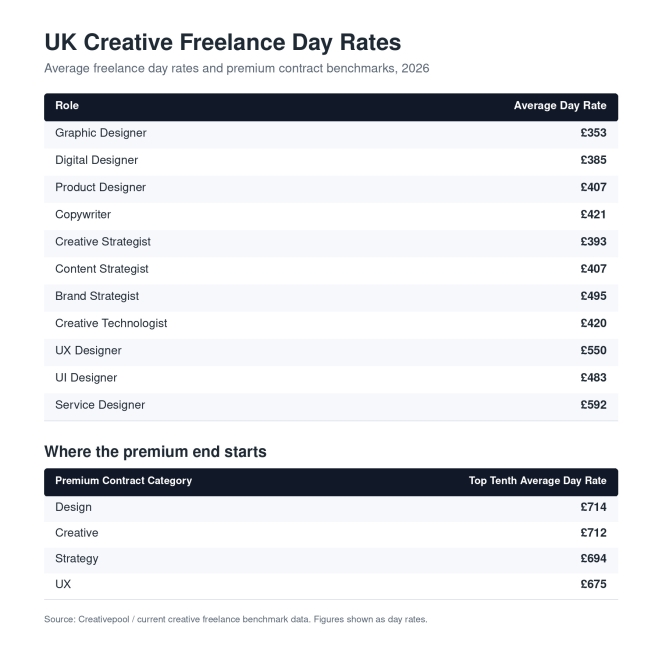
Starting again with the UK, because the day-rate picture is much cleaner there. Current benchmarks show graphic designers averaging £353 a day, digital designers £385, product designers £407, copywriters £421, creative strategists £393, content strategists £407, brand strategists £495, creative technologists £420, UX designers £550, UI designers £483 and service designers £592.
Those numbers aren’t abstract. They’re the market telling us, in real time, how much more clients will pay when a brief moves from “make it look good” into “help us make better decisions, reduce risk and improve performance.”
It’s also worth looking at where the premium end starts rather than where the average sits. The top tenth of contracts average around £714 a day in design, £712 in creative, £694 in strategy and £675 in UX. In other words, the market is already comfortable paying somewhere around the £700-a-day mark when the brief is specialist enough, commercially significant enough or hard enough to fake.
That’s useful perspective if you’ve been told that anything north of £450 feels unrealistic. For plenty of roles, it isn’t.
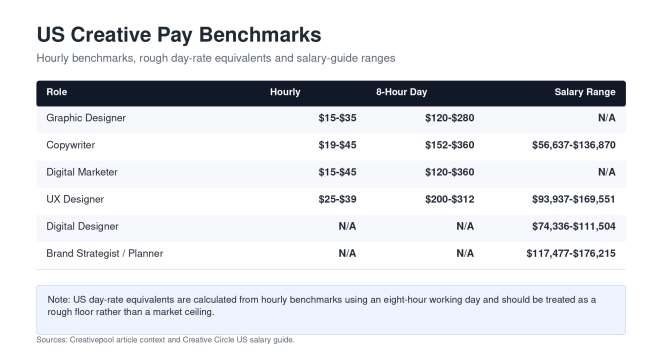
The US is murkier, mostly because the market often publishes hourly or salary benchmarks rather than neat day-rate tables. Median hourly bands sit at around $15–$35 for graphic designers, $19–$45 for copywriters, $15–$45 for digital marketers and $25–$39 for UX designers.
Translated into an eight-hour day, that gives a rough shorthand of $120–$280 for graphic design, $152–$360 for copywriting, $120–$360 for digital marketing and $200–$312 for UX. But that should be treated as a floor, not a ceiling.
Creative salary guides point to a much higher American market ceiling, with digital designers at $74,336–$111,504, copywriters at $56,637–$136,870, brand strategists and planners at $117,477–$176,215, and UX designers at $93,937–$169,551, based on placement pay between July 2023 and March 2025.
The practical takeaway is simple: in the US, it often makes more sense to anchor on hourly or project value first, then reverse-engineer your day rate from there.
Why Freelance Day Rates Vary Across Creative Roles

Zara Picken
Some creative jobs are paid for output. Others are paid for judgment.
That’s the blunt version. The longer version is that a market under pressure will still spend when a freelancer can reduce uncertainty. That’s why strategy and UX continue to sit near the top of the stack in UK freelancer data. Strategy freelancers average £520 a day, brand strategists nearly £500, UX designers £550 and service designers £592.
Compare that with graphic designers at £353 and content writers at £345, and the pattern is obvious. The closer your work gets to research, systems, customer journeys, stakeholder alignment and business transformation, the more clients are prepared to pay.
Product designers command more when they can work across research, systems and training. Service designers charge more when they’re handling transformation projects and stakeholder workshops. UX researchers move up when they bring specialist methodologies or regulated-sector expertise. Creative technologists gain ground when they can bridge emerging technology with real commercial delivery.
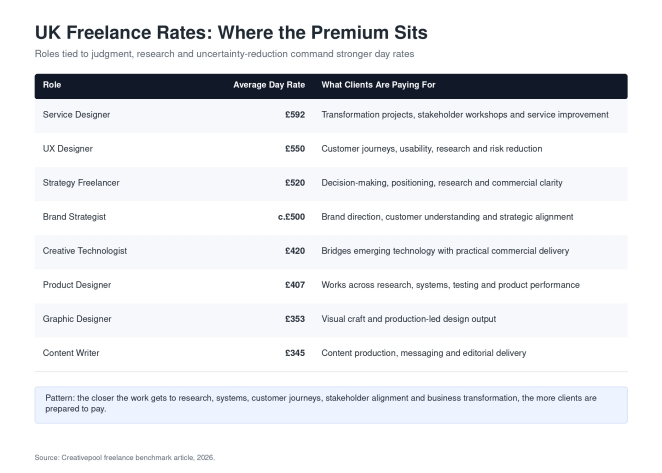
In plain English, the rate rises when the freelancer isn’t just making deliverables, but helping the client think, choose and move.
The US market says much the same thing, just in a different accent. Creative Circle’s salary bands show brand strategists, planners and senior UX roles out-earning a lot of pure production design work. Senior UX designers, for instance, sit at $113,034–$169,551 in its latest guide, while digital designers sit lower at $74,336–$111,504 and mid-level graphic designers lower still at $66,270–$99,405.
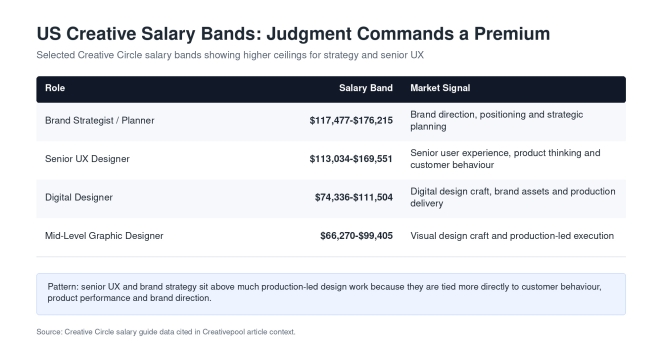
That doesn’t mean design craft isn’t valued. It means the market pays more when design is tied directly to customer behaviour, product performance or brand direction.
Freelance Day Rates vs Hourly Rates: What Makes More Sense in 2026?
Brandon Botha
For most experienced creatives, day rates still make the most sense when the work is embedded, collaborative or fluid. Graphic designers, digital designers, product designers, copywriters, creative strategists, content strategists, service designers, UI designers and UX researchers are all typically priced on a daily basis for longer engagements, with hourly rates reserved for smaller tasks, advisory work or tightly contained consultancy.
That lines up with how creative work actually happens. If you’re inside workshops, Slack threads, presentations and rounds of feedback all day, a clean hourly tally often tells only half the story.
Hourly pricing does still have its place, especially when the scope is uncertain or the work is genuinely intermittent. Upwork’s writing guidance lays out the trade-off well. Hourly rates make it easier to charge for revisions, extra meetings and work that creeps beyond the original brief. They’re also often preferred by enterprise clients.
The downside is just as real: the better and faster you get, the less you earn for your efficiency. And the time you spend on proposals, admin and business development still has to be covered somewhere. Upwork explicitly warns freelancers to account for the gap between hours worked and hours billed. That’s one of the biggest reasons creatives can feel constantly busy while their numbers still look worryingly thin.
Project pricing is where things get interesting. Fixed-fee work can raise your effective hourly return as you get better and quicker, while broader freelancer income reporting suggests that high earners often move away from pure hourly billing towards project-based or retainer models because those decouple income from time invested.
The trick, of course, is scope control. A fixed fee with a loose brief is just another way to undercharge. A fixed fee with sharp deliverables, revision limits and clear approval stages can be a very good business.
The smartest approach in 2026 is usually a mix. Use day rates for embedded team work, strategy sessions, design sprints and anything with a lot of live collaboration. Use hourly pricing for reviews, amends, fractional advisory work and odd jobs that really are measured in small chunks. Use fixed project pricing for tightly definable outputs such as a landing page, email sequence, presentation deck, white paper or campaign toolkit.
The point isn’t to be doctrinaire. It’s to stop using one pricing model for every kind of work simply because it feels familiar.
What Experienced Creative Freelancers Are Charging in 2026

Nicholas Lokasasmita
Once you move past the averages, the premium end of the market becomes easier to see. The top tenth of contracts sit around £675 to £714 a day depending on discipline, while specific specialist roles push higher still. Service designers average £592, UX designers £550 and brand strategists £495 before you even get into unusually high-profile or transformation-heavy briefs.
That’s why the question “what’s a realistic freelance day rate?” needs to be followed immediately by another one: realistic for what kind of problem?
A senior freelancer helping untangle a messy customer journey or reposition a brand is simply not in the same market as someone producing social assets from an established template.
It helps to cross-check those rates against salaried roles. For reference, the current median salaries sit at £33,000 for graphic designers, £31,000 for copywriters, £45,000 for UX/UI designers and £56,250 for product designers.
Some clients look at freelancer pricing and flinch because they’re comparing a day rate against an employee salary without doing the maths properly. But salaried people get statutory paid holiday, and freelancers don’t. Add in National Insurance, allowable business expenses, software, insurance, equipment and gaps between contracts, and the freelance premium starts looking a lot less like a luxury and a lot more like basic arithmetic.
There’s also a more senior layer above mainstream creative freelancing where the numbers stretch dramatically. The Financial Times has reported that high-skilled freelancing in the UK has grown strongly over the long term, citing solo and fractional consultants charging anywhere from roughly £700 to £3,500 a day depending on seniority and background.
That isn’t directly comparable to a freelance designer producing campaign assets, but it does underline a broader truth: the closer your work gets to organisational change, brand risk, growth strategy or board-level decision-making, the less the market cares about the old creative rate card.
On the US side, the same pattern holds. Copywriters earn between $56,637 and $136,870 depending on level, brand strategists and planners, meanwhile, sit at $117,477 to $176,215, senior UX designers at $113,034 to $169,551, and creative directors higher again.
Freelancer hourly ranges are at around $20–$30 for entry-level, $30–$50 for intermediate and $50–$150 for experts. Its graphic designer guidance similarly says designers may bill anywhere from $15 to $150 an hour, with more seasoned designers or art directors earning at the top because they move faster and bring more value.
That’s the real pattern of experienced freelance charging in 2026. It’s not simply “more years equals more money.” It’s “more commercial leverage equals more money.”
Why Some Freelancers Charge More Than Others

Leandra Meintjes
Usually, it’s not because they’re chancers. It’s because they understand what’s actually being bought.
Consistent rate multipliers tend to be specialism, track record, brand experience, regulated-sector knowledge, workshop leadership, research capability, strategic input and the ability to work across channels or disciplines. That appears in copywriting, digital design, product design, brand strategy, content strategy, service design, UX research and creative technology alike.
A freelancer who can sit in a room, ask the right questions, define the shape of the problem and then execute the answer will inevitably charge more than someone who only delivers the final asset.
Clients paying higher rates also expect a different kind of working relationship. In practice, that means the higher-paid freelancer is usually expected to brief better, anticipate issues sooner, require less hand-holding and leave the project in a stronger state than they found it. They’re not just selling time. They’re selling confidence.
There’s a less glamorous point here too. Higher day rates often come from being easier to trust. Cleaner scoping. Faster decisions. Better decks. Better meeting craft. Better follow-through. The market doesn’t always reward the most flamboyant portfolio. It very often rewards the person who makes a fraught project feel calmer and more solvable.
That’s especially obvious in roles like strategy, service design and senior UX, where those pricing premiums show up again and again in the data.
Common Mistakes Freelancers Make When Setting Their Rates

Khudayar Aghayarov
The first mistake is using an old salary as the only benchmark and dividing it by the number of working days in the year. That’s the quickest way to arrive at a number that feels logical and is completely wrong.
Salaried workers get paid leave. UK employees get at least 28 days of statutory holiday in a standard full-time pattern. Freelancers fund their own gaps, gear and admin. In the UK, they also need to account for allowable expenses and National Insurance on profits. In the US, self-employed workers need to factor in estimated taxes and self-employment tax on top of ordinary income tax.
If your rate doesn’t reflect that, it isn’t clever pricing. It’s wishful thinking.
The second mistake is ignoring non-billable time. Billable hours are not the same as hours worked. Marketing yourself, writing proposals, taking meetings, chasing late payments, updating your portfolio and doing admin are part of the job whether anyone pays you for them directly or not.
If you can only bill thirty hours in a forty-hour week, your “nice” hourly rate may already be too low before you’ve even paid for software or tax.
The third mistake is leaving too much inside the number. Research time, revision rounds, rush deadlines, stakeholder workshops, implementation support, travel and usage rights all change the value of the job.
If you keep rolling all of that into one flat day rate with no guardrails, you’ll keep discovering that “well-paid” jobs somehow aren’t that profitable after all.
The fourth mistake is staying too general for too long. The data is clear enough on this. In the UK, service design, UX and strategy outpace broad design and general content work. In the US, brand strategy, UX and senior creative leadership outpace a lot of production-focused roles too.
That doesn’t mean everybody should suddenly rebrand themselves as a strategist. It means the people being paid more are the ones who can point to a sharper edge in their skill set and a stronger business case for bringing them in.
How to Use Creativepool to Find Your Perfect Freelancer
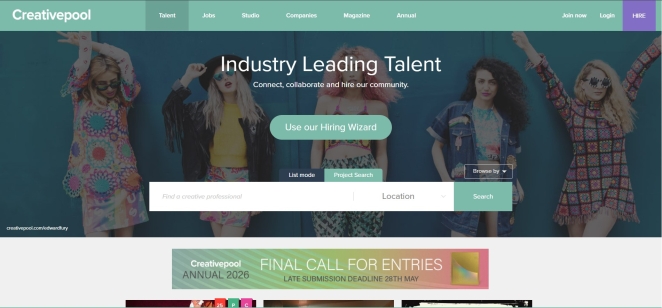
Finding a freelancer should never be treated as a quick keyword search followed by a prayer. The difference between a useful freelance hire and an expensive misfire usually comes down to how well the client understands the problem before they start looking. Creativepool is built around that idea: it lets clients hire creative employees, freelancers or agencies, post jobs and gigs, search for talent, and browse a creative community where profiles, portfolios and professional context sit together rather than being scattered across a dozen tabs.
That matters because the best freelance hire isn’t always the most obvious one. A brilliant illustrator, UX researcher, copywriter, creative director or brand designer won’t necessarily appear under the same tidy label every time. On Creativepool, talent profiles surface role tags, locations, portfolio material, career summaries, rankings, CVs, reels and connect options, which makes it easier to judge someone by the work they’ve actually done rather than just the job title they happen to use.
The smart way to use Creativepool is to start with the brief, not the search box. Are you looking for someone to execute a clearly defined design asset? Do you need a freelancer to join an existing agency team for a sprint? Are you trying to solve something more strategic, such as a brand positioning issue, a customer journey problem or a campaign idea that still hasn’t quite found its shape? Creativepool gives buyers routes to advertise a job, advertise a gig or search for talent directly, so the right approach depends on whether you already know what you need or whether you want the market to show you who’s available.
For a contained freelance project, a gig-style brief is usually the cleaner route. Be specific about the deliverables, timings, usage rights, stakeholder process and budget range. A vague “we need a designer” brief will attract vague responses. A brief that explains the audience, context, commercial objective and decision-making process is much more likely to attract freelancers who can price properly and deliver without endless scope drift.
For more senior or specialist work, search and shortlist with a little more patience. Look at the quality of the portfolio, but also look at the shape of the work. Has this person handled similar sectors? Do they show strategic thinking as well as execution? Are there signs of collaboration, leadership or client-facing experience? Creativepool’s profile format helps here because it brings together the kind of information clients actually need: work, biography, skills, location, CV or reel material, rankings and ways to connect.
It’s also worth remembering that Creativepool is not only a freelance directory. It’s a creative industry network. The platform positions itself as connecting brands, agencies, creative companies and talent, and its homepage explicitly points buyers towards hiring freelancers, employees and agencies. That makes it useful when the brief could go in more than one direction. A brand might begin by looking for one senior freelancer, then realise the project needs a small creative team or agency. Equally, an agency might use it to find a specialist freelancer for a very particular gap in a pitch, campaign or production workflow.
The real advantage is confidence. Rates make much more sense when you can see what someone has done, how they present their thinking and whether their experience matches the risk of the job. If you’re paying a premium day rate, you’re not just buying time. You’re buying judgment, reliability and the ability to make a project less chaotic. Creativepool gives clients a better chance of spotting that before the first call.
How to Maximise Your Creativepool Profile as a Freelancer
Andre Cruz
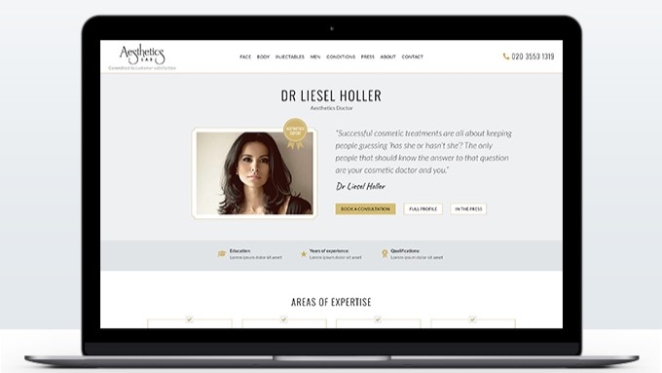
For freelancers, a Creativepool profile shouldn’t be treated as a dusty online CV. It should work more like a living portfolio, a positioning tool and a business development page rolled into one. Creativepool itself describes profiles as mini websites that combine a résumé, portfolio and social network, and that’s exactly how freelancers should think about them.
That starts with clarity. If your profile tries to make you look available for every possible kind of work, it’ll probably make you memorable for none of it. A strong freelance profile should make three things obvious within seconds: what you do, who you do it for, and what kind of problems you’re especially good at solving. “Freelance designer” is fine as a category. “Brand identity designer for hospitality and lifestyle businesses” is stronger. “Senior UX researcher helping fintech teams reduce product risk before build” is stronger again.
Creativepool profiles can include portfolio work, CV material and, where relevant, reels, so the aim should be to build a page that proves your positioning rather than merely listing your availability. If you want higher-value brand strategy work, don’t just upload the finished identity system. Explain the brief, the problem, the thinking and the result. If you want UX projects, show the research, constraints, decisions and commercial context. If you want copywriting retainers, show tone of voice range, sector understanding and the impact of the work.
The profile also needs to be maintained. Creativepool’s own member guidance points users towards Profile Settings as the place to start filling out and improving their public profile, and that’s a useful reminder that visibility is rarely a one-off job. Freelancers should revisit their profiles regularly: update the bio, refresh the skills, remove weaker legacy projects, reorder the portfolio around the work they want more of, and make sure the profile doesn’t undersell their current level.
That last point matters because freelance rates are partly about perception. If your profile makes you look like a general pair of hands, clients will price you like one. If it shows a clear specialism, credible case studies, relevant credits and evidence that you can handle complexity, your rate becomes easier to justify before you’ve even had the first conversation.
Creativepool’s company Pro information also gives a useful clue about how the platform values visibility and content. Paid company features include unlimited project uploads, custom web addresses, sector and skills visibility, follower email tools, access to studio briefs, stronger directory placement, profile management, article support and profile-view insight, depending on package level. Not every freelancer will need paid visibility tools, of course, but the underlying principle still applies: the more complete, current and searchable your presence is, the more likely it is to work commercially.
Freelancers should also treat Creativepool as a network, not just a noticeboard. The platform encourages creative talent to showcase work, apply for vetted jobs and gigs, get connected and keep up to date with opportunities. That means a strong profile is only one half of the job. The other half is activity: connecting with relevant people, applying selectively, keeping work fresh, using credits properly, and making sure the profile reflects the kind of freelancer a client would feel safe hiring.
The best Creativepool profiles don’t simply say “I’m available.” They answer the quieter client question underneath: “Can I trust this person with the brief?” For freelancers trying to move beyond average day rates, that’s the question that really matters.
Open Questions and Limitations
Natalia Talkowska
One limitation in this market is that UK freelance day rates are much better documented than US ones. YunoJuno gives a strong UK day-rate view, but much of the US market still surfaces as hourly bands, salary guides or platform-wide contract data.
Upwork also notes that some of its rate ranges reflect historical contracts worldwide, which means they’re useful as directional benchmarks rather than the final word on what an established US specialist should charge. And, as ever, published averages can understate what happens on confidential retainers, transformation projects or briefs involving licensing and high commercial risk.
That said, the shape of the market is clear enough.
The best freelance day rates and freelance hourly rates in 2026 don’t come from copying somebody else’s spreadsheet and hoping for the best. They come from understanding your cost base, your non-billable time, your level of specialism and the value your work creates.
If you want a practical freelance rates UK benchmark, the current market says production-heavy design still tends to live in the mid-£300s a day, broader creative work around the high-£300s, and strategy and experience-led roles comfortably in the £500-plus bracket. The best freelance designer rates climb well beyond that when the brief moves into research, systems and business transformation. In the US, the smartest move is often to set the value hourly or by project first, then build the day rate from there.
Either way, the number only really works when it reflects what you’re solving, not just what you’re making.