
Any worthwhile creative salary survey in 2026 has to begin with a truth the industry doesn’t always love saying out loud: creative pay is still rising, but for a lot of people it doesn’t feel like progress. Salaries are moving. Inflation has eased compared with the worst of the recent squeeze. Employers are still hiring in design, digital and strategy. And yet a huge number of designers, creatives and strategists remain unconvinced that the money properly reflects the work, the pressure or the expectations attached to the job.
In the UK, permanent salary growth has slowed to just 1.7%, while only 2.4% of permanent employees say they feel paid what they’re worth. That’s not the language of a market in cheerful equilibrium. It’s the language of a market that is functioning, but grumbling and a market that's rewarding expertise much more eagerly than it's rewarding mere experience.
This is why searches creative salary searches aren’t really about idle curiosity. They’re about whether a career in the creative industries still stacks up. They’re about whether a move from agency to in-house is worth it, whether a jump from brand design into UX might finally shift someone into a better pay bracket, and whether titles that sound glamorous on LinkedIn are actually translating into a life that feels stable.
A decent salary guide should help answer those questions without pretending there’s one neat global number that covers everyone from a junior designer in Leeds to a senior UX lead in London. There isn’t. There never was. But we can, at least, use the figures available to us to make something more than an educated guess.
Creative Salary Survey 2026: Key UK Salary Findings

Kostis Petridis
The broad UK picture is clearer than the industry mood might suggest. Median gross annual earnings for full-time UK employees who had been in their jobs for at least a year reached £39,039 in April 2025, up 4.3% from £37,439 a year earlier. Median weekly earnings for full-time employees rose 5.3%, and median hourly earnings excluding overtime rose 5.4%.
Those are real increases. They are not imaginary. But they also don’t automatically translate into a sense of abundance, especially in sectors where expectations have ratcheted up just as quickly as pay packets.
The creative sector itself looks flatter. Salary growth in the creative industries has fallen sharply from the previous year, with day-rate growth slowing to 1.2% and 60% of businesses struggling to manage salary expectations. That tells its own story. Employers want control. Talent wants recognition. Nobody feels totally unreasonable, which is usually the sign of a strained market rather than a broken one.
It's worth also noting that salaries exclude bonuses and benefits. This matters because a lot of the real negotiation in 2026 is happening in the gap between base pay and total package. A role that looks slightly weaker on salary alone can start to look much better when hybrid working, pension, progression or bonus structure come into view.
Craft still matters, but craft tied to performance, product, data, customer experience or strategic clarity is where the premium is most obvious.
Graphic Designer Salary UK: Average Salaries in 2026

Jean Jullien
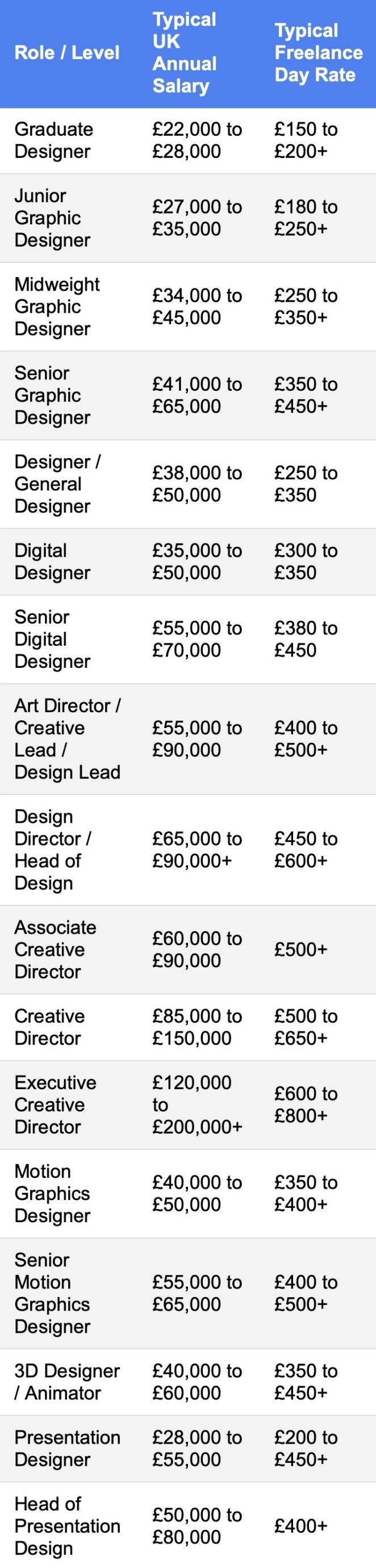
For anyone searching for a graphic designer salary in the UK, the honest answer in 2026 is still the least tidy one: it depends. It depends on seniority, location, agency versus brand-side, whether the role is permanent or freelance, and, increasingly, whether “graphic designer” still means classic design or something much more hybrid.
One thing you'll notice in the table below is the gap between the lower and upper benchmarks and this really matters. It shows how much context now shapes pay. A designer in a smaller studio, a generalist agency role or a regional business may sit close to the national median. A designer in a high-performing brand, digital product environment or integrated creative team may command considerably more.
Overall, hiring has strengthened particularly within in-house brand teams, while social-first briefs, motion capability, platform fluency and AI integration are becoming baseline expectations rather than nice extras.
That is the key point for graphic designers in 2026. “Graphic designer” is no longer one clean job title. In one business it still means brand, print, layout and campaign assets. In another it means Figma collaboration, social-first content, light motion, presentation design, digital production, AI-assisted concepting and enough strategic judgement to understand how the work will live across platforms. This is also why freelance rates vary so widely.
So, the useful answer is not simply that graphic designers in the UK earn “about £35,000” or “about £50,000.” The useful answer is that the classic graphic design ladder still exists, but the premiums are moving elsewhere. Designers who remain narrowly executional are more likely to sit in flatter salary bands.
Designers who can combine strong visual craft with motion, digital systems, campaign thinking, AI fluency, social content and brand-side commercial awareness are much better placed to push above the average.
In other words, graphic design iremains a viable, respectable profession in both the UK and the US, but it no longer enjoys automatic premium status simply for existing. The more a graphic design role expands into digital systems, campaign thinking, content production or product-adjacent work, the easier it becomes to command better pay. The more narrowly it remains classic executional design, the more it risks sitting in a flatter band.
Graphic Designer Salary UK: 2026 Benchmarks
Creative Strategist Salary UK: Strategy Still Pays for Judgement in 2026

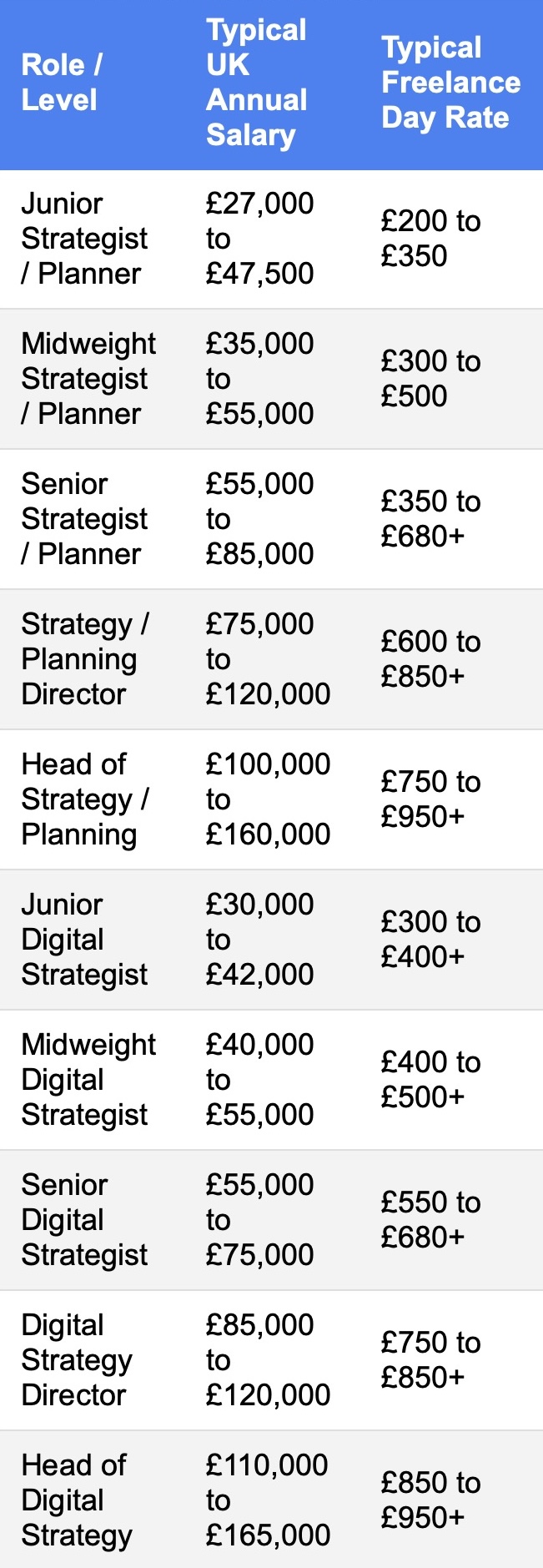
If graphic designer salary UK searches are often about fairness, creative strategist salary searches are usually about something slightly different: where the market starts paying for judgement. And in 2026, judgement still commands a clear premium.
Strategy remains one of the stronger-paying creative disciplines because it sits closer to decision-making, positioning, growth and commercial risk. The obvious reason is that strategy is still expensive when it is genuinely useful. Businesses will tolerate a surprising amount of aesthetic debate, but they are much less relaxed about uncertainty.
A strategist who can sharpen a brand’s position, stop a campaign drifting into fog, align a messy stakeholder group and give creative teams something solid to build from is not being paid for cleverness alone. They are being paid for reducing risk and improving the odds that expensive work lands properly.
That matters even more in a cautious market. The UK Government’s Creative Industries Sector Plan positions the sector as a long-term growth priority, with the ambition to make the UK the leading global destination for investment in creativity and innovation by 2035.
But inside that growth story, businesses are making more selective hiring decisions. This is particularly relevant in an industry under pressure from AI, offshoring, consolidation and tighter margins, with many agencies relying on project-based work and more brands building in-house capability.
That is where strategy becomes commercially valuable. In a market where permanent salaries are rising slowly and freelance rates are under pressure, businesses are still willing to invest in people who can make work more effective, not just more attractive.
The most valuable strategic profiles are increasingly those who can operate across commercial context, brand thinking, platform behaviour, audience insight and measurable outcomes. Strategy is no longer just the planner with a stack of decks and a fondness for a four-quadrant diagram. It is closer to growth, product, customer experience, performance and organisational decision-making.
So, the useful answer is not simply that creative strategists earn more than designers or copywriters. The useful answer is that strategy is paid better when it is closer to consequence. The strategist who only produces abstract thinking may still struggle in a market obsessed with efficiency. The strategist who can diagnose the problem, frame the opportunity, understand the audience, guide the creative work and connect it all back to commercial value is still in a very strong position.
In 2026, the premium is not on “having opinions.” It is on having judgement that helps businesses make better decisions. If there’s a common thread here, it’s that strategy roles tend to earn well because they sit close to decision-making. That is increasingly the dividing line across the entire creative economy.
The closer someone gets to defining priorities, shaping investment, interpreting audience behaviour or steering large pieces of work, the more their salary tends to move. Execution is still needed. Greatly needed. But direction remains the scarcer commodity.
This is also why strategy has become such an attractive refuge for mid-career creatives who feel their original discipline has flattened financially. Designers edge into brand strategy. Copywriters slide into content strategy.
Digital leads absorb customer experience and insight work. Sometimes that’s because they’re genuinely fascinated by the bigger picture. Sometimes it’s because they’ve noticed where the money went. Often it’s both.
Creative Strategist Salary UK: 2026 Benchmarks
Digital Designer Salary UK: Why Digital, UX and Product Skills Command a Premium

If there is one part of the market that best explains how creative pay has changed, it is digital design. The old hierarchy, where traditional design leadership sat comfortably at the top and digital execution sat somewhere below it, has been breaking down for years. By 2026, it looks increasingly outdated.
The UK’s wider creative economy is still being framed as a national growth priority. The government’s Creative Industries Sector Plan aims to make the UK the leading global destination for investment in creativity and innovation, with a target to significantly increase investment by 2035.
But inside that growth story, the salary data shows a clear shift: the biggest premiums are increasingly going to the people who can connect creativity to digital products, platforms, data, customer experience and measurable commercial outcomes.
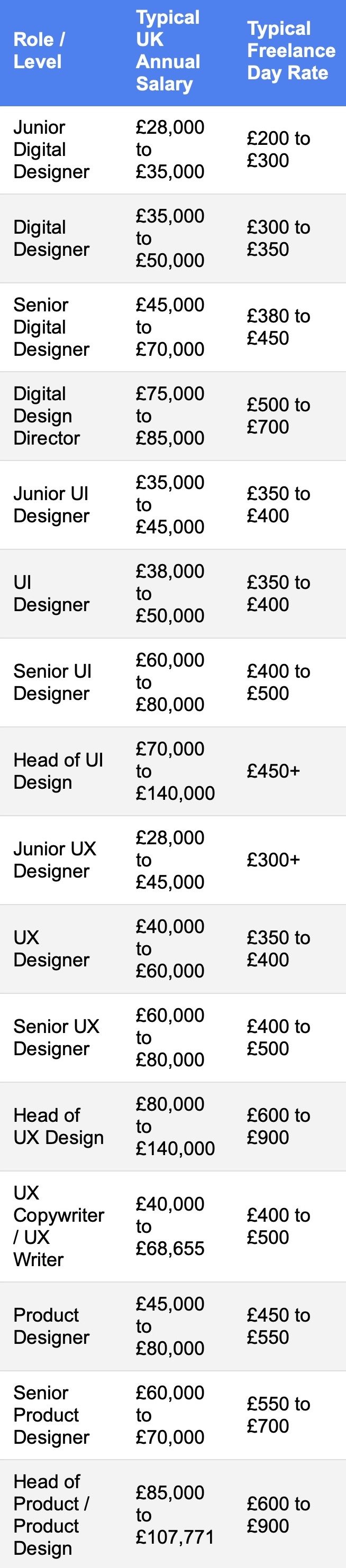
Digital designer salary UK searches are often leading people toward some of the strongest salary bands in the wider creative market, especially once digital design shades into UX, UI, product design and service thinking.
The designer who can make something look good is still valuable. The designer who can make something easier to use, easier to buy, easier to navigate, easier to understand or easier to scale is increasingly easier to justify on a balance sheet.
Why the gap between digital and traditonal though? Mostly because businesses have become much more comfortable measuring value in digital environments than they are in traditional brand environments. A stronger onboarding flow, a better interface, a clearer user journey or a more intuitive product experience can be tied to retention, conversion, revenue, satisfaction or support costs. That makes the salary case easier.
It does not mean brand design has become less culturally important. It means product, UX and digital design have become easier to defend financially. In 2026, that distinction matters. Major Players notes that platform fluency, motion capability and AI integration are becoming standard expectations for creative candidates, while Aquent’s guide shows salary growth continuing to concentrate around technology, experience, product design, performance and analytics.
The result is a market where “digital designer” no longer means the person who takes a finished idea and adapts it for screens. It increasingly means someone who understands systems, interaction, behaviour, content, platforms, accessibility, conversion and the commercial consequences of design decisions. That is why digital design pay is not just a little higher than classic design in many cases. It is part of a structural shift in how creative value is being priced.
Digital Designer Salary UK: 2026 Benchmarks
Salary Benchmark UK: Agency vs In-House Creative Salaries

Scott Balmer
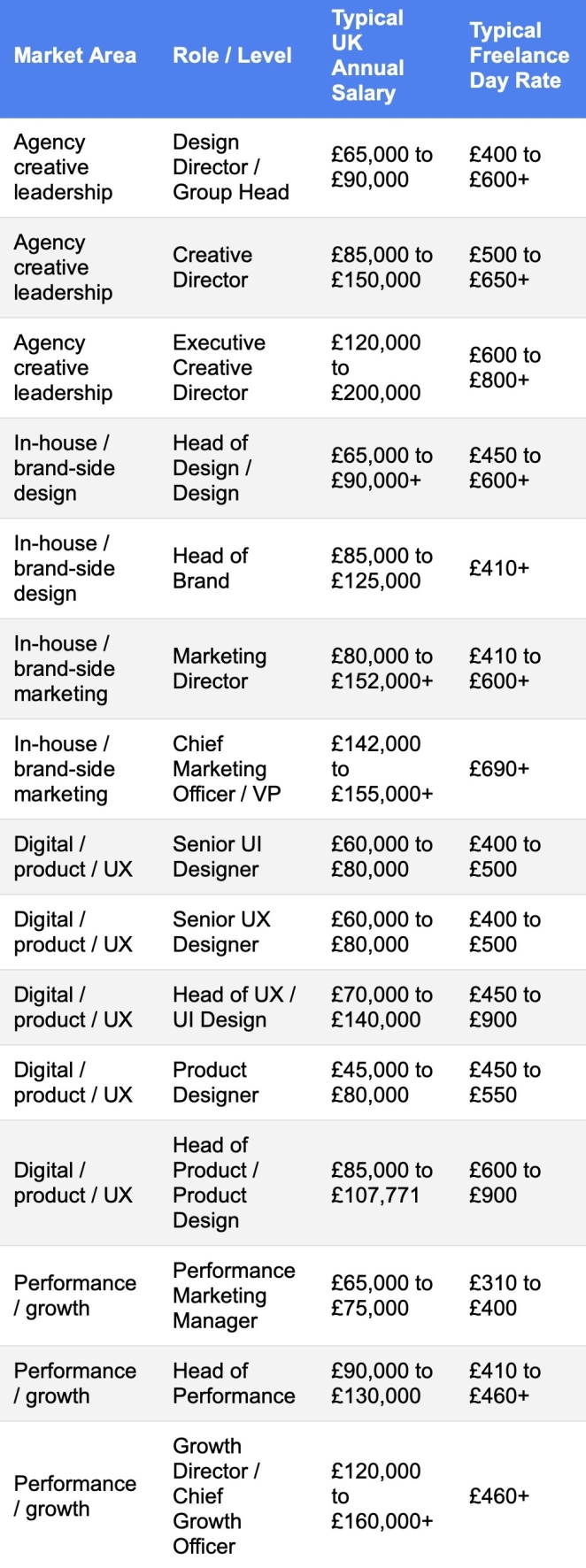
People love asking whether agency or in-house pays better because they want a clean answer. The annoying thing is that the real answer is more conditional than dramatic. In both cases, there is good money available. But the premium is no longer attached to the word “agency” or “in-house” by itself. It is attached to seniority, specialism, commercial usefulness and how close the role sits to measurable business value.
Agency environments can still pay very strongly at the top of creative leadership, especially in high-profile shops, network agencies, specialist studios and businesses where the creative product is still the thing being sold.
In other words, agency-side creative leadership has not stopped being valuable. The higher up the ladder someone goes, the more the market pays for taste, judgement, client confidence, team leadership and the ability to turn ambiguity into work that can actually be made.
But the old assumption that client-side means safer, duller and less creatively serious looks increasingly out of date. Most brands now have fully or partially in-house teams, while only a handful rely heavily on agency support. Brand-side workers also now earn, on average, £2,600 more than their agency counterparts, with the gap reaching up to £9,200 in sectors such as SaaS and technology. That does not mean every in-house designer earns more than every agency designer. It does mean the centre of gravity has shifted.
The reason is fairly simple. Many brands no longer see creative capability as something they rent only when they need a campaign. They are building brand, content, product, UX, performance and customer experience capability inside the business. That makes certain in-house roles much more commercially embedded than they used to be.
A Senior UI Designer, Product Designer, CRM specialist, Head of Brand, Performance Marketing Manager or UX Lead may be working directly on conversion, retention, customer journeys, platform experience or revenue growth. Those are not consolation-prize jobs. They are often closer to the machinery of the business than traditional agency roles.
That does not mean creative and brand roles are losing relevance. It means pay growth is being redistributed toward roles that can connect creativity to systems, platforms, data and commercial performance.
This is where the “agency or in-house?” question starts to fall apart. A junior designer in a small agency, a senior designer in a global brand team, a UX lead inside a SaaS business and a Creative Director at a respected independent studio are not really in the same market. They might all sit under the creative industries umbrella, but they are being valued according to different business needs.
We're looking at a sector being reshaped by in-housing, project-based models, offshoring, AI adoption and agency margin pressure. 43% of agencies describe their pipeline as unstable, while 39% have already outsourced talent internationally. At the same time, in-house capability is expanding as brands seek more direct control over content, performance and customer experience. That helps explain why the salary premium is increasingly attached to usefulness rather than environment.
The UK Government’s Creative Industries Sector Plan adds the wider backdrop. The plan aims to make the UK the world’s leading destination for investment in creativity and innovation and significantly increase investment by 2035. It also frames the creative industries as a growth-driving sector, with policy attention on innovation, skills, access to finance and regional growth.
So yes, agencies can still offer strong pay, especially at senior creative and strategic levels. They can also offer variety, cultural cachet, a portfolio of brands and the kind of creative intensity that still attracts ambitious talent. But in-house roles increasingly offer competitive salaries, clearer commercial influence, stronger proximity to decision-makers and, in some cases, more stable progression routes.
There is also the matter of lifestyle, which many salary conversations pretend not to be about while being almost entirely about it. Gabriele notes that salary is now only one part of the decision, with flexible and hybrid working, holiday, healthcare, development, wellbeing initiatives and culture playing a critical role in how candidates assess offers.
In 2026, total value matters more than ever. A role paying slightly less cash can still be the stronger move if it gives someone a saner week, better development, clearer progression, stronger leadership or less of that familiar low-level sense that work is eating their entire personality.
The better question is not whether agency or in-house pays better. It is whether the role pays properly for the value it expects someone to create.
Agency vs In-House Creative Salaries: 2026 Benchmarks
Creative Designer Salary by Experience: Why Seniority Is Really About Trust

The most useful way to understand a creative designer salary in 2026 is by looking at what actually changes as someone becomes more senior. Time alone does not do the trick. Titles alone definitely do not. What moves the money is not simply that someone has been around for longer, but that they are trusted with more consequential decisions.
At junior level, designers are usually paid for potential, taste, craft and execution. At midweight level, they are paid for reliability: the ability to take a brief, solve the immediate problem, work with fewer interventions and keep quality consistent.
At senior level, the market starts paying for judgement. Designers stop being paid only to make things and start being paid to shape what gets made, why it gets made and how confidently it gets defended.
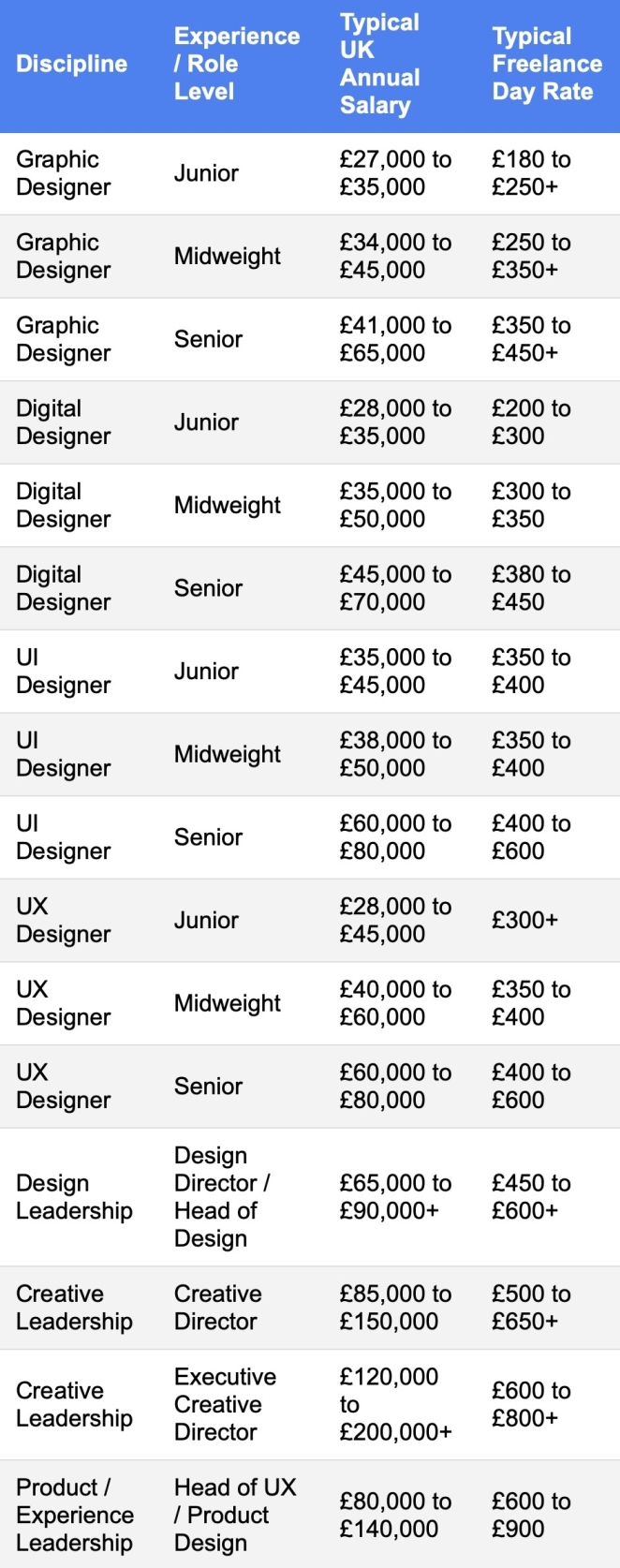
Across the 2026 UK salary surveys, the design ladder remains fairly legible. Junior Graphic Designers sit at a median of £31,335, Midweight Graphic Designers at £35,884 and Senior Graphic Designers at £41,681.
That gives a useful national baseline, but it also shows the limits of a purely executional design track. The steps are real, but they are not huge. The curve steepens only when the role starts to absorb more ownership, digital capability, strategic input or leadership responsibility.
Social-first briefs are now the default, motion and animation have moved from specialism to baseline expectation, and AI fluency is increasingly expected as part of modern creative output. That is why digital experience changes the salary curve.
It's the same story told in a different accent: the more the role blends design with direction, research, systems, product thinking or business responsibility, the more convincing the salary becomes. A beautifully crafted layout still has value.
A designer who can shape a customer journey, improve a product experience, build a scalable design system, understand platform behaviour or explain why one creative route is strategically safer than another becomes easier to pay more.
The wider market context matters too. The UK Government’s Creative Industries Sector Plan positions the sector as a long-term growth priority and aims to make the UK the leading global destination for investment in creativity and innovation by 2035. But within that growth story, salary increases are becoming more selective.
That spread is worth paying attention to because it explains a lot of the emotional weather around creative pay. Juniors are often underwhelmed because the entry point feels low relative to the polish employers now expect. Midweights become restless because they can see the next band but not always the route into it. Seniors can still earn well, but usually once they are no longer valued solely as talented hands.
Somewhere between “great at the work” and “trusted to steer the work” is where the salary curve really starts to steepen. In 2026, the market is not just paying for experience. It is paying for experience that reduces risk, improves decisions, widens capability and gives creative work a better chance of mattering.
Creative Designer Salary by Experience: 2026 Benchmarks
Highest Paid Creative Jobs: Where the Salary Premium Sits in 2026

Ashley Gray
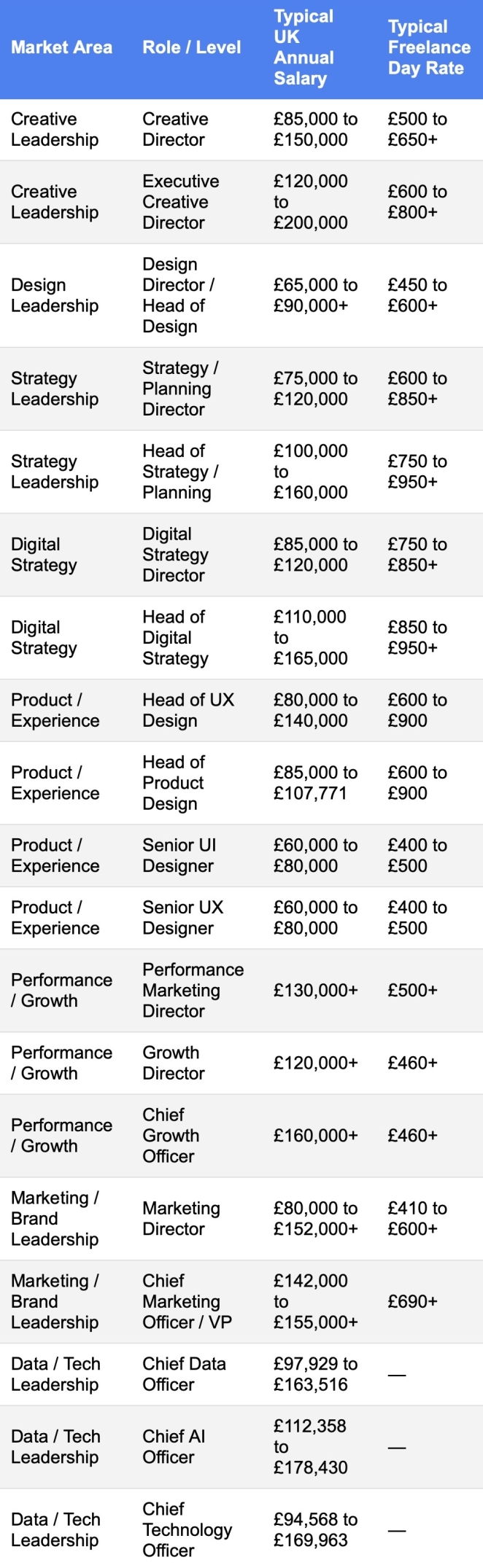
This is where the answer becomes almost boringly consistent. Across the 2026 salary data, the highest-paid creative jobs tend to cluster around three areas: leadership, strategy and digitally measurable design work. The market still values ideas, craft and taste, but the biggest salaries increasingly sit where creativity meets commercial consequence.
That wider shift sits inside a sector that is still being treated as strategically important. The UK Government’s ambition is to make the UK the number one destination worldwide for investment in creativity and innovation, while significantly increasing investment by 2035.
But this growth story is not being spread evenly across every creative role. Pay is concentrating around the roles most clearly tied to business value, digital capability, data, leadership and transformation.
That does not mean brand or content work has stopped mattering. It means the market is paying more aggressively for roles that can connect creativity to systems, products, performance and measurable outcomes.
These are not all “creative” roles in the old-fashioned sense, but that is precisely the point. The best-paid roles are often the ones where creative judgement merges with growth, product, brand, customer experience or commercial accountability.
In practical terms, this means the closer a design role gets to customer journeys, conversion, retention, product experience or platform performance, the stronger the salary case becomes.
So, while there is still plenty of romance in the creative industries about pure talent, the pay data is much less sentimental. It likes ideas. It likes taste. It likes originality. But it loves leadership, structure, product logic, research, audience intelligence, data fluency and results it can point at.
In 2026, the highest-paid creative jobs are not always the ones with the most traditionally glamorous titles. They are the jobs where creative thinking has a direct line into how brands grow, how products work, how customers behave, how teams perform and how businesses make better decisions.
Highest Paid Creative Jobs UK: 2026 Benchmarks
Are creative salaries increasing in 2026, or just standing still more expensively?

Pranav DP
The answer, infuriatingly, is both. Yes, salaries are increasing. But no, it doesn’t feel like a boom, because the increases are selective, cautious and often swallowed by broader expectations about performance, availability and skill expansion.
That helps explain why so many people feel underpaid even when they have had a raise. What they are often reacting to is not just the number itself, but the ratio between compensation and complexity.
Their job title may not have changed much, but the role now includes more platforms, more content formats, more reporting, more stakeholder management, more speed, more AI literacy and more tolerance for ambiguity. In that context, a modest increase can feel less like recognition and more like a gesture.
There’s also a simple market truth underneath all this. The premium has shifted away from generic capability and towards specialist usefulness.
How Creativepool Can Help You Find a Job That Matches Your Salary Expectations
Caroline Brown
A salary benchmark is useful, but it only becomes properly useful when it starts shaping real decisions. Knowing the going rate for a senior designer, creative strategist, UX lead or digital designer is one thing. Finding a role that actually respects that value is another.
That’s where Creativepool can be genuinely helpful for creative talent. The creative jobs board is built specifically around the creative industries, rather than treating design, strategy, advertising, content, digital and production roles as a slightly decorative subsection of a generic job site.
Creativepool’s jobs section allows talent to browse live opportunities by job title, company and location, with roles spanning permanent, remote, freelance and contract work. Many listings also include salary or budget information, making it easier to compare opportunity against expectation before investing time in an application.
That matters because salary expectations are not just about wanting “more money.” They’re about knowing what kind of market someone is actually operating in. A midweight designer looking at senior roles can compare the language of those job descriptions with the benchmarks in this article. A strategist can see whether a role is really strategic or just account handling with a better title. A UX designer can judge whether the salary matches the level of research, product responsibility and stakeholder complexity being asked of them.
Creativepool’s role-specific job pages can also help talent get a clearer sense of live demand. For example, the site has dedicated pages for graphic design jobs, creative jobs, motion graphics jobs, digital editor jobs and other creative specialisms, each showing current opportunities in that area. For anyone trying to work out whether their salary expectations are realistic, that live market view is often more revealing than another abstract average.
The profile side matters too. Creativepool is not only a place to apply for jobs; it’s also a place to be found. Building a strong Creativepool profile gives employers and recruiters a clearer view of someone’s portfolio, experience, discipline and creative point of view before the formal hiring process begins. That’s particularly important in a market where the best-paid roles tend to reward evidence rather than aspiration. Saying “senior” is easy. Showing senior-level thinking, polished case studies, measurable outcomes and strong creative judgement is what makes the salary conversation more credible.
There’s a practical point here as well. Getting found means being specific about desired jobs, locations and salary range. A narrow salary range is more useful than an overly broad one because it helps employers understand the level of role someone is actually seeking.
That advice feels even more relevant in 2026. If the market is sorting creative talent more aggressively by specialism, seniority and commercial value, then a vague profile does nobody any favours. Clear positioning helps the right employers understand what someone does, where they sit in the market and whether their expectations are aligned.
For freelancers, senior creatives and portfolio-led specialists, Creativepool Pro can also strengthen visibility. Pro members are given priority in relevant searches, can see who has viewed their profile and receive a Pro badge alongside their listing, all of which can make it easier to spot interest and follow up with the right people. That doesn’t magically guarantee a better salary, of course. Nothing does. But it does improve the odds of being seen by the kinds of companies already looking for creative talent.
So, for anyone reading this salary survey and quietly wondering whether they’re underpaid, overreaching or simply ready for a better-fit role, Creativepool offers a useful next step. Use the benchmarks to understand the market. Use the jobs board to see what employers are currently offering. Use the profile tools to make your value visible. Then approach the salary conversation with something stronger than a hunch.
Because the best job move in 2026 probably won’t come from chasing the biggest number in isolation. It’ll come from finding the role where the salary, seniority, creative responsibility and long-term opportunity finally line up.
What this creative salary survey really says about the market

The most honest conclusion from a creative salary survey in 2026 is that the market is not collapsing, but it is sorting people more aggressively than it used to. In the UK, graphic designer salary UK benchmarks remain respectable without feeling extravagant. Digital designer salary UK figures are stronger, especially where UX, UI and product thinking enter the picture. Creative strategist salary levels remain among the healthiest because strategic clarity still saves businesses money and embarrassment.
That means the question for creative professionals is not simply “What does my title pay?” but “What kind of value does my role create, and how visible is that value to the market?” That sounds a bit mercenary, perhaps, but 2026 has not been especially sentimental about these things.
The roles earning the most are usually the ones closest to decisions, systems, research, product logic or measurable outcomes. The people feeling the most squeezed are often the ones doing excellent work in areas where value is culturally obvious but commercially harder to quantify.
And for employers, the lesson is fairly blunt. Benchmarking matters. Transparency matters. Total package matters. A salary benchmark UK or US salary guide is not just a hiring tool now. It is a retention tool, a trust tool and, increasingly, a reality check.
If a company wants senior creative judgement, cross-functional fluency, digital capability and strategic thinking, it cannot keep paying as if it is hiring for a narrower 2018 version of the job. The market has moved. The job has moved. The salary conversation has had to move with it.
So yes, salaries are up. But the bigger story in this creative salary survey is where the money is concentrating. It is concentrating around leadership, strategy, UX, product and commercially legible expertise. It is concentrating around people who don’t just make the work, but help businesses understand what work to make in the first place and whether it’s actually working.