
I make AI imagery for a living, and I also think a lot of AI imagery is bad. Not because it is AI, but because it is generic, overworked and forgettable.
That is why I think the conversation around “AI slop” often focuses on the wrong thing. The criticism usually lands on the tools. AI makes everything look the same. AI has no taste. AI produces some visual average of everything it has seen.
There is truth in that. Give a model a vague prompt asking for something “cinematic”, “luxury” or “editorial” and it will usually reach for the most familiar version of those ideas. But that is the starting point. The problem is when nobody pushes it any further.
What actually makes an image feel AI?
The obvious mistakes get most of the attention: hands, teeth, weird text. Those are becoming less interesting to me.
The images that feel most obviously generated are often technically fine. What gives them away is something subtler. The lighting looks beautiful, but you cannot work out where it is coming from. Metal looks silver and shiny instead of reflecting the environment around it. Fabric has texture but no weight. Skin is technically skin, but it has been polished until there is barely a person left.
The composition is often too resolved too. Everything sits nicely where you expect it to sit. And there is usually too much stuff. More flowers, more reflections, more smoke, more fabric, more little particles floating around because apparently every beauty campaign now takes place inside a snow globe.
One thing I have noticed from working with these tools every day is that when a model is unsure, it tends to add. A lot of the job is doing the opposite.
The model does not know what is right
AI can produce an image incredibly quickly. What it cannot do is decide whether that image is right for a particular brand.
It does not know that the reflection on a lipstick feels too glossy for the world you are building. It does not know that frame three is beautiful but suddenly makes the model look like a different person. It does not know that the shot would be stronger if half the things in it disappeared.
That still requires somebody to make a decision, and I think this is where the interesting part of AI image-making actually sits.
Generating has become easy. Choosing has not.
A traditional shoot forces decisions quite early. You pick the model, location, lens, light and styling. At some point the shoot ends. AI removes a lot of that friction. You can make another version, and another, and another.
Which sounds great until you realise that you now need a very good reason to stop.
Most of the work is rejecting things
A campaign might end up with seven final images. It definitely did not begin with seven.
There are usually dozens of versions before that. Some are obviously wrong, but most are almost right. The model is right, but the pose feels too familiar. The product looks accurate, but the image belongs to a completely different visual world. The lighting works, but the material does not.
Or everything is technically perfect and I simply do not like it.
That last part matters more than people admit. Creative judgement cannot always be turned into a prompt. Sometimes you know something is wrong before you can explain exactly why.
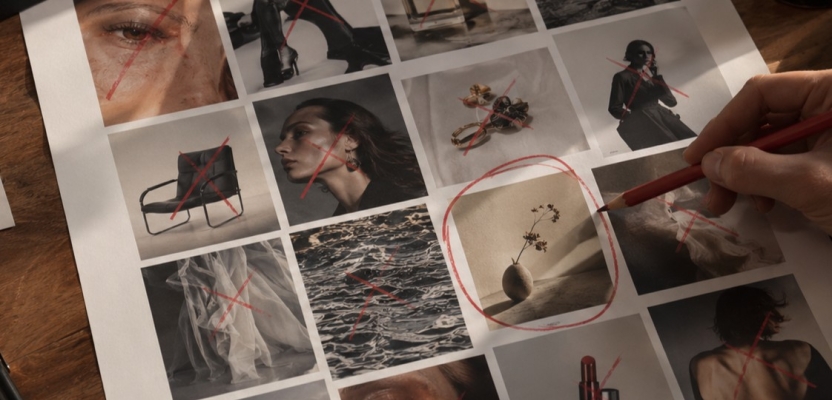
So a huge part of the work is rejecting things. Choosing one direction and letting the other five go. Making one frame quieter because the full set works better that way. Removing the flower. Losing the reflection. Changing the angle. Starting again.
The discarded work is a huge part of the work.
AI made taste more important
AI has made producing images easier. It has not made choosing good images easier.
If anything, having an endless supply of nearly-right options makes judgement more important. When you can produce ten directions in the time it once took to make one, the valuable skill becomes knowing which one deserves to survive.
That is what I mean by taste. Not knowing what is trendy, but having an opinion. Knowing when something is too polished. Knowing when the obvious image is the wrong one. Knowing what to remove. Knowing when to stop generating.
AI slop is not simply what happens when people use AI. It is what happens when nobody makes enough decisions.