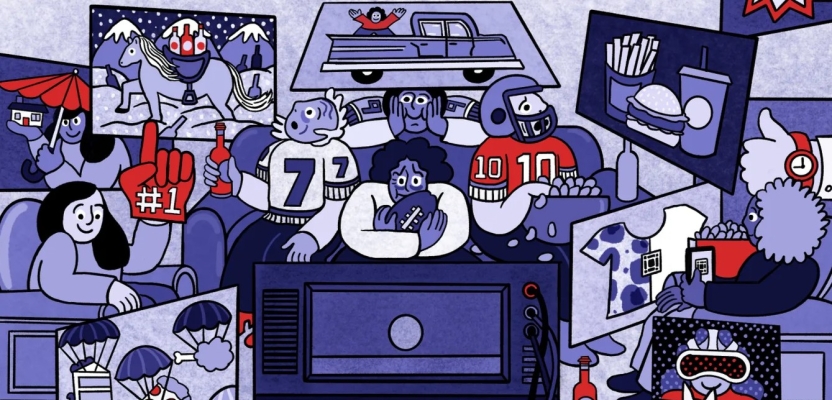

The Super Bowl is a legitimate cultural phenomenon that, in recent years, has even managed to gain some popularity over here in the UK. For so many of us creatives, however, the real battle isn’t happening on the field; it’s happening between the breaks.
The Super Bowl has long been seen as not only US football’s big night but advertising’s big night too, with brands investing up to $8 million for 30 seconds of airtime, hoping to captivate 100 million+ viewers.
However, as VCCP’s recent Cracking the Memory Code: Super Bowl Edition report reveals, only 16% of ads are recalled and correctly attributed to their makers by audiences. This paradox underscores a critical question: How do brands transcend the noise to create ads that linger in our collective memory?
In partnership with behavioural science consultancy Cowry, VCCP’s report dissects the science of memorability, analysing over a decade of Super Bowl ads to identify the “levers of memory” that forge lasting impressions. Drawing from this research and decades of the finest (and most memorable) Super Bowl Ads, below I’ll explore the alchemy of unforgettable Super Bowl advertising. Just in time for Super Bowl LIX this Sunday!
The Science of Memory: How VCCP Cracked the Code
VCCP’s methodology combined recognition/recall tests and implicit response tests to measure both conscious and subconscious audience reactions. By evaluating 1,000 participants, the study pinpointed five key levers that drive memorability - humour, characters, emotion, sonic devices, and surprise. These elements align with neuroscientific principles—emotional engagement and novelty, for instance, enhance memory encoding by activating the amygdala and hippocampus.
As Martin Coomber, VCCP US Head of Strategy, notes: “Memory is the ultimate driver of purchasing decisions. To win at the shelf or search engine, brands must first win in the mind”.
The Five Levers of Memorable Super Bowl Ads
1. Humour: Laughter as a Cognitive Hook
Humour isn’t just entertaining—it’s a strategic tool. Ads like Budweiser’s “Wassup?” (1999) and Snickers’ “Betty White” (2010) used absurdity and wit to become cultural touchstones. VCCP’s report highlights humour’s dual role: it disarms audiences while forging positive brand associations.
Modern examples include State Farm’s “Drake from State Farm”, which used self-aware humour (and celebrity star power) to refresh its brand persona. Humour works best and feels more authentic when it aligns with a brand’s identity, creating distinctive brand worlds that audiences revisit mentally.
2. Characters: The Power of Familiar Faces (and Mascots)
Characters—whether human, animated, or anthropomorphic—serve as mnemonic anchors. M&M’s spokescandies and Mr. Clean’s rebooted persona exemplify this, embedding brands into pop culture through consistent, relatable personas.
VCCP’s findings echo timeless successes like Geico’s Gecko and Old Spice’s Isaiah Mustafa, whose quirky charm turned ads into viral phenomena. Characters act as “fluent devices,” blending branding with emotional resonance.
3. Emotion: Storytelling That Stirs the Soul
Emotionally charged narratives, such as Google’s “Loretta” (2020) and Budweiser’s “Puppy Love” (2014), tap into universal themes of love, resilience, and nostalgia. These ads trigger dopamine and oxytocin release, cementing memories through affective engagement.
VCCP’s implicit response tests revealed that ads like Farmer’s Dog’s tear-jerking pet stories outperform purely informational campaigns. As Tim McMahon, a marketing professor, observes: “Emotional storytelling transforms ads into shared cultural experiences”.
4. Sonic Devices: The Unsung Heroes of Recall
Soundscapes—jingles, voiceovers, or even frogs croaking “Bud-Weis-Er”—act as auditory mnemonics. Intel’s iconic chime and Coca-Cola’s “I’d Like to Buy the World a Coke” demonstrate how sonic branding transcends visual clutter.
VCCP’s report emphasizes the rising use of sonic logos in Super Bowl ads, such as Mastercard’s melodic “priceless” tagline, which reinforces brand identity without visuals.
5. Surprise: Disruption as a Memory Catalyst
Unexpected twists, like Tide’s “It’s a Tide Ad” (2018) or Volkswagen’s “The Force” (2011), jolt viewers out of autopilot mode. Surprise triggers heightened attention and dopamine release, enhancing recall.
VCCP’s study singles out Farmer’s Dog’s 2023 ad, which subverted pet food tropes with a poignant adoption narrative. As Menno Kluin of Iris Worldwide notes, “The best ads always balance shock with authenticity”.
Decoding the Past Decade’s Most Memorable Super Bowl Ads
Over the past decade, several campaigns have transcended the traditional boundaries of advertising by forging deep emotional connections with viewers while driving tangible business results.
Budweiser’s “Puppy Love” (2014)
Budweiser’s “Puppy Love” remains one of the most iconic Super Bowl ads for its masterful use of emotion and character. In this campaign, the ad juxtaposes the loyalty of the Budweiser Clydesdales with the tender, universally appealing theme of puppy love. The narrative is simple yet evocative—by showing an unexpected friendship and a touch of vulnerability, Budweiser created a story that resonated across demographics. The emotional storytelling not only boosted the brand’s image but also turned the spot into a viral sensation, proving that when you tap into shared values like loyalty and compassion, viewers are more likely to remember and share your message.
State Farm’s “Jake from State Farm” (2020)
In 2020, State Farm reimagined its iconic character, Jake from State Farm, to redefine insurance marketing. Known originally for his deadpan delivery in a late-night service call scenario, the updated ad leaned into humor and relatability. By presenting a character who feels like a trusted friend—one who is available and dependable even in the most mundane of circumstances—State Farm transformed a traditionally staid industry into something accessible and engaging. The blend of wit with everyday scenarios allowed audiences to connect with the brand on a personal level, showing that even insurance can be rebranded with a human touch. The fact it was iconic enough to earn it's own SNL sketch speaks volumes.
Farmer’s Dog’s “Forever Home” (2023)
More recently, Farmer’s Dog’s “Forever Home” campaign demonstrated how a combination of surprise and emotion can yield extraordinary business results—in this case, a 300% surge in sales. This campaign built its impact on an unexpected twist that intertwined heartfelt storytelling with a message of belonging. By leveraging surprise, the ad disrupted expectations and invited viewers into a narrative that was both personal and uplifting. The emotional core of the campaign not only drove engagement but also solidified customer trust, illustrating how authentic stories can translate directly into commercial success.
The Future of Super Bowl Advertising: Lessons for Marketers
The evolving landscape of Super Bowl advertising suggests that long-term success will hinge on strategies that balance creativity with consistency and cultural insight. Here are four key lessons for marketers aiming to craft the next memorable Super Bowl ad:
Consistency Over Spectacle
While spectacle often draws immediate attention, consistency builds a lasting brand identity. Campaigns that utilize recurring characters or signature sonic motifs—for example, Budweiser’s enduring Clydesdales or State Farm’s Jake—create an evolving narrative that consumers come to recognize and trust. This consistency transforms fleeting moments of high viewership into a steady, recognizable brand world that remains in public memory long after the ad airs.
Data-Driven Creativity
In today’s digital era, creative intuition is increasingly augmented by data. Using implicit response testing and other analytics tools, marketers can measure how audiences emotionally and subconsciously react to different elements of an ad. This data-driven approach allows for the refinement of emotional triggers and surprise elements, ensuring that every creative decision is both innovative and optimized for maximum impact. The fusion of creativity and analytics makes it possible to design ads that are as effective as they are memorable.
Cultural Resonance
The most impactful ads are those that speak to the cultural moment. Campaigns like Always’ “#LikeAGirl” (2015) demonstrate that when an ad aligns with or challenges societal values, it can spark conversation and foster a sense of belonging among viewers. By tapping into current social narratives or values, brands not only capture attention but also build emotional connections that extend far beyond the commercial itself.
Use Multi-Sensory Cues
Holistic memorability arises when an ad engages multiple senses simultaneously. Integrating sound, visuals, and narrative storytelling creates a richer, more immersive experience. Whether it’s a catchy jingle that sticks in your head, stunning visuals that captivate your eyes, or a compelling storyline that resonates emotionally, the combination of multi-sensory cues can elevate an ad from a mere commercial to a full-fledged cultural moment.
Memory as the Ultimate Currency
In an era of increasingly fleeting attention spans, where many audiences will struggle to pay attention to anything that lasts longer than a sneeze, Super Bowl ads that master the levers of memory—humour, characters, emotion, sound, and surprise—are always going to be the ones that transcend the status of mere commercials. They become cultural landmarks, driving not just recall, but loyalty and sales. The science of memory should be seen as the cornerstone of modern marketing.
For brands eyeing Super Bowl LX next year, the message is clear: To be remembered, you must first be unforgettable.