

(Without Dying in the Attempt)
Adapting the script, defining tone, and building a world before it exists ⸻
What is The Fingerless Archer and where does the project stand today?
The Fingerless Archer is a television and streaming series adaptation of the
seven-novel saga El Siniestro Arquero Sindedos by Daniel Bilbao, published in
Spain. The project is currently in its final stage of development and pitching.
If one had to describe it boldly, the series is a contemporary western set in the
15th century, infused with dark humour and mystery. The paradox, already present
in the novels, is that despite the historical setting, the drama is unmistakably
modern. Power structures, personal relationships, and moral compromises have
not changed much since the Middle Ages.
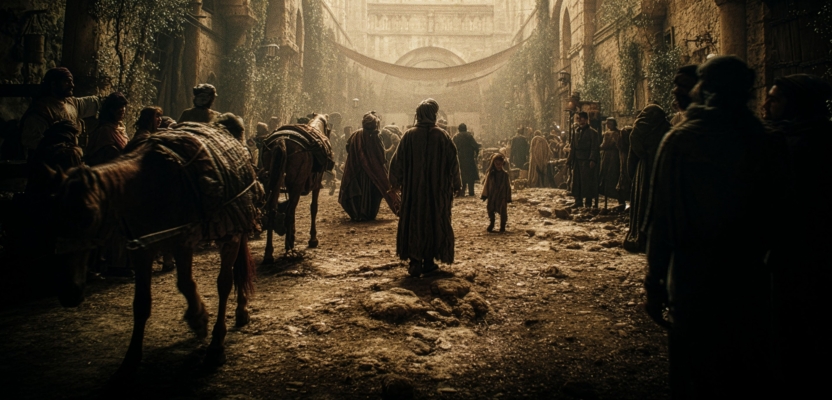
At this stage of development, creating a teaser was not optional. It was essential
to define the tone of the final project. ⸻
The unsolvable problem
How do you sell a series that doesn’t exist yet?
Let’s imagine the situation.
The calls have been made, promising conversations have taken place, and after a
year of hard work you find yourself, one rainy morning, sitting across from the
executive who might greenlight the project. Some readers will have been there.
That familiar moment of silence.
The idea, in theory, is simple: the scripts are ready — I’m not going to explain
them. Watch this instead. Let the screen speak.
This approach has a clear advantage. You can be dismissed immediately, saving
everyone time... or the exact opposite can happen.
A script alone is not enough. A single screenplay can generate multiple films —
one per reader. At the other extreme, some major successes spent decades
forgotten in a drawer (Forrest Gump, The Shawshank Redemption). Perhaps the
writer was not convincing that rainy morning. Perhaps the executive failed to see
what was really being proposed.
If a script is an architectural blueprint, a good teaser adds colour, tone, judgement
— and, when necessary, a touch of edge. Its purpose is not to persuade at all
costs, but to be precise. If the project is rejected, let it be rejected for the right
reasons. ⸻
Author and director
If they want the same thing, why does it sometimes feel like they don’t?
From page to screen, a century of conflict.
Imagine again. Three months after the commission, the novelist receives the
adapted script. The silence on the other end of the phone can only mean one
thing: you’ve changed more than I expected.
Of course you have. It is his novel. The project would not exist without it. This
classic friction is not a problem to be avoided — it is the work itself. And this is
precisely where the teaser becomes useful.
Development is not a theoretical exercise; it is a succession of concrete decisions
that must end in consensus — or not end at all. This is the fragile magic of cinema.
Every disagreement, every discarded idea, every boundary negotiated between
roles ultimately benefits the project. The teaser is not only a tool for presentation. It
is also a way for author and director to define, together, what they are actually
going to make. ⸻
Inventing a world alone
No crew, no budget, no set
At this point, countless meetings are avoided. Questions such as what does the
character wear?, what does the dungeon look like?, or what is the colour palette?
no longer remain abstract.
Whether or not the final production improves upon these early decisions — and it
should — the general intention behind art direction, cinematography, and visual
language can already be outlined.
The advantage of this stage is that it can be handled by a single person, without
the pressure of a large production structure. The process becomes agile and
effective. All narrative responsibility rests on the shoulders of the teaser’s director.
If he fails, he can be replaced. The system may be many things, but it is efficient. ⸻
AI
A Heidelberg press can print Romeo and Juliet — or Mein Kampf
Generative AI is a Heidelberg press.
It produces a prototype — in this case, the prototype of the series you want others
to fall in love with.
Optimistic estimates suggest that generative imagery will reach maturity within a
year. This seems reasonable, considering the technology first appeared on the
radar around 2014. Today, it can already generate visual prototypes such as the
teaser discussed here, which is no small achievement.
Will we ever see a series created entirely by a silicon heart? I doubt it, for the
same reason actors only truly shine during the dress rehearsal, once they put on
Hamlet’s costume. The faces and decisions that shape our stories remain human.
AI is improving rapidly and will continue to assist the process — but it is a tool, not
an author, and certainly not a replacement for one. ⸻
And all this, for what?
The finish line
The Fingerless Archer is currently open to development conversations. In many
respects, it is a more English project than a Spanish one. We believe it is strong
enough to find its place on its own.