

The really great thing about searching for something to type about (if I’ve not had a situation that fired me into a keyboard warrior mini-rage) is the forced-hand of looking for things to think around (and yes, it’s an active thing. You won’’t learn much sat there on your arse, Richard.)
It really does come with it’s own unexpected benefits. There are so many interesting things out there I’d never come across otherwise. Some are even useful for me.
Take the Regressional Goodhart. Nope, me neither. But what a thing. And as the author bringing this to my attention stated, once you ‘see’ it, you’ll start to see it everywhere. Here’s why:
"Every time someone does something that is anything other than the thing that maximizes their goal, you could view it as them optimizing some kind of proxy (and the action to maximize the proxy is not the same as the action to maximize the goal)."
Sound familiar? Working for the ‘other thing’ rather than the actual thing that needs fixing? Yep. Regressional Goodhart, right there.
Does it help to have a Theory (capitalised to infer science-at-work) about this stuff? I think so. Getting under the skin of why people do this, understanding why they swap out “working on a problem for real” for “pretend work (they believe) is useful” means someone has done some proper investigative work and the neat dovetail between Goodheart behaviour and everyone’s bête noire - middle management; and specifically ‘Recursive Middle Manager Hell’.
I’m always needing to check precisely what certain words that sound familiar, actual mean. Take ‘recursive’, which I’d a hunch was something between ‘repeating’ and ‘regressing’ - which turns out to be sort-of right. While the (Cambridge) definition reads ‘involving doing or saying the same thing several times in order to produce a particular result or effect’, when prefiguring ‘middle manager’, I think my take might be more apposite.
Ok, cheap shots at figures of fun like these are a penny a dozen, but there does seem to be a correlation in my experience; of more tiers of managers, the less connected everyone appears to be to those “problems for real”.
What’s the solution? You need to a brave heart to beat the Goodharts, because nothing gets in the way of a good project outcome as power-structures for their own sake.
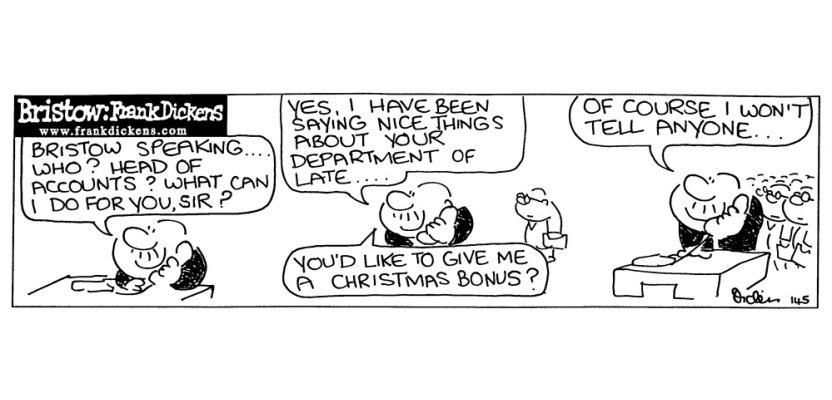
And apologies to the wonderful Frank Dickens ‘Bristow' (and Knight Features) for shamelessly borrowing his work in the feature image. Can’t think of a more appropriate picture given the subject.