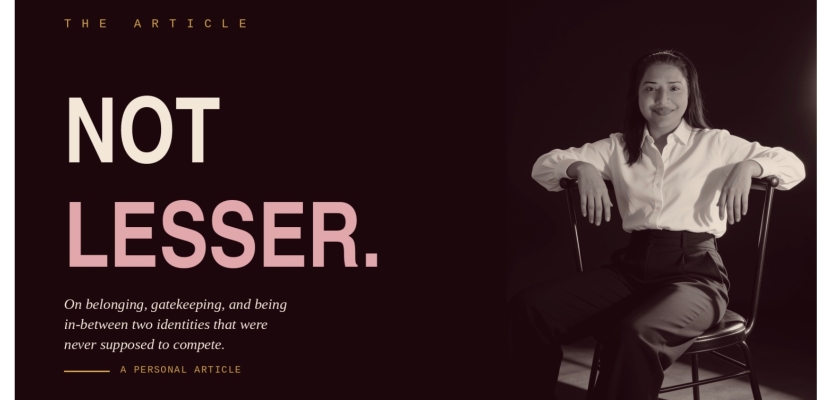

Not Lesser: What I Learned About Belonging From Being Made to Feel Foreign in My Own Community
There's a particular kind of loneliness that doesn't have a name yet - the loneliness of being excluded by people who are supposed to be your people.
I felt it for the first time in a room full of Pakistani women who had, on paper, everything in common with me. Same language, same faith, same food on the table. But something in the air shifted the moment it became clear I hadn't grown up here. A joke that assumed a childhood I didn't have. A slight, amused correction of my English. A conversation that moved on before I could find my footing in it.
It wasn't cruelty, exactly. It was something quieter and, in some ways, harder to name: the sense of being ranked.
The Hierarchy Nobody Admits To
If you're an immigrant woman in a diaspora community, you've probably felt this even if you've never said it out loud. There's an unspoken hierarchy between women who were born and raised here and women who arrived later in life. Being "British-born" carries its own kind of currency - ease, fluency, cultural shorthand. It signals that you've already done the work of belonging, on both fronts, effortlessly.
Immigrant women, by contrast, are sometimes read through a narrower lens. Less polished.Still catching up. Somehow behind in a race nobody agreed to run.
I want to resist the urge to make this simple, because it isn't. It would be easy to write an article that paints British-born Pakistani women as unkind or superior, and immigrant women as blameless. But most of the warmth and generosity I've experienced in this community has come from women born here. This isn't a story about a group of people. It's a story about a pattern that exists within a community - one that most people participating in it would probably be uncomfortable seeing named.
Trying to Understand, Not Just Accuse
Here's where I want to slow down, because I think this is the part that actually matters.
Growing up Pakistani in Britain is its own difficult negotiation. You're often not fully accepted as British by the wider society around you, and you can feel judged as "not really Pakistanienough" by relatives back home - too Western, too different, not quite legitimate in either direction. That's a real and exhausting tension to carry, especially through childhood and adolescence.
I've come to wonder whether some of what gets aimed at immigrant women isn't really about us at all. It might be a way of resolving that old insecurity - a way of finally getting to stand on solid ground, even if that ground is built by placing someone else slightly beneath you. If you've spent years being told you're not authentically anything, there's a kind of relief in finding someone you can, even unconsciously, be more authentic than.
This doesn't make the exclusion acceptable. But understanding it as a defense rather than simple cruelty changes how l've chosen to carry it. Less resentment. More curiosity.Occasionally, even compassion for a struggle that predates me entirely.
The Specific Weight of Being Excluded From the Inside
Exclusion from a stranger is one thing. You brace for it. You expect the wider world might not fully welcome you, and there's almost a script for how to metabolize that.
But exclusion from someone who shares your language, your food, your prayers, your history - that lands differently. You didn't expect to have to prove yourself here too. Finding out that belonging has its own internal gatekeepers, informal but very real, produces a specific kind of loneliness: too foreign for the diaspora, too foreign for Britain, standing in a space that doesn't quite have a name of its own.
I've spoken to enough other immigrant women to know this isn't just my story. The details shift - sometimes it's about class, sometimes about which city or village someone is from, sometimes about religious practice or accent - but the underlying shape repeats itself: a hierarchy of "authentic enough," policed most sharply by people who are themselves still negotiating their own place in it.

What l'd Actually Want, Instead
I'm not interested in flipping the hierarchy - claiming immigrant women are somehow more"authentically" Pakistani, more legitimate, more deserving. That just rebuilds the same ladder with the rungs reversed.
What I want is flatter ground. An understanding that belonging to a diaspora was never supposed to be a competition with a correct answer. A British-born woman and an immigrant woman are both negotiating identity - just from different starting points, carrying different griefs, solving different versions of the same puzzle.
If I could leave one thought with British-born readers, it's this: the fluency you've builtmoving between two cultures is a genuine strength, hard-won and worth owning. But it isn't evidence that a woman still finding her footing here is somehow lesser for it. Her disorientation isn't a character flaw. It's just an earlier chapter of a story you've already lived through yourself.
And if I could leave one thought with immigrant women reading this - the discomfort you've felt in these rooms is real, and it deserves to be named rather than swallowed. Naming it isn't ingratitude toward the community. It's the beginning of asking for a better one.
We are, all of us, some version of in-between. The diaspora is stronger when that in-betweenness is met with recognition instead of ranking - when it stops being a hierarchy, and starts being what it always should have been: a shared, ordinary, human condition.