



Being “good” is table stakes. Being findable is the multiplier. In 2026, the best answer to how to get recruiters to notice you is usually not “work harder” but “be easier to find and easier to understand.” Recruiters and hiring teams use keyword filters, profile search, and fast-scanning workflows to narrow huge candidate pools quickly, which means if the right signals are missing, even strong creatives can fail to get noticed by hiring manager searches.
This article breaks discoverability into three layered realities.
First, there is algorithmic filtering of CVs and applications, where keywords and readable formatting can determine whether a human ever sees you.
Second, there is platform search, where tools like Creativepool are queried like databases and returned like search results.
Third, there is open-web discovery, where your own portfolio site can rank in search if it is built and written in a way search engines can understand.
The practical message is simple, even if your ego hates it: you need to build your career presence like a product. That means a clear “searchable identity” (job title, location, specialism), a keyword-smart bio, case studies that describe outcomes, tags that match how employers filter, and a portfolio that is crawlable and easy to navigate. Then you maintain it with a cadence, not a panic update when you suddenly need work.
Discoverability works like search

Nicola Gastaldi
Start with the mental model, because it stops you doing expensive nonsense.
Recruiters don’t “browse” the internet like curious art patrons. They search. They apply filters. They narrow by job title, location, skills, and keywords, then sort for freshness and availability. That’s not cynicism but triage, and it is the only way to deal with volume.
On Creativepool, People Search is a core feature that searches through job titles, locations, company names, individual names, tags and keywords, including keywords on member profiles and in their CV. The system also treats multi-word searches as an AND query (so “design London” returns profiles containing both terms, for example).
If someone uses keyword search, Creativepool looks through a long list of fields, including job title, location, experience fields like skills and clients, intro text, and company name. If the recruiter uses typeahead and selects a specific job title from the dropdown, the search becomes strict and only returns users with that exact job title in the relevant “Get Listed” field. Translation: your job title choice is not decoration. It is literally a filter.
On LinkedIn, the mechanics are similarly clear from official documentation. LinkedIn Recruiter’s Skills filter leverages Skills Match and looks for skills candidates have explicitly listed.
Now add the gatekeeper before search. Many organisations use applicant tracking systems to scan, score, and rank CVs by keywords and phrases, flagging higher-matching applications for human review. I’d always recommend matching job description wording because ATS tools do literal matching, not generous interpretation. The UK government’s JobHelp guidance echoes this advice by advising candidates to spot keywords in the advert and use them in the CV, and to keep formatting simple because some ATS tools struggle with complex layouts.
If this all feels depressing, then good. It should. The aim is not to romanticize hiring. Far be it from me to do that in such a blatantly competitive market. The aim is to stop you losing opportunities for reasons unrelated to the quality of your work.
Also, a necessary note on algorithmic hiring. The CIPD has discussed employers using AI and machine learning in recruitment and onboarding, and frames the reality that technology is being used to streamline processes. This does not mean “robots decide your career.” It does mean discoverability now includes systems that reward structured signals and penalise ambiguity.
The only sane response is to treat discoverability as a design constraint. Your “pretty portfolio” is not the full product. Your findability layer is part of the work.
Build a keyword map for how you want to be found

Oliver Polanski
Before you optimise anything, decide what you are optimising for. If you skip this step, you will go wide, become vague, and be searchable by nobody in particular.
Creativepool’s own profile guidance stresses that Work Settings let you choose up to three preferred job titles, and that your ranking is based on the first job title. It explicitly recommends using specific keywords like “digital designer” rather than broad categories to improve search visibility. The “Getting found on Creativepool” piece makes the same point in older but still relevant language: be specific about desired job and desired location rather than selecting “all jobs” or “all locations,” because specificity improves how employers interpret you.
So, build a keyword map that has three layers.
The first layer is your “primary role label.” This is the phrase you want to win, the one that should follow you across platforms. Choose the role you actually want to be hired for, not the role you think sounds impressive at parties. On Creativepool, your job titles are listed in order of preference and you climb rankings based on the first one, which is a polite way of saying indecision costs you visibility.
The second layer is your “specialism terms.” These are the skills and domains that make you an obvious match when someone filters. Explicitly listed skills matter, not implied skills hidden in a gorgeous case study. If you don’t list the skill, the tool cannot match the skill.
The third layer is what I’ll call “proof keywords.” These are nouns and verbs that show outcomes, not tool names. Think “conversion uplift,” “campaign performance,” “community growth,” “retention,” “lead gen,” “brand refresh,” “toolkit rollout,” “design system,” “accessibility,” “stakeholder alignment,” “user research.” Your work is not only what you made; it is what the work changed. If you include only tool keywords, you will be found by people hiring hands, not brains.
Now do one more thing that feels basic and still gets ignored. Write down the exact phrases that appear repeatedly in the job descriptions you want. ATS tools and recruiter filters reward language matching and ATS scoring is influenced by keywords and terminology matching. That’s why “retail experience” might not match “customer sales experience” in an ATS context, because the system is literal.
This is not about lying. It is about translation. If you did the thing, name it the way the market names it.
You can also be keyword-smart without becoming a robot. The goal is keyword alignment plus human credibility, not compliance theatre.
Optimise your Creativepool profile so recruiters can actually find you
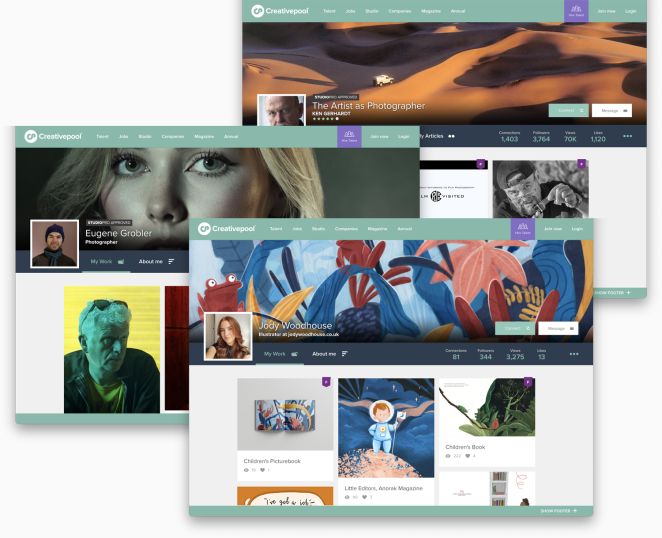
Creativepool is more than just a portfolio gallery. It’s a searchable database of creative talent, and the platform itself tells you what the search engine reads. If you treat your profile like a mood board, you are leaving discoverability to chance.
Understand what Creativepool search indexes
Fields the keyword search reads of course include job title and location, but also experience fields like industry, education, languages, skills, sector experience, clients, trade associations, awards, intro text, and even company names. The implication here is that your profile cannot be “just visuals” if you want to be found. Text fields are part of the index.
When it comes to phrase search rules, meanwhile, quotation marks create exact phrase matching (“Web designer”), while selecting a typeahead suggestion forces a strict match to the job title field. This makes job title selection a high-leverage decision, because recruiters using dropdown job title filters will miss you if your job title is creatively written but not literally matched.
A Few Notes
- Hidden profiles are excluded from search. If you have set your profile to hidden, your discoverability strategy is not “bad.” It is self-sabotage by default.
- Data is refreshed daily at around 04:00 AM, meaning profile updates may not appear immediately in search results. If you change something and then panic-refresh the search page, you are fighting a refresh schedule, not your own capability.
- Search results are searched for active and with CV/Resume and profile images by default. That means the presence of a CV upload and a profile image is part of the default filtering environment. Leaving these blank is the digital equivalent of turning up to a meeting and refusing to speak.
Make your Work Settings do the heavy lifting
You can choose up to three preferred job titles under Work Settings and your ranking is based on your first job title. Being active on the platform also influences ranking so I’d always recommend actively engaging with the community to not only improve your experience and build connections but improve your chances at being found.
When it comes to choosing job titles, the mistake is to settle on titles that flatter you rather than define you. “Creative” is not a job title, it is a category. A recruiter searching “motion designer” will not find “visual storyteller” if they select job title filters. Job titles matter enormously and can make “all the difference.”
If you want a cheap hack that is not gross, study what people who rank well do, then write your own version. Look at the Top 25 profiles for inspiration and study the emergent norms for language, tags, and structure. That way, you’re learning, rather than guessing.
Write your bio like a searchable pitch, not a diary entry
The About Me section is comfortably the most important part of your profile and frames it as where employers decide what you are about. So, tell your story, clarify what is crucial for an employer to know, and make your value clear.
A discoverable bio has three jobs:-
- It states your primary role label in plain language.
- It names your core domains, tools, and outputs in terms that match market search behaviour.
- It proves credibility with evidence signals: industries, outcomes, recognisable kinds of projects, awards, associations, or client types, depending on what is true for you.
If you write your bio with only adjectives (“passionate, creative, detail-oriented”), you’re writing something that nobody can search for. If you write your bio with only tool names, you’re writing something that makes you interchangeable. Balance specificity with proof.
Tag projects so you show up in the right searches
If tags are searchable, they are not optional. They are the handles recruiters pull to find the kind of work they need.
The most common tagging error is tagging for other creatives rather than for hiring behaviour. Recruiters and hiring managers often look for role terms (“brand designer,” “motion designer,” “UX researcher”), deliverable terms (“campaign,” “rebrand,” “design system”), and platform terms (“TikTok,” “email,” “OOH”), plus tool and file format terms when they hire for production speed (“After Effects,” “Figma”).
The “How to Create the Perfect Portfolio” article explicitly recommends choosing the right job titles and keywords and including narrative case studies, which implies that project descriptions and tags are part of discovery.
There is also an ethics and accuracy point to be made here. If you tag work with skills you don’t actually have, you might buy temporary visibility, but you create a mismatch that burns trust. In a tight market, trust is the real conversion metric.
Use activity as a discoverability lever without becoming annoying
Being active and engaging helps. Ranking always considers how recently you have logged in and your activity level so make a habit out of engaging with the platform. Indeed, the search interface even includes sort options like “last login,” which tells you recruiters may filter for active members. Activity is a signal of availability and current relevance.
This doesn’t mean you should spam the feed though. It just means you should avoid looking dormant. Upload new projects, update older case studies, refresh your work settings when your target changes, and make small edits that keep the profile current. Done consistently, this creates the simplest possible career advantage: you look like you are active within the industry.
Make your portfolio and personal website crawlable and searchable

John Hollander
The annoying truth is that your personal site can be your best discoverability asset because it is the one space you own. Platforms change. Algorithms twitch. Your site is where you control narrative, structure, and proof. It can also rank in search and become an inbound funnel if it follows basic search principles.
Google’s own SEO Starter Guide explains that search engines are users too, and that SEO is about helping search engines understand your content and helping users decide whether to visit. It also notes that Google is automated and uses crawlers to find pages and add them to its index, and in most cases, you don’t need to do anything beyond publishing. The catch is that “do not need to do anything” doesn’t mean “everything will be understood as intended.” It means your site still needs to communicate clearly.
Use words people would use to look for your content and place them in prominent locations such as the title and main heading, and in descriptive locations like alt text and link text. This is the SEO version of what recruiters do in platform search: they filter by the words that match their need.
If you want your site to rank for your work, treat each case study like a page that answers a query. Not “Project X.” Instead, “Brand identity for fintech startup” or “Motion design showreel for product launch,” depending on what you actually did. Your headings and titles should describe the work in language a non-creative decision maker might search.
This is where many portfolios accidentally fail. They look beautiful and say almost nothing. A recruiter searching “London motion designer After Effects” is not going to find a page titled “Play” unless your text supports it. That’s not a judgement on your artistic taste. It’s a mismatch with how search works.
Meta descriptions are a useful conversion lever when your site appears in search results. Good meta descriptions are like a pitch that informs and interests users and descriptions can vary per page. This matters because a portfolio page that ranks but looks vague in the snippet still loses the click to someone clearer.
There is also a structural point that creatives often miss because it sounds like “developer stuff.” Links should be crawlable so Google can find other pages via your links. If your site is built like a single scrolling canvas with hidden content, or your projects are loaded in ways crawlers struggle with, you can throttle your visibility. You do not need to become an engineer. You do need to avoid building a “portfolio experience” that search engines cannot easily parse.
Now connect your owned site to your platform presence. Google’s guidance makes clear that discovery happens via crawling and links. If your Creativepool profile links to your site, your site links back, and your LinkedIn profile links to both, you create a loop of credibility and easy navigation. This is not “link building” in a spammy sense. It’s simply making your identity coherent and crawlable across the places recruiters actually look.
One more concept that is unfashionable but works: write like a human being. Google’s guidance on creating helpful, reliable, people-first content says ranking systems prioritise content created to benefit people, not content created to manipulate rankings. A portfolio that is only keyword stuffing, with no meaningful explanation of outcomes, risks being ignored by humans and potentially underperforming in search. Helpful wins.
Turn visibility into inbound opportunities and interviews
Discoverability gets you seen. It does not automatically get you hired. The second half of the game is conversion: turning profile views into messages, interviews, and gigs.
This is where it helps to hear from someone who thinks like a marketer, because discoverability is a marketing problem. And yes, that applies to you.
"From an SEO perspective, discoverability isn’t just for brands it applies to people too. If you work in a creative industry, your portfolio is your storefront. A personal website that clearly showcases your work, process and outcomes will always stand out on a CV. It demonstrates capability, not just claims.
Beyond that, tailor your cover letter to the company you genuinely want to work for. Referencing their work, challenges or positioning shows intent and effort, and in competitive markets, effort differentiates.
Use numbers. Include performance metrics in your CV summary: growth percentages, engagement rates, revenue impact, campaign results. Creative is powerful, but measurable creative is compelling. Evidence turns interest into interviews."
Amy Sokhi, Marketing Manager at SEO agency Polaris
If you strip this quote down to mechanics, it's effectively saying three things.
First, your portfolio should demonstrate capability rather than merely claim it. If you want to be discovered and trusted, you need proof narratives that reduce doubt quickly.
Second, targeted effort differentiates. Creativepool’s talent-hunter guidance discusses recruiters searching for potential and purpose, and also notes that online communities and social platforms can be discovery spaces for emerging talent. “Effort” in this context means relevance signals: referencing the employer’s category, constraints, and work intelligently rather than firing generic applications into the void.
Third, measurable creative is compelling. This is where many creatives get nervous because not every project has clean metrics. But “no metrics” does not mean “no evidence.” Evidence can be performance outcomes, engagement changes, conversion uplift, reduced production time due to a system you built, stakeholder adoption, user feedback patterns, or any measurable or observable change you contributed to.
If you want recruiters to reach out, remove the reasons they hesitate. That means clarity on what you do, proof you can do it, and cues that you are someone they can place without drama.
Finally, a note on discoverability versus privacy. CIPD guidance on inclusive recruitment cautions against using social media to sift applicants because it can introduce bias and undermine inclusive processes. That is a reminder that discovery happens in imperfect ways and not always in ways HR would endorse. Your response should not be paranoia. It should be professionalism: assume your public professional presence may be viewed and make sure what it signals is coherent and fair.
Your weekly operating system for staying findable

Addi Rujoh
Most people treat discoverability as a one-time task. They “optimise” their profile in a weekend, then never touch it again until they need a job. That’s like opening a shop, arranging the shelves beautifully, then locking the door for six months. Search systems reward current, coherent signals. Humans also trust current signals.
A sustainable approach is a cadence.
Once a week, do a light refresh. Update what you are working on, add a line of outcome evidence to one project, or refine a tag list so it better reflects hiring language. Keeping details up to date and being active and engaged keeps you from looking dormant.
Once a month, do a discoverability audit. Open your Creativepool profile in an incognito window and ask: does my job title match the role I want? Are my top skills explicitly listed? Is my CV uploaded and accessible in the way I intend? Also, CV access defaults to mutual connections unless you change it, which matters if you want recruiters outside your network to read it. In other words, you can accidentally block the very people you are trying to attract.
Once a quarter, publish or refresh one flagship case study. Not a new masterpiece. A clear, structured proof page for work you have already done. Portfolios that explain context, role, and impact perform better for hiring decision makers.
Also, don’t neglect your “conversion surface.” Make it easy to contact you. Many creatives build beautiful portfolios that hide their email like it is a secret. That’s not mystique. It’s lost work.
The Communication Game

Davide Saraceno
In a market shaped by filters, keywords, and platform search, your talent is not the limiting factor as often as your visibility.
Your job is not to game systems with gimmicks. Your job is to communicate clearly in the places decision makers actually look, because when you’re getting a job interview no call back, it’s often not the interview performance that failed first; it’s the chain of signals that got you shortlisted (or misread) in the first place.
Use the right role language, make your skills explicit, and present proof in a scannable way. That is still the most reliable strategy for how to get recruiters to notice you and get noticed by hiring managers in a market shaped by filters, keywords, and speed.
Most of all, be active and be available. Everything else is just window dressing.