
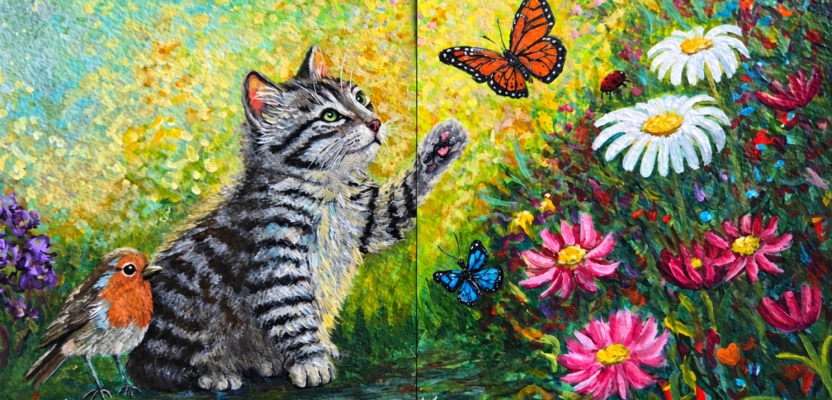

For artist and illustrator Viktoria of Heartbeat Studio, the journey into art began with a life-changing moment: becoming a mother. In 2022, just two weeks after her daughter was born, she made a commitment to pursue a long-held dream of learning to draw and paint. What started with just twenty minutes of daily practice gradually developed into a distinctive artistic practice, bringing together traditional painting, vibrant colours and a deep appreciation for the natural world.
Today, Viktoria's work celebrates animals, flowers and the small details that make the world feel alive. Her artistic journey is also closely connected to her beloved cat, Paru, whose memory continues to inspire her work and her current children's book project, Paru's Adventures. We spoke to Viktoria about finding her creative voice, developing her approach to animal and nature-inspired illustration, staying motivated through observation and experimentation, and turning personal experiences into meaningful works of art.
How did you first get into the industry?
 My journey into art really began in 2022, when my daughter was born. Becoming a mother completely changed my relationship with time. Strangely, it was when I suddenly had very little free time that I realised how much time I had had before — and how long I had been postponing something I had always wanted to do.
I remember thinking that if I didn't start pursuing my dream now — learning to draw and paint, and finding my own way of interpreting the world around me on paper — I might keep postponing it forever.
So, about two weeks after my daughter was born, I started. I made a commitment to practise every day, even if some days I could only find twenty minutes. Twenty minutes was still better than nothing.
I taught myself gradually. During night feeds, my beloved cat Paru would often be beside me while I watched artists painting and studied their processes. When my daughter slept, I would practise. I began with coloured pencils, oil pastels and soft pastels before eventually moving into acrylic painting and learning how to build colour, texture, light and three-dimensional form.
Over time, that daily practice developed into my own body of work and eventually into sharing and selling my art and taking on commissions.
In a funny way, having less time was what finally made me stop waiting for the “right time” to become an artist.
What is your personal background and what role did it play in your career?
Animals have always been deeply connected to my life and, naturally, they became central to my work.
In 2014, while in India, I found a tiny kitten who became my cat, Paru. I brought her back to the UK, where I had already been living for around ten years. She became an extraordinary companion to me. When I later met my future husband, there was never any question in my mind that Paru and I came together! Eventually, all three of us moved to Manchester.
Paru was beside me through so many stages of my life, including the beginning of my artistic journey. She was my rock. Yet while she was alive, I only painted her once, almost as an experiment to see whether I could capture her. I didn't feel a need to preserve her on paper because she was simply there. Her presence and her love were enough.
Paru died in 2025, and something changed in my work afterwards. I developed a strong need to paint her, and I began to recognise something of her in the other animals I painted too.
That experience has shaped the subjects I am drawn to now: animals, birds, pets, flowers and the natural world. There is often a central animal character surrounded by a living environment. Sometimes the work is more traditional or fine-art influenced; sometimes I allow the setting to become more imaginative and whimsical.
For me, animals in paintings aren't simply decorative subjects. They have personalities, relationships and stories.
Can you explain your creative process? What makes it unique?
 My process usually begins with an animal and the feeling or story I want to build around it. I don't think of the animal separately from its surroundings. Flowers, plants, birds, insects, changing seasons and small details all help create a world around the character.
Over time, my style has developed into something colourful, detailed and gently whimsical, while still being rooted in traditional painting and observation of the natural world. I am especially drawn to creating quiet, intimate moments and using flowers, foliage and light to give each piece its own atmosphere. Even when a painting is imaginative, I still want its subject to feel believable and alive.
This has become especially important in the children's book I am currently illustrating, Paru's Adventures, inspired by my cat. In the story, Paru explores the natural world, encountering birds, butterflies, bumblebees, a snail and ducks, wandering among flowers and experiencing the changing seasons.
The illustrations are created traditionally by hand, and I want them to feel abundant, colourful and alive — somewhere between the real natural world and a slightly magical one.
The project is very personal because it transforms my memories of Paru into something that can exist beyond my own experience of her. I would love for a child to open the book, become absorbed in those bright, colourful worlds and come to know Paru as a character in her own right.
There is something very special to me about the possibility that children who never met her might one day know that there was a little cat called Paru 
What’s your secret to staying inspired and motivated?
A lot of my inspiration comes simply from being outside and paying attention. I love nature walks and observing the world around me — wildlife, flowers and plants, changing light, water, landscapes and the way places transform through the seasons. Quite often, something I notice on an ordinary walk will later find its way into a painting.
I also enjoy photographing and filming what catches my attention, whether it is an animal behaving in an unexpected way, an unusual flower, reflections on water, a particular combination of colours or simply the atmosphere of a place. Sometimes this inspires an animal or botanical piece, and sometimes it develops into a landscape or a more imaginative scene. Observing real life gives me a visual library that I can later interpret in my own way.
Connecting with like-minded people is another important part of staying motivated. Sharing work, seeing what other artists are creating, exchanging ideas and receiving feedback gives me a sense of creative community and encourages me to keep developing.
For me, inspiration isn't really something I wait for. It comes from staying curious, noticing what is around me and continuing to engage with the things I genuinely love.
Any websites, books or resources you would recommend?
 YouTube has probably been one of the most useful practical resources for me, particularly when I was first learning. I found it incredibly helpful to watch different artists work from beginning to end — not necessarily to copy their techniques, but to understand how they approached colour, layering, light, texture and composition.
I also think one of the best resources for an artist is simply observation. Spending time in nature, photographing things that catch my attention and really looking at animals, plants, landscapes, light and changing seasons has taught me a great deal. Museums and galleries are valuable for the same reason: seeing artwork in person allows you to notice colour, texture and brushwork in a completely different way.
There are also three books that have stayed with me, although none of them are specifically about art. I read Mama Namibia in 2021, and it left a lasting impression on me through its story of survival, loss and human resilience. Man's Search for Meaning by Viktor Frankl is another book that influenced the way I think about meaning, experience and what we create from the things that happen to us.
And on a much more practical level, Eat That Frog! by Brian Tracy has influenced the way I approach actually getting things done. The idea of starting rather than waiting for perfect circumstances resonates with me — and connects closely to how I began making art in the first place.
More generally, I would recommend learning from many different sources rather than trying to follow one artist or one method. Observe, experiment, practise consistently and gradually you begin to discover what feels like your own.