
Cristina Lisovoi is a Graphic Designer based in Chișinău, Moldova, whose work bridges academic discipline and emerging technology. With a strong foundation in classical art education and visual communication, she specializes in logo design-athlete, branding systems, packaging, and digital advertising. Her approach combines structured exploration with intuitive thinking, resulting in work that is both strategically grounded and visually compelling.
From studying graphic design abroad in Romania to developing a fully produced board game as her graduation project, Cristina’s journey reflects resilience, technical precision, and long-term vision. Today, she actively integrates artificial intelligence into her workflow, not as a shortcut, but as a creative amplifier, positioning herself at the intersection of traditional craftsmanship and modern innovation.
How did you first get into the industry?
 My journey into design started very early in childhood. I’ve always loved creating things with my hands — attending art clubs, crafting, drawing, experimenting with forms and materials. At home, my mother and I were constantly making something together, and my father, despite having no formal artistic education, was naturally talented at drawing. I believe that’s when visual creativity became a natural part of who I am.
Instead of continuing music school, which didn’t resonate with me, I chose art school. There, I studied under a strict, classically trained teacher from the Soviet academic tradition. He was demanding, sometimes tough, but incredibly professional. He built my foundation — discipline, composition, structure, and respect for visual form.
In high school, I consciously chose graphic design as my future direction. It felt like the perfect combination of creativity and structure — something both expressive and practical. I was especially drawn to print design — the idea of creating something that would later exist in the physical world.
To receive the kind of education I was looking for, I moved from Moldova to Romania and enrolled in a Graphic Design and Visual Communication program. I studied on a state-funded (budget) position and received a scholarship due to my high academic performance. It wasn’t easy, but it built resilience and independence.
During my studies, I actively pursued internships, worked part-time, took freelance projects, and consistently developed my portfolio. Even before defending my diploma, I received a job offer based on my portfolio. That moment felt like confirmation that all the effort had been worth it.
Where are you based now and who do you work for?
I am currently based in Chișinău, Moldova, working full-time as a Graphic Designer at a marketing agency. I’m part of a design team under the guidance of a creative director.
My main focus is digital advertising — creating visuals for Google and Meta campaigns, social media design, branding, identity systems, and various marketing materials. I also occasionally work on web design and contribute to broader visual concepts for campaigns.
An area I’m deeply invested in right now is artificial intelligence in creative production. I am genuinely interested in everything related to AI-driven visual creation. I don’t just experiment with tools — I actively and successfully integrate them into my workflow, from ideation and mood boards to production and creative optimization.
In a way, I consider myself an AI creator — someone who combines a strong academic design foundation with modern AI tools, not as a replacement for creativity, but as an amplifier of it. This allows me to work faster, think broader, and experiment more strategically.
Alongside my job, I continue my education through additional courses in branding and marketing, and I plan to obtain professional Adobe certification. I’m also considering pursuing a Master’s degree focused on print production and technical design processes.
What is your personal background and what role did it play in your career?
 My background is a combination of academic art education, independence, and early responsibility for my own growth.
I didn’t grow up in a privileged environment. Studying on a state-funded program, earning a scholarship, working while studying, and paying for additional courses myself — all of this shaped my discipline, strategic thinking, and internal motivation.
Moving to another country for education was a defining step. It taught me adaptability, independence, and decision-making under pressure.
Today, this background directly influences my professional mindset. I constantly strive to deepen my knowledge, develop new skills, and stay at the forefront of technological changes — especially in AI and creative technology.
I see my career as a long-term journey. And I truly believe this is just the beginning.
If you weren’t in your current industry, what would you be doing?
That’s a difficult question because I genuinely wish we could live multiple lives. In one, I would be a designer. In another, maybe an astronaut. In a third — a veterinarian, a surgeon, or a scientist. I’ve always been curious about very different fields.
If I imagine a realistic alternative path — it would probably be something related to science. I’ve always been fascinated by astronomy, physics, space, quantum mechanics, even chemistry. There is something incredibly intriguing about understanding how the universe works. It may seem very different from a creative profession like design, but in a way, both require curiosity, analytical thinking, and imagination.
At different points in my life, I also considered philology or writing. Language, storytelling, and structure have always interested me. So perhaps I would have explored something connected to research, science, or literature.
But ultimately, design became the field where I could combine creativity and structure — which feels natural to me.
Can you explain your creative process? What makes it unique?
 My creative process is structured, analytical, and at the same time very intuitive. While the specifics vary depending on the project, the foundation remains consistent.
Everything begins with research. I carefully study the brief, the brand concept, the target audience, and the competitive landscape. If it’s a branding project, I analyze positioning, market context, and visual trends. Only after understanding the strategic layer do I move to inspiration gathering — building mood boards, mapping associations, and defining emotional direction.
One important part of my process is sketching by hand. I strongly believe that pencil and paper allow more freedom than jumping straight into software. On paper, ideas flow faster and more organically, without the technical constraints of digital tools. I deliberately create concepts that differ radically in style — not small variations of the same idea, but fundamentally different visual approaches. For example, one direction might be minimal and typographic, another illustrative, another based on negative space or geometric construction.
After selecting the strongest 3–4 concepts, I refine them digitally — usually starting in black and white to focus purely on form and structure. Only after a direction is approved do I develop the color system, typography, and visual identity elements.
What makes my process unique is the balance between academic discipline and modern technology. I have a strong classical foundation — composition, structure, visual hierarchy — but I also actively integrate AI tools into my workflow. I use artificial intelligence not to replace creativity, but to enhance research, accelerate exploration, and test visual hypotheses faster. In that sense, I combine traditional craftsmanship with technological experimentation.
Another defining aspect is that I approach each project as an individual system. Even though the structure of the process is consistent — brief, research, mood board, sketches, refinement — the solution is never templated. Every brand requires its own logic, visual language, and emotional tone.
For me, creativity is not chaos — it’s structured exploration.
How would you describe your style?
Honestly, I don’t believe a graphic designer should be defined by one fixed personal style. A strong designer is someone who can work across different visual languages and adapt to the client’s needs, the target audience, and the market context.
Working strictly “in your own style” feels more appropriate for a fine artist or illustrator. In graphic design, the priority is not self-expression, but problem-solving. Sometimes a project requires minimalism, sometimes a complex visual system, and sometimes bold expressiveness. Flexibility is a professional skill.
That said, aesthetically I feel particularly drawn to naïve art — simple forms, expressive lines, visible textures, and a sense of handmade imperfection. I enjoy combining childlike visual language with ironic or philosophical undertones. When visual simplicity contrasts with deeper meaning, it creates an interesting tension.
At the same time, I appreciate structure and well-built systems. Even the most emotional or playful idea should stand on strong compositional logic.
Which individuals do you gain inspiration from? Do you have any heroes in the industry?
 There are definitely designers whose work I deeply admire — for the clarity of their ideas, the courage of their decisions, and the precision of their execution. However, I try not to build idols. For me, inspiration is not limited to one person or one name.
I draw inspiration from everything around me — architecture, books, films, conversations, scientific discoveries, everyday details. Sometimes inspiration comes from something completely unexpected — a texture on a wall, a children’s illustration, a piece of research, or a casual dialogue.
I believe it’s essential to constantly expand your perspective: read, observe, experiment, and explore new tools — especially in the field of AI and creative technologies. For me, inspiration is an ongoing process of observation and analysis.
What tips would you give to aspiring creatives looking for work?
The first and most important advice is: never stop learning. The creative industry evolves rapidly. It’s crucial not only to master the fundamentals but also to understand what the market currently demands. Look at job descriptions, analyze which skills and tools are most frequently required, and work on developing them. In particular, do not ignore technological shifts — including AI tools, which are already becoming part of the profession.
Second, find your additional value. Develop skills that not everyone has — whether it’s advanced print production knowledge, motion design, 3D, AI integration, or a strategic approach to branding. Having a distinctive strength makes you stand out.
Third, learn how to present yourself. Being able to design is not enough — you must be able to explain your decisions, demonstrate your thinking process, and communicate the value behind your work. A portfolio is not just a collection of visuals; it is proof of your reasoning.
Fourth, be proactive. Participate in competitions, initiate personal projects, reach out to companies directly, and create opportunities for yourself. Don’t rely only on sending a standard resume by email. Sometimes what makes the difference is being memorable.
And most importantly — don’t wait for the perfect moment. Success is sometimes about being in the right place at the right time. But if you don’t act, you will never get there. Take initiative, ask, negotiate, step into situations that feel slightly uncomfortable.
A creative career is a long-term journey. The earlier you start acting intentionally and consistently, the sooner you’ll see results.
What tips would you give to other professionals to get more clients?
 Since I’m still relatively early in my career and currently work full-time at an agency, I don’t position myself as someone who has “figured it all out” in terms of client acquisition. However, based on my experience so far, I can share a few observations.
First — you need to market yourself. Talent alone is not enough if no one sees your work. Build a strong, well-structured portfolio. Show not only the final visuals, but also your thinking process. Communicate your value clearly.
Second — understand positioning. Instead of trying to be “a designer for everyone,” it’s often more effective to highlight a specific strength: branding systems, print production expertise, AI integration, motion, strategy, etc. Clients are more likely to choose a specialist who solves a clear problem.
Third — be visible and proactive. Participate in projects, publish your work, connect with people in the industry, attend events (online or offline), and don’t be afraid to reach out directly. Sometimes opportunities come from unexpected conversations.
And finally — think long-term. Building trust takes time. Consistency, reliability, and professionalism often bring repeat clients and referrals — which are much stronger than one-time projects.
Can you share a memorable experience from your career journey that shaped your approach to creativity?
There were many important moments, but two stand out.
The first was moving from Moldova to Romania at the age of 18 to study graphic design. I’m originally Russian-speaking, and Romanian was not my native language. I had studied it in school, but I had never lived in a Romanian-speaking environment. Suddenly, I was in another country, studying in a language I wasn’t fluent in, completely on my own.
It was a full separation from home and a very early step into independence. There were moments of uncertainty, but I didn’t give up. Over time, it became easier. By the end of my studies, I had built friendships, professional relationships, and confidence. That experience taught me resilience and adaptability — qualities that deeply influence how I approach challenges today.
The second defining experience was my graduation project.
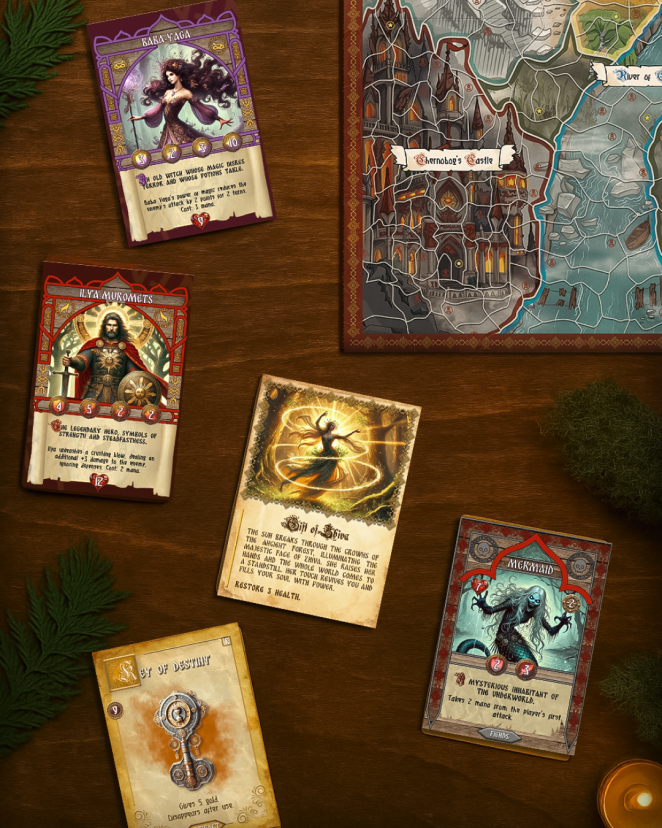
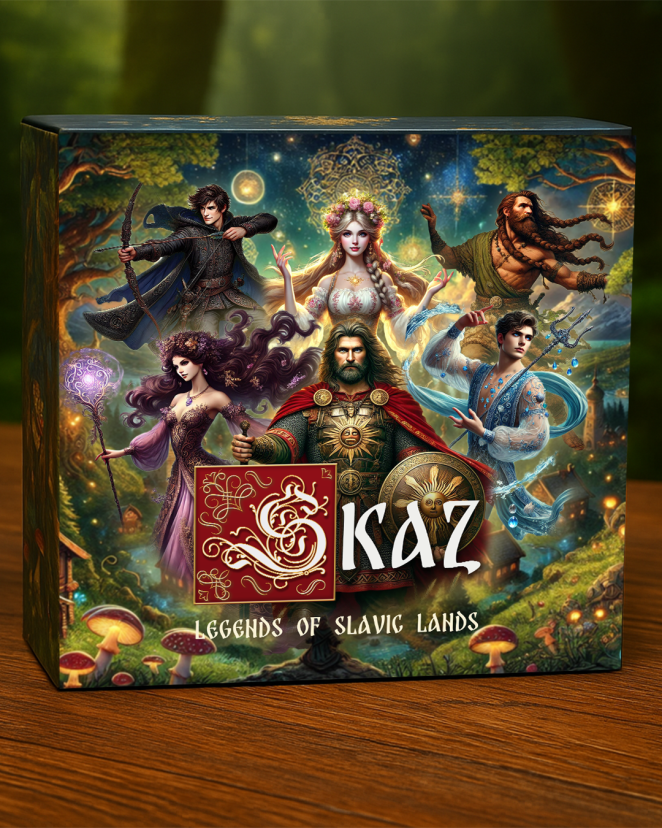
For my diploma, I created a large-scale board game — fully developed from concept to physical production. It included a complete brand identity, characters, mechanics (partially developed with the help of AI tools), more than 150 game cards, character sheets, dice, tokens, a 50×50 cm illustrated folding game map, a professionally typeset rulebook, and fully designed packaging — a 30×30 cm box structured like a retail-ready product.
Designing it digitally was only half of the challenge. The real test was production.
Printing a single prototype of such a complex project turned into a three-month quest. Large print houses weren’t interested in producing just one copy. Smaller ones were more open but technically limited. I ended up contacting and visiting over 30 print shops, discussing materials, paper density, folding systems, lamination, cutting, box construction — every tiny production detail.
It was exhausting, but unexpectedly fascinating. For the first time, I truly understood how many micro-decisions stand behind a “beautiful final product.” Creativity didn’t end at the screen — it extended into materials, mechanics, engineering, and communication with manufacturers.
That experience fundamentally shaped my approach. It made me deeply respect production processes and technical precision. Today, when I design, I don’t think only about how something looks — I think about how it will exist in reality.
It reinforced my belief that creativity is not only about ideas — it’s about bringing them to life, down to the smallest detail.
What kind of tools/kit/software could you not do without?
 My essential setup starts with my MacBook and a dual-monitor workspace. Having enough visual space is extremely important for me — it improves efficiency, supports multitasking, and allows me to manage multiple aspects of a project simultaneously. I also regularly use a graphic tablet, especially for illustration work and when creating custom textures.
In terms of software, my core toolkit includes:
- Adobe Illustrator — for branding, logo design, and vector graphics
- Adobe Photoshop — for image manipulation, compositing, and retouching
- Adobe InDesign — for layout design and complex print materials
- Figma — for digital interfaces and web-related projects
- Occasionally After Effects and Premiere Pro — for motion design and basic video editing
A significant part of my workflow now also involves AI tools. Recently, I’ve been actively using platforms like Nano Banana, Seedream, and Midjourney. These tools help accelerate visual exploration, idea generation, mood board development, and concept testing. For me, AI is not a replacement for design thinking — it’s an extension of it.
What’s your secret to staying inspired and motivated?
For me, inspiration is not accidental — it’s cultivated intentionally. I constantly try to expand my perspective by reading, watching films, exploring scientific topics, observing architecture, packaging, and everyday visual environments.
Changing context helps a lot. Stepping away from the screen, traveling, having conversations with people outside the creative field — all of that refreshes perception.
Another strong motivator is growth. Learning new tools — especially in AI and creative technology — keeps me curious and energized. I’m deeply motivated by the feeling of progress.
And finally, discipline. Inspiration doesn’t always come first. Sometimes you simply start working — and momentum creates motivation.
What’s the work achievement you’re most proud of?
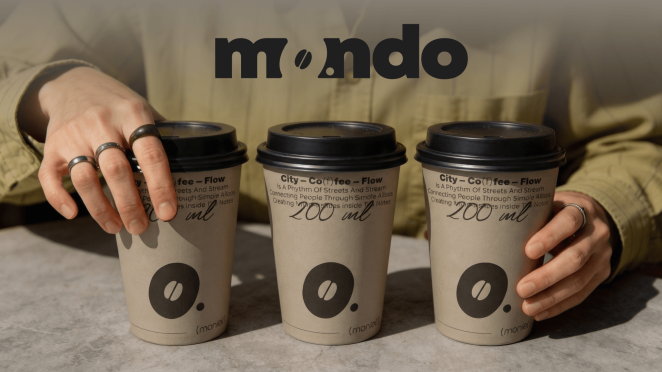 At this stage of my career, I’m most proud of my graduation project — a large-scale board game that I developed entirely from concept to physical prototype.
The project included full brand identity development, character design, game mechanics (partially explored and refined using AI tools), more than 150 playing cards, a 50×50 cm illustrated folding game board, a professionally typeset rulebook, tokens, dice, and a 30×30 cm retail-ready box structure.
But what truly made it transformative was the production process. Turning digital files into a physical product required deep involvement in print specifications — paper density, lamination, die-cutting, folding systems, box construction, and material durability. I personally contacted and visited numerous print houses to make it happen.
That experience reshaped my understanding of design. It taught me that creativity doesn’t end with visuals — it extends into engineering precision and material reality.
On a broader level, I’m also proud that I received a job offer before even defending my diploma, based on my portfolio. For me, that was strong validation that the effort and discipline invested in my development were meaningful.
As someone with experience in the industry, what trends do you foresee shaping the future of creativity?
I don’t believe trends themselves shape the future of creativity. Past, present, and future are built on fundamental principles — composition, hierarchy, balance, clarity of message. Trends are temporary; strong foundations are timeless.
Design that relies solely on trends rarely becomes long-lasting. To be relevant over time, creative work must be rooted in structure, logic, and purpose.
That said, the most transformative force shaping the future of creativity is undoubtedly artificial intelligence. AI is not just a trend — it’s a structural shift. It is redefining workflows, expectations, and production speed. The industry today is already fundamentally different from what it was five or ten years ago.
The future will likely belong to those who can combine classical design principles with technological fluency.
What do you think sets apart truly exceptional creatives from the rest of the pack?
Truly exceptional creatives are distinguished by depth of thinking, not just visual execution.
They understand fundamentals. They don’t blindly follow trends — they interpret them strategically. They think systemically. They ask the right questions before jumping into visual solutions.
Exceptional creatives also demonstrate adaptability. They evolve with technology rather than resist it. They are curious, disciplined, and constantly expanding their perspective.
And perhaps most importantly — they take responsibility for their ideas. They understand that creativity is not chaos; it is structured exploration guided by intention.
How do you think technology has influenced the creative industries and how have you adapted to these changes?
 Technology — especially artificial intelligence — has radically transformed the creative industry.
The profession today is not the same as it was even a few years ago. Tools, expectations, production speed, and skill requirements have shifted significantly. AI has accelerated ideation, prototyping, and content production to a degree that was previously unimaginable.
My first reaction, like many others, included uncertainty and even a degree of fear. But I quickly realized that adaptation is not optional — it is essential. You either evolve, or you become irrelevant.
Instead of resisting change, I immersed myself in learning AI tools and integrating them into my workflow. Over time, I genuinely grew to appreciate them. AI has expanded creative horizons, opened new possibilities, and optimized processes in ways that were impossible before.
For me, AI is not a threat — it’s an amplifier of creativity. It allows ideas to move from imagination to execution much faster.
What is the one thing that you would change about the industry?
If I could change one thing, it would be the level of unnecessary competition and toxicity within parts of the creative community.
I’ve noticed that designers often perceive each other primarily as competitors rather than collaborators. There can be a lack of openness, mentorship, and constructive exchange. This sometimes creates an unhealthy environment.
I believe the industry would benefit greatly from stronger collaboration, networking, and knowledge-sharing. Creativity grows faster in supportive ecosystems than in hostile ones.
Any websites, books or resources you would recommend?
There are many excellent resources that have influenced my development. A few that I recommend:
Design Blogs:
Logo Design Love, David Airey, Ace Jet 170, Aisle One, Brand New (UnderConsideration)
Books on Design:
The Non-Designer’s Design Book — Robin Williams
The Elements of Typographic Style — Robert Bringhurst
Logo Design Love — David Airey
Design Is a Job — Mike Monteiro
Being Wrong — Kathryn Schulz
The last book, although not strictly about design, is particularly important. It reminds us that both designers and users are human — and humans make mistakes. Empathy and intellectual humility are powerful qualities in any creative professional.