

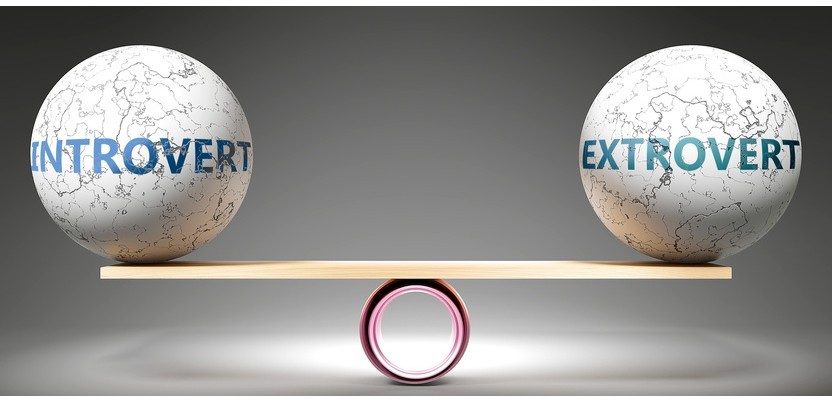

Rumors have it, extroverts rule the world. Well, you know: all that stuff about they are more successful in life and career, thanks to a proclivity for leadership, communication, and constant search for fresh experiences.
Every second person works in open spaces today, having tons of small talk with colleagues. Kids are told that teamwork matters for career success. And self-presentation during a job interview is often treated as one of professional experience and skill.
All this leads to the fact it may be not simple to admit you are an introvert:
If you are lucky, people will associate your introversion with modesty and delicacy; if not — they'll call you a gun-shy, egocentric, or even misanthropic person.
The problem with most job openings
I have a few introverted friends who seriously believe they'll never succeed in their careers because of introversion. They read job openings online, see something like, "We look for a cheerful, active, and sociable person. Networking skills are a must-have," and they are ready to throw in the towel.
Sad but true: such requirements still have a place to be in many career opportunities. Do they doom all introverts for career failures or remote work, as a minimum?
Sure enough, you can pretend to be a super-active and communicative extrovert during a day in the office; but if that's the case, big chances are you'll spend all evenings exhausted and stressed after work.
So what shall I do to get the job of my dreams? Crucify my introversion for the sake of my career? Or live in the shadow of my extroverted colleagues, sitting in a dark corner and fulfilling monotonous tasks?
Four kinds of introversion
Introverts are often defined as those opposed to extroverts. Maybe, it's because extroverts spend much time on building communication with the outside world? They are more visible to others and, therefore, easier to understand. They are sociable, open, cheerful, and adapting to the environment.
Perfect job candidates, right?
Conversely, introverts struggle to establish contact with people and adapt to new circumstances. What employer would like that, huh? However, the division into introverts and extroverts is tentative: most of us are at different points in the spectrum, combining qualities of both types.
Jonathan Cheek from Wellesley College outlines four types of introverts:
-
Social: a person prefers solitude or socializing with small groups, but it's not because they are shy; it's their choice.
-
Thinking: a person is introspective and self-reflective in an imaginative and creative, not a neurotic way.
-
Anxious: a person prefers to be alone because they are unconfident about their social skills, so they feel awkward around other people.
-
Restrained: a person prefers to think carefully before they speak or act to avoid impulsive decisions.
Our choice of extroverted or introverted method of adaptation and its further implementation depends on many factors: cultural background, emotional stability, intellectual and spiritual level of development, environment, and context. That's why it's wrong to consider introversion a negative personality trait or a behavioral defect.
Introversion is coded in our DNA, which saves us from the need to redesign ourselves so we would fit into a system where only extroverts are believed to be successful in life and career.
Successful introverts
We can find tons of success stories of famous people who have been described as introverts, from unsociable Isaac Newton to well-liked Joan Rowling.
For example, Frédéric Dubut, over @ Bing, is considered one of this decade’s most prolific local SEO experts. He’s a former contributor to Xbox and producer OptimysticLabs—he’s also an international public speaker—but was he always so extraverted? Nope.
Another great example the children's book writer Theodor Geisel, better known as Dr. Seuss, worked alone and was afraid of meeting with kids. He didn't want them to see he wasn't that funny man everyone supposed him to be. But his aloofness didn't influence his writing talent, did it?
Modern realities give us, introverts, a lot of chances: a whole generation of IT entrepreneurs and opinion leaders is headed by Facebook founder Mark Zuckerberg, whose invention helped millions of people to communicate. But those who got to see him call Mark a typical introvert.
Over to you
Do we really need many people around to feel happy? Do we need to redesign our personalities to meet the formal criteria of success? If there was one thing we could learn in 2019, it would be self-acceptance.
The biggest lesson I've learned: there’s no pure black or pure white in this world. It doesn't need to be divided into pure extroverts and introverts or pure success and defeat. And if you feel uncomfortable with your career, it's never too late to make a turn.
Yes, it's scary. Yes, you will doubt. And yes, many will try to dissuade you.
But it is better to take the risk than spend years doing something that doesn't bring comfort and harmony with your inner self.