

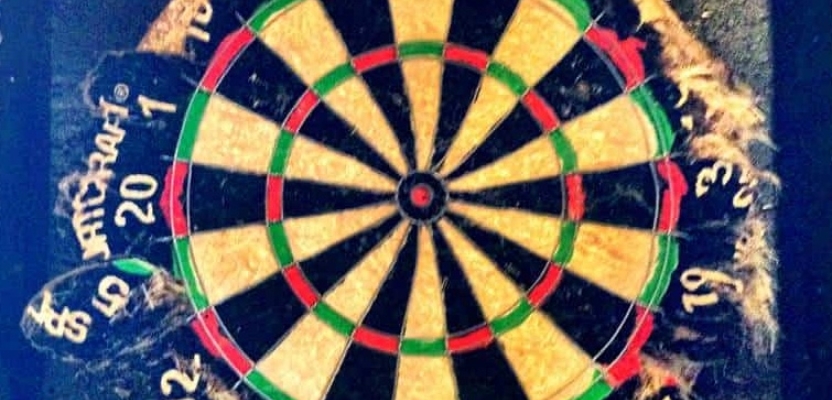

Was thinking, while staring into space (as I can’t do two things at once, and the brain was using all the glucose) about why dartboard (darts-boards?) numbers have that curiously loopy sequence.
Never considered it before, thinking ‘if I ask a darts-champ they roll their eyes’ or - worse - they might not know either.
So to spare everyone’s blushes, I looked it up.
Turns out there is a reason for the randomness - that the disorder is believed to increase the skill of the player, apparently. I took this anecdotally, at face value. I didn’t think anyone in Academe (or so I thought…) would PHD’d it out, that if the numbers run in any other order, including in order, darts-masters 180-it more effectively, efficiently, 10x more pointedly.
What distracted me from the enquiry was that, more interestingly, why any one person might stumble on that thought - and create the sequence we’ve ended up with?
A cursory search pointed to one Brian Gamlin (C.19th Lancastrian carpenter), who, again, anecdotally, was familiar with gambling laws and that the law took a dim of whether games gambled on were based on luck or skill (why not cheating I can’t fathom.)
His sequence gave us a game based on something mathsPeople call ‘flatness of distribution’ - meaning, I think, it reduces the element of chance. But that rewarded skill, or quickly speared poor skill.
And as in life, so in marketing - because one Thomas William Buckle (a Yorkshireman. Naturally, there had to be a ‘Roses’-based grudge to the invention-match) is also feted as the inventor, and while Gamlin failed to patent the idea, Buckle seems to have become a footnote (and who reads those?) and neither appear to have been able to capitalise on it.
Anyway, the point is (well, at least to me) that sometimes randomness is a much more useful path to follow if you have the skills, because randomness’ flatteningness lowers the chance of one thing being singled out - which is exactly what you need when exploring questions, instead of alighting on the first answer that springs to mind. Might be a lucky chance. Won’t happen often though.
Which also makes a good case for not asking the machine first. The quickest answer might not be the one you actually need.
Sometimes it’s better to start on slide 14 and then work your way around.