

Several things that I’ve needed to interactive within the last few days have brought home that, yet again, design has a lot to answer for when it comes to who to trust.
And I doubt it was the designer’s making those decisions, so let’s get that one out of the way first.
Because mostly (and I can only speak personally here) as a profession we don’t deliberately set out to design-out trust in the things we want people to use. Which leaves the question hanging, who does?
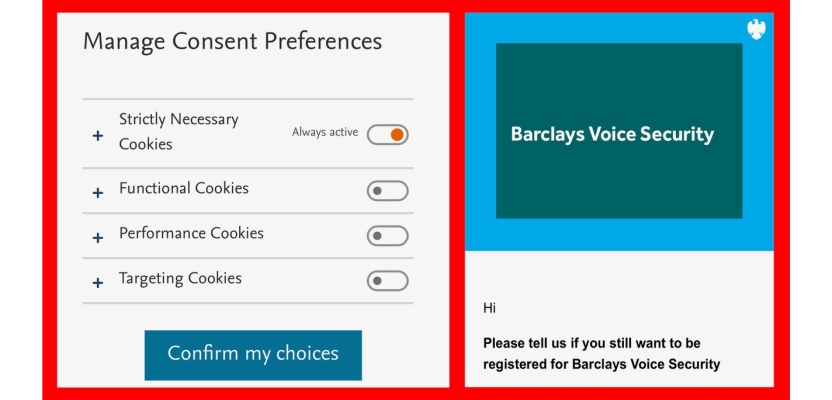
In the first instance I have to assume it was the client. Take the left-hand part of the header image. Typical set of GDPR allow / decline modal choices.
However, the ‘always active’ thing is in red. Red, in my world, means off. Or stop. The other optional three are in grey. Which to me looks like ‘on’, but when I switch them over, they go to red. Is that on? Or off?
Colour me suspicious but I’d say this kind of deliberate, let’s call it ambiguity, (and it’s not the first time I’ve seen it recently) isn’t really conducive to trusting the vendor. But it’s their loss, I bailed and hit the back button, a fall at the first fence.
The reason for my increasingly guarded behaviour is that we (well, I) now watch for even the smallest of signals that something isn’t what it purports to be - and I’m wondering how this is starting to play out in other areas of our online activities.
Take banking. Lots to trust needed there. But when agencies start to erode that - or undertake small gestures through the interface design that are ambiguous - it’s a pernicious path.
The other half of the header image is a screenshot from an email from a bank. Now, I think I might have signed up to Voice Security, but the tone of the email, I dunno, just snagged somehow. Do I still want to be registered? I haven’t asked not to be. Why should I not be? Has my voice changed somehow? Has the software changed somehow? Is it still secure?
See? Already I’m not sure I trust this.
I’ve started to ignore test messages from business I previously interacted with, as so much mental negotiating is needed I’d rather err on the side of caution. You want to reach me? Well, it’s going to cost that business as a. They might now need to spend more time and energy getting in touch or b. Post me a letter.
When everyone was dreaming of cost efficiencies and streamlined savings, and how much simpler all this stuff was going to be, one really important thing gradually began to get overlooked.
That most important commodity, trust. And the most fragile.
If you’re a designer working on this kind of thing, you need to be working extra hard to remind your client to make sure they’re not getting you - by oversight, accident, intention - to design-out trust.
You (we) have a duty to remind them of the consequences to the relationships they’re investing in, on spending money on design that will build trust; or at least the means to re-inforce it - and not to use thoughtless design decisions undermine it.
Once it’s gone, design ain’t going to help bring it back.
We have that responsibility to say so - even if ultimately we can’t make it so, because, well, yes, clients.
Right, must get on, just had an email from those lovely people at Boots that I’ve won a Ninja Air Fryer. Just what I wanted, better get my claim in quick. Lucky me!