


Breathe is an award-winning interactive data story (2nd Prize, Data Lab Competition 2026, University of Edinburgh) that explores how climate action can lead to exponential improvements in air quality across the UK. Using online shopping and parcel delivery as a familiar example, it shows that small, everyday choices add up, helping individuals understand their role in reducing avoidable emissions. The project uses modelled data from the Edinburgh Climate Change Institute (ECCI), based on Climate Change Committee (CCC) recommendations, to illustrate potential air-quality gains over the next 25 years. These co-benefits are expressed as monetised estimates, allowing users to compare places and understand how local actions contribute to wider societal gains.
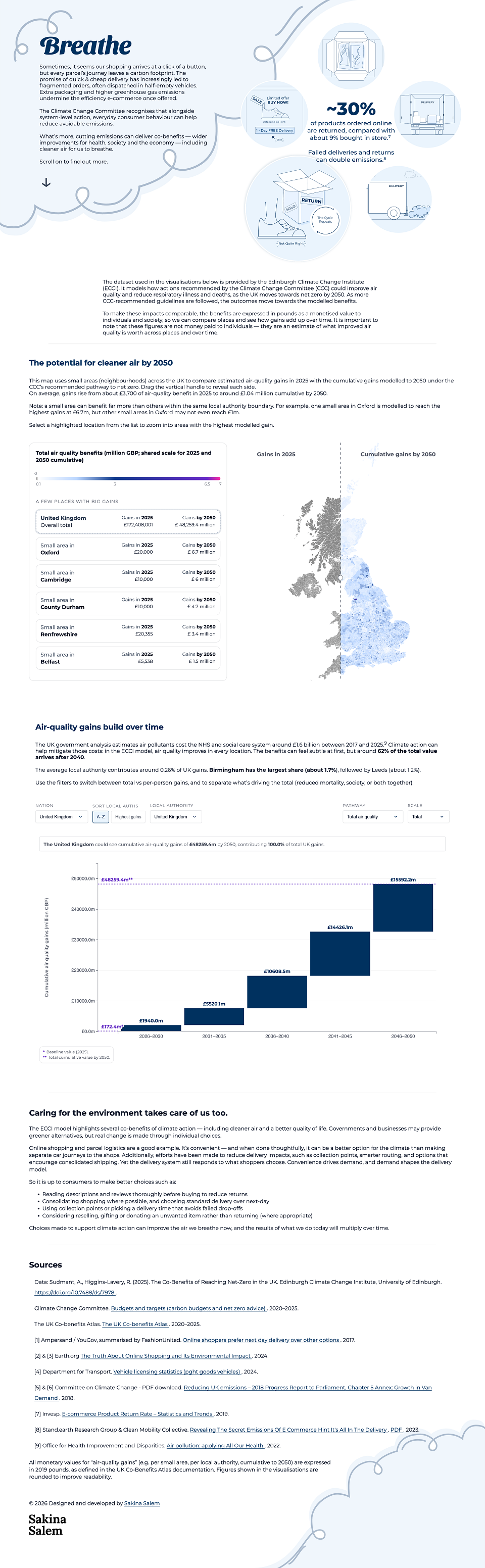
The project has three main sections:
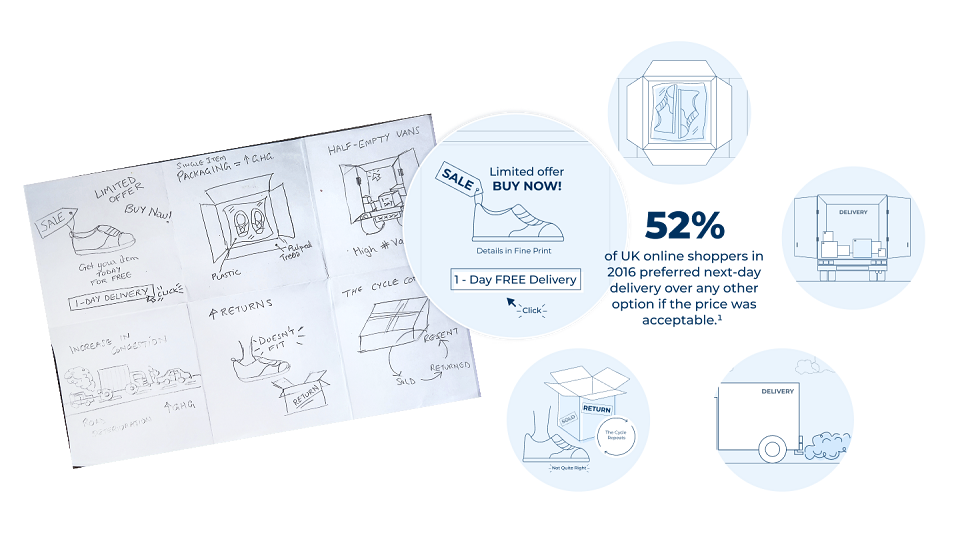
Carousel: Introduces the challenge of high emissions from online shopping and returns. Unlike typical carousels, it presents the full cycle while highlighting each stage sequentially, using scale and opacity rather than hiding elements. Hand-drawn sketches were used to plan the flow, which were then designed and prototyped in Figma.
Interactive Map: Visualises air-quality gains at neighbourhood level across the UK. Users can compare estimated benefits in 2025 versus cumulative gains by 2050, using a slider and magnifier to explore locations with the highest gains. The map was optimised for fast loading with a lighter-weight shapefile from mapshaper
.
Waterfall Chart: Demonstrates cumulative air-quality gains, showing how incremental actions compound over time. A waterfall chart was deliberately chosen over line or bar charts to emphasise accumulation.
The site was built using HTML, CSS, and D3.js, with illustrations and overall design crafted in Figma to create a cohesive and immersive storytelling experience.
Breathe shows that air-quality improvements are exponential and consistent across all locations, challenging the perception that individual efforts are insignificant. By reframing climate action as a tangible, achievable outcome, it empowers individuals to make greener choices that collectively create meaningful societal impact. The project was recognised for its design-led approach and effective storytelling, demonstrating how complex datasets can be translated into accessible, engaging, and actionable insights for both the public and stakeholders.
For this insight—enabled by the choice of the waterfall chart and the overall design and narrative experience—the project was awarded 2nd Place at The Data Lab Competition 2026.
The DataLab Competition 2026