

The creative industries are experiencing a paradigm shift with the rapid rise of artificial intelligence. From design studios and ad agencies to film sets and music production, AI tools are infiltrating creative workflows at an unprecedented pace.
The big question echoing from boardrooms to brainstorming sessions is whether this new technology is a trusted sidekick enhancing human creativity, or a stealthy rival poised to usurp the well-earned roles of creatives. The debate is heated and multifaceted, with industry voices split on whether AI will augment or undermine the creative process.
The Sidekick: AI’s Promise in Creative Work
Many creatives and industry leaders argue that AI is best viewed as a powerful creative sidekick – a tool that can amplify human talent rather than replace it. In this view, AI takes on supporting duties, handling tedious tasks or generating fresh ideas, thereby freeing up artists and writers to focus on the uniquely human aspects of creativity. The ideal is that AI can act as an enabler or co-pilot, working in service of human vision.
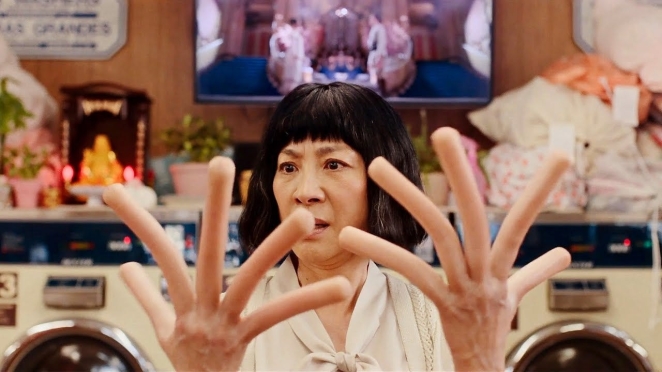
Examples of AI playing a supporting role are increasingly common. In filmmaking, AI-based tools have been used to accelerate visual effects and editing processes without removing the human creative spark. The Oscar-winning film Everything Everywhere All at Once is a case in point: the team used Runway AI’s video tools and other generative tech to conjure up surreal multiverse visuals on an indie budget. Rather than replacing the VFX artists, these AI tools allowed a small team to achieve ambitious imagery faster and more affordably than traditional methods.
In fact, the major Hollywood strikes of 2023 reinforced this supportive vision of AI – the unions insisted that “AI should serve as a tool to support, not replace, human talent” in creative fields. This principle, established by the Writers Guild and SAG-AFTRA, frames AI as a co-creator that handles grunt work while artists steer the creative direction.
Advertising and marketing professionals are likewise finding an ally in generative AI. Brainstorming is one area where AI shines as a sidekick. Creative teams report that chatbots and image generators can rapidly spitball concepts and visuals, sparking human imagination.
“AI definitely has a place in the creative process,” says Adrienn Major, founder of London post-production company POD LDN. Creatives find it “particularly useful and valuable as a brainstorming tool to prompt ideas that teams can then build on,” she notes.
In other words, an AI tool like ChatGPT or Midjourney might suggest an off-the-wall tagline or rough sketch, which human creatives can then refine and infuse with emotional nuance. AI can also crunch data behind the scenes – analysing audience demographics or past campaign performance – to provide insights that inform the creative strategy. This data-driven assistance augments the creative decision-making with facts and patterns that humans might miss.
Crucially, proponents argue that AI’s capabilities complement rather than compete with human strengths. AI models excel at processing vast datasets and mimicking patterns; they can produce a hundred variations of a concept in seconds or handle mind-numbing production tasks. But humans bring emotional intelligence, cultural context, and originality.
As Adrienn Major points out, current AI “models can create text and images using information that is already available, but they cannot apply emotions or think of new ideas that have never been done before”. Originality and empathetic storytelling are still uniquely human domains. In this optimistic scenario, AI does the heavy lifting of execution while humans focus on ideation, intuition, and the creative “spark” that machines lack.
Voices from large agencies echo this collaborative outlook. WPP, one of the world’s biggest advertising groups, has heavily invested in AI, with its CEO declaring the technology “fundamental” to the future of the business. However, WPP’s tech leaders emphasize that creativity remains a human forte.
“Creativity, in its purest form, remains a human skill,” says Stephan Pretorius, WPP’s Chief Technology Officer. He argues that AI can eliminate repetitive tasks – generating variations of an ad copy, resizing images, basic editing – but that doesn’t equate to eliminating jobs outright. Instead, roles will be redefined. “AI replaces tasks... it doesn’t eliminate jobs,” Pretorius explains, though it does force agencies to restructure teams and workflows around these new tools.
In practical terms, an art director might spend less time manually tweaking layouts and more time guiding the AI with the right prompts and then curating its outputs. New hybrid roles like prompt engineers or AI art directors are emerging, illustrating how human creatives can ride the wave rather than be swept away by it.
Beyond boosting efficiency, AI can open up new creative frontiers that were previously out of reach. Generative AI systems can conjure visuals, music, or prose in styles and combinations never before imagined, serving as an “inspiration engine.”
Creative professionals in fields from fashion to game design are experimenting with AI to spark novel ideas – for example, generating hundreds of quick concept art pieces to envision a character or setting, then picking the most striking ones to develop further. This democratization of ideation means even smaller studios or independent creators can access a virtually limitless idea factory.
As a report from the World Economic Forum noted, GenAI is “expanding the canvas of possibility, empowering more people, including those without deep technical or artistic skills, to join the creators’ board”. In other words, someone with a creative vision but limited traditional skills can use AI tools to bring their ideas to life, whether it’s a storyboard for a film or a prototype logo design. Proponents hail this as democratising creativity – AI as the great equalizer that lets human creativity flourish on a broader scale.
The Stealth Rival: Fears and Creative Clashes
On the other side of the debate, there is palpable anxiety that AI may become a stealthy rival, displacing human creators and devaluing creative work. Skeptics point out that the same capabilities that make AI a handy sidekick also enable it to perform creative tasks with minimal human involvement – and potentially compete with human creatives for jobs and audiences.
In advertising, this fear hit a crescendo when tech giant Meta (Facebook’s parent company) announced plans for generative AI tools that could let businesses auto-produce entire ad campaigns. Mark Zuckerberg boldly described the approach as a “redefinition” of advertising where “you don’t need any creative, you don’t need any targeting, you don’t need any measurement, except to be able to read the results that we spit out”.
To many ad professionals, that sounded like sounding the death knell for large swathes of the industry – comments that “appear to render much of the advertising industry obsolete,” as The Guardian observed. If a company can just feed a prompt to Meta’s AI and get back thousands of ad variations optimized for performance, why hire a creative agency at all? The prospect of AI bypassing human creatives entirely has stoked fears of job losses on a massive scale.
Those fears are not unfounded. Within big advertising agencies, executives acknowledge that AI-driven automation will shake up employment. The expectation is that roles in production and basic content creation will be the first on the chopping block, as those tasks get automated by algorithms.
From automated graphic design tools to copywriting bots, the lower-level execution work is increasingly done by machines. Creative strategists and high-level concept developers might remain in demand, but entire production departments could be slimmed down dramatically. Indeed, some ad holding companies have already started restructuring and announcing redundancies in response to AI efficiencies. The economic incentive for clients is clear: if campaigns can be generated “quicker and cheaper” by technology, they will push agencies to cut costs accordingly.
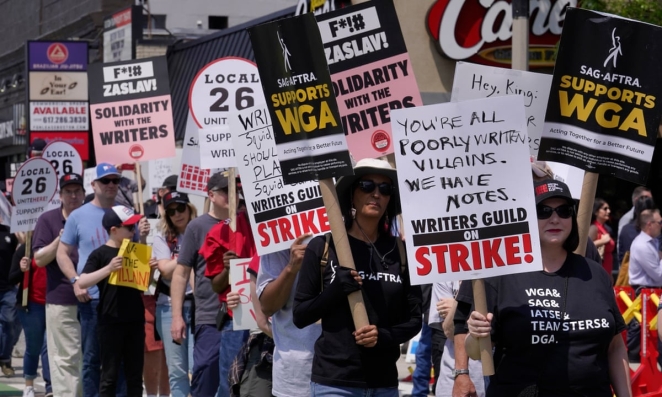
This undercurrent of job risk isn’t limited to advertising either. Across creative sectors, artists, writers, and performers have raised alarms about AI undercutting their livelihoods. In Hollywood, the threat of AI-written scripts and digital actors became a flashpoint in 2023. Screenwriters feared studios would use AI to churn out scripts or doctor existing ones without proper credit or pay for writers.
Meredith Stiehm, President of the Writers Guild of America West, articulated a core concern: “Writing, like any art form, is based on a lived human experience, an emotion... AI can’t bring lived experience”. In her view, a machine might assemble a plot competently, but it lacks the human soul that infuses authentic storytelling. The guild took a firm stand in negotiations, demanding protections so that AI could not replace writers or underpay them.
Their strike succeeded in securing some first-of-their-kind clauses – for instance, studios agreed that an AI-generated script cannot be simply handed to a human writer for polishing without that writer getting full credit and pay as an original author. And significantly, the WGA won recognition that “for purposes of compensation and credit, AI cannot be an author”. These measures underscore the guild’s stance that AI is a tool, not a creator, and any content it helps produce still requires human authorship to be viable.
Visual artists and designers have been equally vocal. Many view generative AI image models as copycats that threaten original art. The Graphic Artists Guild and other artist organizations have issued statements condemning AI image generators trained on scraped artworks. They argue that these models effectively plagiarize existing art without consent – a legal and ethical quagmire currently being fought in courtrooms.
In late 2023, a group of prominent authors (including John Grisham and George R.R. Martin) sued OpenAI for training ChatGPT on their novels without permission. Their claim: AI is effectively mining copyrighted creative works to produce derivative content, a practice they liken to theft.
“Writers are very skeptical of the technology,” noted Laura Blum-Smith of the WGA, adding that their position is that AI-generated content “is based on theft of their work”. For many creators, the rise of AI triggers a fundamental question about authorship and ownership: if a machine recombines the collective output of humanity to make a new image or story, does it have any true creative agency – or is it just laundering human creations in a soulless way?
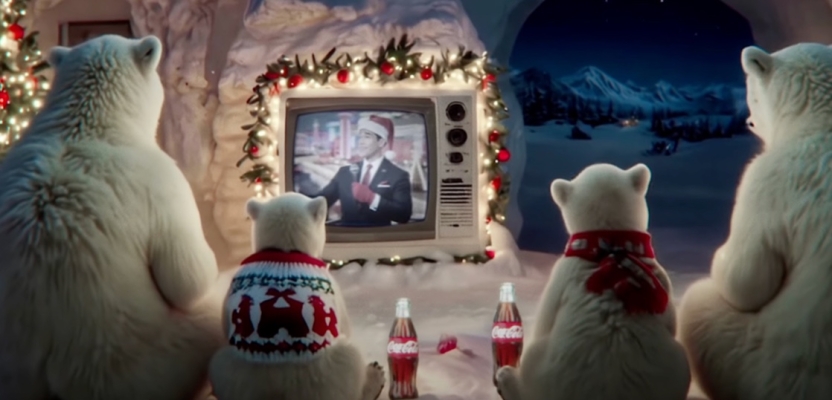
AI has even been used to reimagine beloved ads – Coca-Cola’s iconic “Holidays Are Coming” polar bear Christmas commercial was recreated with generative technology in 2024. While initial tests found positive consumer responses to the AI-crafted ad, a backlash soon followed as critics felt the remake had “sucked the warmth and joy” out of a classic, and “represented a larger threat to the creative community”.
The public and industry reaction to this experiment highlighted the unease that AI-generated content can provoke. Many felt the magic of the human touch was lost in translation, illustrating how AI’s involvement in creative work can be a double-edged sword.
High-profile incidents like the Coca-Cola ad debacle underscore a broader point: authenticity and emotional resonance are hard to fake. Audiences often can tell when something is a “pure AI piece of work” – it may look polished on the surface but comes off as “glossy, very idealised and slightly plasticky” as one creative director observed. In Coca-Cola’s case, what began as an impressive technical feat quickly turned into a PR lesson on the limits of AI creativity.

The brand was accused of stripping the soul and creativity from a much-loved holiday tradition in favour of a gimmick. For many in the creative community, this was emblematic of the stealth rival problem: AI can mimic and mass-produce, but it lacks the genuine warmth, imperfection, and cultural insight that human creatives bring. When pushed too far, AI risks crossing from helpful tool to outright replacement, potentially churning out content that is efficient but devoid of the spark that resonates with people.
Nowhere is this cultural clash more evident than in music. In 2023, an AI-generated song mimicking the voices of Drake and The Weeknd (“Heart on My Sleeve”) went viral and sent shockwaves through the music industry. Fans were astonished at how closely the AI replicated the artists’ vocals, and some even praised it as a glimpse of the future. But record labels and musicians saw a looming threat.
The track was quickly pulled from streaming platforms after Universal Music Group condemned it as “infringing content created with generative AI.” UMG’s statement drew a line in the sand, asking “which side of history all stakeholders in the music ecosystem want to be on: the side of artists, fans and human creative expression, or on the side of deep fakes, fraud and denying artists their due compensation”. In framing it as a moral choice, the label voiced what many artists feel – that AI clones are a form of creative identity theft and a direct rival to real artists.
The incident fueled debate about the “soul” of music: listeners noted that despite the novelty, the AI song lacked the subtlety and emotive ad-libs of a true Drake performance. Critics in the hip-hop community called it “an insult to the artistry” of the genre, echoing a sentiment that no algorithm can capture the lived experiences and cultural context from which authentic music flows.
Indeed, some of the strongest words against AI in creative fields come from celebrated creators themselves. Oscar-winning filmmaker Guillermo del Toro lambasted the notion of AI-generated art in film, calling it “an insult to life itself”. “I consume and love art made by humans,” del Toro said emphatically, expressing no interest in artwork made by machines. He and others, like animation legend Hayao Miyazaki, see AI art as antithetical to the very definition of art – which, to them, is the expression of human life and soul.
Such impassioned critiques highlight a fear that if AI becomes a ubiquitous creator, art could lose its meaning as a human endeavour. The phrase “insult to life” might sound extreme, but it captures the visceral rejection many artists feel toward algorithmic creativity. In their eyes, treating AI as just another creative tool downplays the profound difference between something born of human struggle or inspiration and something generated by pattern prediction. It’s a warning that if the creative industries aren’t careful, they could embrace efficiency at the cost of authenticity and humanity.
Navigating the New Creative Landscape
Between the enthusiastic early adopters and the staunch resistors, a nuanced middle ground is emerging: one where the future of creativity is a partnership between human and AI, albeit a partnership that must be managed thoughtfully. The reality is that AI is here to stay in the creative industries – the genie is out of the bottle. The challenge ahead is figuring out how to harness AI’s strengths without undermining human creativity, ethics, and jobs. This means establishing new norms, skills, and safeguards in creative work.
One key realization is that embracing AI does not necessarily mean the death of human creativity, but it does require adaptation. Forward-looking creatives and companies are reframing the narrative: rather than viewing AI purely as a threat, they see it as a catalyst to evolve outdated workflows.
Patrick Garvey, co-founder of agency We Are Pi, suggests that Meta’s automated ad tools signal “not the death of agencies, [but] the death of outdated agency models.” In other words, agencies that cling to old methods may struggle, but those that reinvent themselves around AI can still thrive.
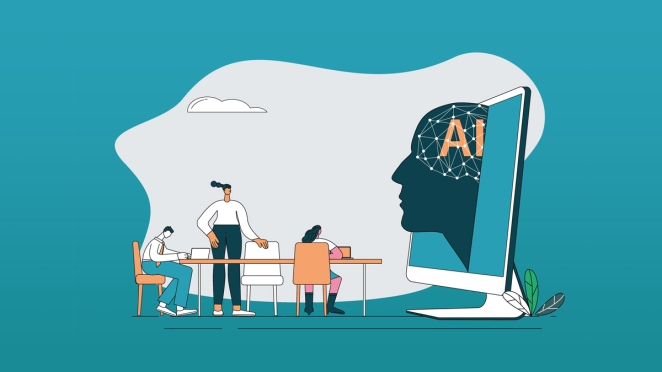
This sentiment is increasingly common – that the introduction of AI is forcing a creative renaissance of process, where human talent works alongside AI in new, more efficient configurations. Agencies are experimenting with hybrid teams where, say, an AI might generate 100 rough ad variants, then human creatives curate and polish the best ones. Design studios might use AI to produce countless thumbnails or colour schemes, but the creative director still chooses and refines the final aesthetic. In effect, the creative process itself is being reimagined: less manual grunt work, more curation and high-level decision-making by humans.
To make this partnership work, skills development and ethical guidelines are crucial. Many creative professionals are upskilling, learning how to “talk to” AI systems through effective prompt engineering.
As Adrienn Major described, her team leans heavily on ChatGPT to fine-tune prompts that get the desired results from various generative tools – essentially turning prompt-crafting into an art form of its own.
At the same time, industry groups and companies are formulating ethics rules and best practices for AI use. For instance, advertising bodies in the UK have formed AI taskforces to set guidelines on transparency and intellectual property. Discussions are underway about content labelling – should AI-generated content be disclosed to audiences? – and about fair compensation (e.g. if an AI is trained on an artist’s style, should that artist get a royalty?).
Regulators are slowly catching up too; Europe’s proposed AI Act and various copyright lawsuits will eventually draw some legal boundaries for acceptable AI use. The overarching goal is to ensure AI is implemented in a human-centric, responsible way. That means creatives using AI should respect source materials, avoid bias and misinformation, and ensure the technology serves creative expression rather than cheapening it.
Another emerging trend is the development of in-house AI tools tailored to creative workflows. Rather than relying solely on generic models, some agencies and studios build custom AI systems that align with their specific needs and values. These bespoke tools can be trained on a limited, curated dataset (to avoid legal issues and align with brand voice) – a concept often called “walled garden” AI.
For example, a film studio might train an AI on its own script library to assist with storyboarding or a game studio might develop an AI to generate concept art in its signature style, under the art directors’ guidance. By controlling the training data and objectives, creators can use AI in a way that amplifies their brand and protects originality.
This approach mirrors what we’re seeing in news media too, where publishers are negotiating licensing deals so AI can be used with their content ethically. Across sectors, the message is that if AI is to be a sidekick and not a rival, humans must stay in the driver’s seat – setting the creative vision, curating the outputs, and ensuring the final product carries the intentionality and responsibility that we expect from human-made creations.
As the dust settles, a likely scenario is that AI will become a standard part of the creative toolkit, just like digital cameras or design software – indispensable for efficiency, yet still reliant on human operators for meaningful results. The companies and creatives that flourish will be those who learn to strike a balance: leveraging AI’s speed and scale while preserving the human elements of insight, emotion, and storytelling.
It may also mean a shift in what skills are valued. The next generation of creatives might be prized not just for their ability to draw or write, but for how well they can direct AI tools to realize a vision. In this sense, AI could elevate the role of human creatives to more of a curator or editor-in-chief, orchestrating a symphony of machine-generated drafts into a cohesive, inspired final piece.
The debate won’t be settled overnight. In truth, AI is proving to be both – it can be a sidekick in the hands of those who wield it wisely, and a rival in situations where it’s allowed to supplant human effort without care for quality or ethics. The creative industries are in the midst of negotiating this relationship. Cautious optimism seems prudent: treat AI as a promising apprentice but watch it closely.
Many in the industry maintain that no matter how advanced AI becomes, the core of creativity is deeply human – rooted in personal experience, cultural context, and emotional connection. As long as we safeguard those elements, AI can turbocharge production without extinguishing the creative spark. Or, as one might put it, the magic still comes from the human heart, with AI providing both the wand and the spellbook.
Word Nerd Copy July 29th, 2025, in the small hours
This is a great, insightful read that tackles both sides of the debate sensitively. One aspect that isn't covered, however, is the impact the theft of original work has on creators. For example, recent layoffs across the media industry (tech journalism sites, particularly) have mostly been due to declining traffic. This is a direct result of Google's AI search boxes. Many people get the answer they need to their search directly from the AI search box, without clicking through to the original source. This answer, collated from content stolen from writers for these various sites, eliminates the need for people to visit the sites in question. That decline in traffic has seen some well established, huge sites like Laptop Mag shuttered entirely, while others like Polygon have been bought out, paying off entire teams of writers and editors. It's the hidden impact of AI nobody is talking about and I believe it needs more media coverage.