
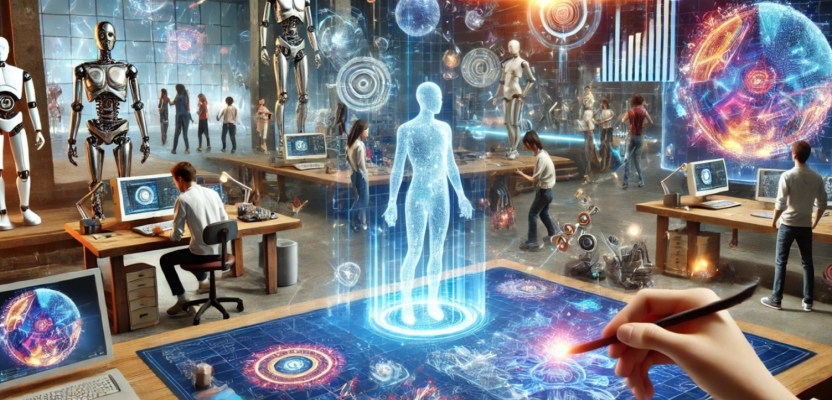

Generative AI has become a huge trend in the last few years. This technology allows us to create unique creative works for different purposes. It opens up new opportunities for artistic expression. Today, many businesses are partnering with a generative AI development company to build innovative solutions and enhance their creative capabilities.
By using ML algorithms and data analysis, generative AI pushes the boundaries of what is possible. We want to tell you more about the working principles behind this advancement. Keep reading and learn how it will impact the creative industry in 2025!
What Is Generative AI?
Generative AI is a subset of artificial intelligence systems. It is designed to create new content or data and mostly focuses on producing novel outputs. This technology relies on advanced machine learning techniques to analyze and recreate patterns in data.
GANs and Transformer models are the main architectures for Generative AI.
GANs consist of two neural networks – a generator and a discriminator. The generator produces new data samples. The discriminator evaluates their authenticity.
Transformers use attention mechanisms to process and generate sequences. They excel in handling large amounts of text and understanding context.
How do generative AI models work?
First, we train the models on the type of content we want to generate. During training, they learn about every aspect of data, like
-
Patterns;
-
Relationships;
-
Structures.
Then, the model considers all these patterns to generate new materials.
Main Applications of Generative AI
You already understand the basics of generative AI. It uses advanced algorithms to provide innovative and diverse outputs. Now, let's talk more about its applications in the creative sector.
Content Creation
Automation of content creation is the main application of generative AI. For creators still learning what is generative ai, these systems use machine learning models to generate original content such as images, text, music, and video based on existing data patterns. It allows creators to save time and find new ways to express themselves. We believe that this advancement will continue helping them produce different forms of content.
The first type we want to highlight is visual art. For example, tools like DALL-E and Stable Diffusion generate unique images based on textual input. They allow artists to experiment with different styles and compositions without extensive manual effort. These tools can also help them visualize concepts much faster.
AI-powered tools are also enhancing image editing, making it easier to refine and adjust visuals with minimal effort. An AI image editor can quickly modify images, enhance details, and apply creative transformations, giving artists more flexibility in their work.
Composers might use AI algorithms to create original musical pieces. These systems can generate music tailored to specific requirements, like
-
Background scores for films;
-
Video games;
-
Commercials, etc.
They let artists find unconventional harmonies and melodies.
AI tools like ChatGPT assist in producing narratives, articles, and even poetry. Writers can use these tools to overcome creative blocks or generate ideas. AI can adapt the tone and vocabulary to match the needs of a specific audience or project. Many creators still refine the output further to humanize AI-generated text, ensuring it reflects their unique voice and creative intent. AI tools can also aid translators in producing content for multilingual audiences. Similarly, Respeecher enables creators to turn that written content into expressive, human-like audio using advanced voice cloning technology. Whether you're producing an audiobook, course material, or localized media, Respeecher’s AI voice cloning delivers natural, emotionally rich audio across multiple languages.
According to Karina Egle, an SEO specialist from the internet marketplace platform Whop, "Generative AI is making content creation more agile and adaptable. Writers can leverage these tools to quickly generate ideas and refine their content, significantly speeding up the writing process. What's particularly exciting is AI's ability to tailor content to specific audiences by understanding trends and context. This allows for more targeted, relevant storytelling, which can boost engagement and improve SEO outcomes."
Game Development
Generative AI will impact the gaming industry as well in 2025. These systems can generate realistic game environments. They take inspiration from actual geography or completely fictional landscapes. This reduces the workload for game developers.
AI tools create complex characters with unique
-
Appearances;
-
Behaviors;
-
Backstories.
These characters can evolve depending on player interactions and choices. It makes the games more engaging.
Plus, this technology allows for adaptive storytelling that changes when a player makes certain decisions. It makes their experience more personalized. This unique playthrough ensures the game remains interesting for everyone.
In the gaming industry, personalizing user experiences is highly effective. Using iGaming personalization helps developers create customized content and interactions, which increases player engagement and satisfaction. These strategies can improve retention rates and provide better gaming experiences.
Film and Animation
The film and animation industries can also benefit from generative AI. This technology automates many time-intensive tasks and boosts creativity.
AI-driven tools simplify the creation of realistic visual effects, like
-
Natural phenomena simulations;
-
Explosions;
-
Addition of fantastical elements, etc.
This reduces production costs and shortens timelines.
Also, this technology helps filmmakers during pre-production. It can generate ideas and even draft dialogues. AI can also analyze existing scripts to suggest improvements or identify plot inconsistencies.
The next functionality we want to mention is AI-powered voice generation. This development creates lifelike dialogues for animated characters. It can mimic specific vocal tones or generate entirely new voices. This gives more flexibility in character portrayal with tools like FineVoice AI voice that enable creators to produce realistic and expressive audio with ease.
Advertising and Marketing
Generative AI demonstrates a lot of potential in the marketing sector. It allows specialists to create more impactful campaigns.
AI can generate advertisements and marketing materials based on individual preferences. It evaluates the tastes and needs of each person to design custom content, including
-
Video ads;
-
Emails;
-
Social media posts, etc.
Also, AI is a perfect tool for visual branding. It can assist in designing logos, banners, and other promotional visuals. This is really useful for businesses that want to create a consistent and appealing brand identity.
There are many AI platforms that can help with copywriting as well. For instance, Jasper AI and Copy.ai can produce engaging ad copies and promotional content much faster than human marketers. It gives them more time to focus on strategy and ideation.
Fashion Design
The next industry Generative AI will continue to change in 2025 is fashion. This technology introduces novel approaches to design and production.
AI algorithms will allow designers to push the boundaries of traditional aesthetics. They can help them generate innovative patterns, textures, and fabric designs.
Also, this advancement excels in data analytics. It evaluates information from
-
Social media;
-
Search trends;
-
Consumer behavior, and more.
AI can predict upcoming fashion trends based on these points. It helps designers stay ahead in the fashion market.
Architecture and Interior Design
Generative AI will continue to support architects and interior designers. This technology can generate innovative architectural designs and interior layouts. It often proposes ideas that human designers may not have considered.
AI tools can also produce high-quality renderings and 3D models. It allows clients to explore designs interactively before construction begins.
Plus, before generating designs, AI analyzes different factors like
-
Energy efficiency;
-
Material usage:
-
Structural integrity, etc.
Based on this evaluation, it suggest improvements to meet sustainability goals.
Challenges of Using Generative AI
Generative AI will bring even more exciting opportunities for creative industries in 2025. However, its integration also brings a unique set of challenges. You need to understand which difficulties you might have to use the full potential of this technology.
Ethical Concerns
The first concern we want to highlight is copyright infringement. AI models often train on big datasets, some of which include copyrighted material. It may result in intellectual property violations.
Also, AI outputs can mimic styles or reproduce patterns from existing creators. This may blur the lines between inspiration and copying.
Plus, this technology may accidentally strengthen the bias present in the training data. It usually results in stereotypical or exclusionary content.
Quality Control and Consistency
AI can produce remarkable outputs but it often lacks the nuanced understanding of context that humans can bring. Plus, it sometimes produces inconsistent results. This makes it unreliable for projects requiring precision and uniformity.
So, human intervention is a must to ensure the quality and relevance of generated content. An AI Humanizer can help with this process by making AI-assisted drafts sound more natural. However, too much manual editing can diminish the efficiency gains AI offers.
Job Displacement
The increasing use of AI also raises concerns about the displacement of creative professionals. Plus, many workers are worried about the need to adapt to new roles. They often require proficiency in managing and supervising AI tools.
Without proper education and training, it can become a huge problem. You need to explain how this technology can complement the work instead of replacing it.
Dependence on Data
We also want to mention that the effectiveness of generative AI depends on the quality and diversity of its training datasets. Poor data can lead to subpar or biased outputs.
Plus, gathering and using personal data for training AI models can raise significant privacy concerns. It can turn into a big issue if you don't obtain consent.
So, it's extremely important to approach all of this responsibly and ensure the quality of data you use.
Cost and Accessibility
Building and maintaining generative AI systems can be expensive. So, it can become a concern if you have a limited budget.
You'll need substantial computational power and energy to train these models. So, you might be at a disadvantage compared to big corporations.
Remember to evaluate how much you can spend and if it will pay off.
Regulatory Challenges
The last difficulty we want to mention is legal challenges. The development of generative AI outpaces the creation of legal frameworks for it. So, it might be hard to handle issues like liability and intellectual property rights.
Also, differences in AI regulation in different countries might become a concern if you operate internationally. So, you need to be really careful with how you use this technology to avoid unwanted consequences.
Conclusion
Generative AI will only continue to evolve in 2025. This technology has already made a huge impact in the creative sector and we believe it won't stop.
This technology allows creators to focus more on ideation and creativity instead of mundane tasks. Plus, it can become a huge source of inspiration. AI is already a big trend in many creative fields.
However, remember that no technology can become a substitute for human work. So, use it responsibly and enjoy the results it brings!