
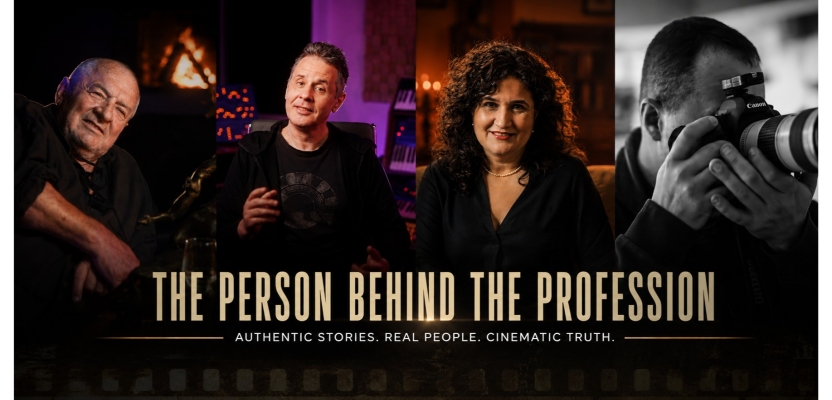

Three very different people. One question: how do you film professional authority without turning a human being into an advertisement?
I have a problem with a certain kind of professional film.
You know the type. Beautiful office, carefully placed lights, slow camera move. Somebody looks slightly off-camera and talks about passion, excellence, commitment, maybe innovation if we are unlucky.
Technically, there may be nothing wrong with it.
But quite often I get to the end and realise I still don't know the person.
I have made films professionally for more than twenty years, and I don't pretend I arrived at some grand theory from the beginning. A lot of this came gradually, while filming very different people and noticing what worked — and, probably more importantly, what felt false.
I'm Mugur Marin, filmmaker, cinematographer and editor at N-trance Media. My work has moved through events, concerts, corporate productions, interviews and documentary pieces. In the last few years I have become particularly interested in something simpler: putting one person in front of the camera and trying to understand what is actually interesting about them.
Not what sounds impressive in a brochure.
What is interesting.
Three films made that especially clear to me: one with a sculptor, one with a sound designer and one with a lawyer.
They couldn't be much more different.
Start with curiosity, not a list of services
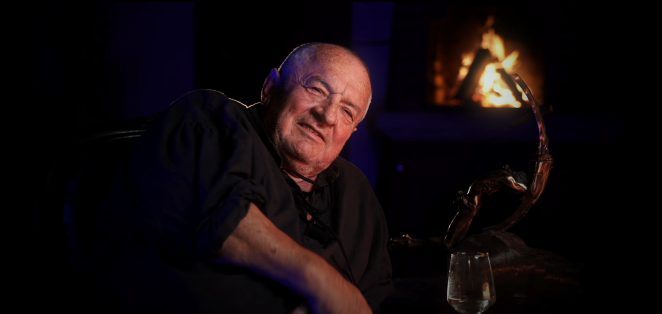
When I filmed Romanian sculptor Ion Mândrescu, I had an advantage that you normally don't get on a commissioned job: I already knew him.
We are friends.
That sounds like a small detail, but it changed the film.
With Ion I wasn't trying to discover his CV. I already knew the exhibitions, the sculptures, the themes that keep returning in his work. What I didn't know — or hadn't really looked at closely enough — was the rhythm of the man when he was surrounded by his work.
We filmed at night. There was fire behind him, bronze next to him, cameras everywhere, cables on the ground. On paper it sounds almost over-designed. In reality, after a while, all of that stopped mattering.
Ion started talking.
And once he forgot about us a little, things became interesting.
I found myself watching his hands. The way he would stop before answering something. The way a piece of bronze sitting beside him could suddenly become part of the conversation without anybody planning it.
There were questions I had wanted to ask about man, time and space — ideas that run through his sculpture — but some of the best moments were not answers to those questions at all.
They were the spaces around the answers.
I think that's when I understood that I didn't need to convince anybody that Ion was an important sculptor. Trying too hard to do that would probably have made the film worse.
The job was simply to stay there long enough for a little of his relationship with the work to become visible.
That is a very different objective.
Filming sound is a strange problem
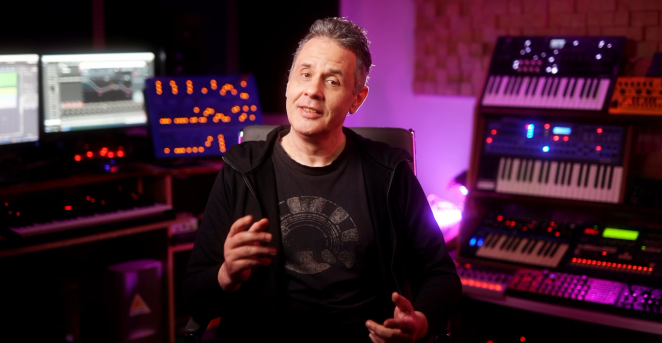
With Victor Popescu at Square Sound Studio, the problem was almost comic.
How do you film somebody whose work is mostly heard?
The studio is visually fantastic. Synthesizers, screens, speakers, blinking LEDs, keyboards — you could spend half a day making glamorous shots of equipment and come away with something that looks very expensive.
For a while that is tempting.
But none of those machines explain Victor.
What I kept noticing while filming him was the way he listened.
He would play something, stop, listen again, make a tiny adjustment, then listen once more. Sometimes the physical change was almost nothing. I couldn't necessarily hear what he heard immediately either.
That was much more interesting to me than the gear.
It made me think about how much professional experience is almost invisible from the outside. A client sees the finished result. They don't necessarily see the hundreds of tiny judgements that got it there.
When Victor is good at his job, nobody watching the final film says, "What excellent audio post-production."
They simply believe the film.
Once I understood that, the studio stopped being the subject and became the environment. Victor listening was the subject.
That's a small distinction, but it changed what I wanted from the camera.
With a lawyer, the temptation is the opposite
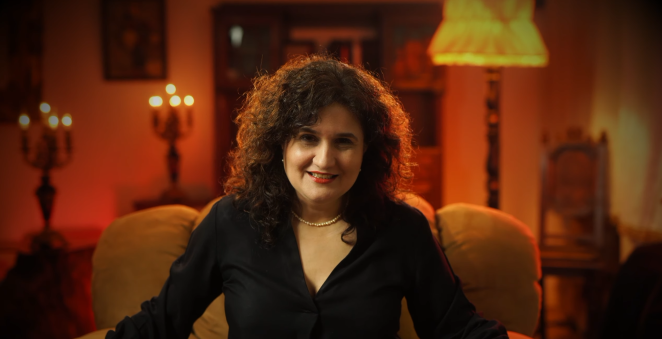
Then I filmed Ioana Adina Marin, who is a lawyer and mediator.
Here I had almost the reverse problem.
A legal profession already comes with a lot of visual baggage: authority, seriousness, formality. It would have been extremely easy to make everything darker, more imposing and more "important".
I didn't want that.
If somebody is choosing a lawyer, of course qualifications and experience matter. But I suspect another calculation happens at the same time, even if people don't say it out loud.
Will this person actually listen to me?
Will she understand what I'm saying before telling me what to do?
Will she explain something complicated without hiding behind jargon?
Would I trust her when things become difficult?
Those questions have very little to do with making somebody look powerful.
So with Ioana I tried to keep things restrained. The lighting was controlled, but I didn't want it shouting. The camera was close, but not aggressively close. In the edit I resisted the temptation to remove every pause just because I could.
Some pauses tell you something about a person thinking.
And once you notice that, cutting all of them out starts to feel strangely dishonest.
The camera can become part of the problem
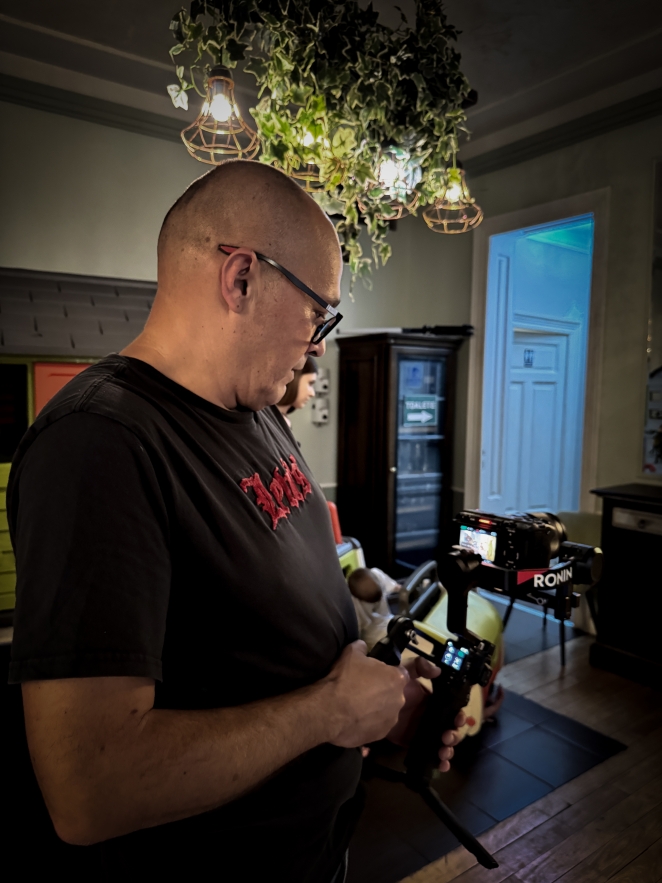
I like equipment. A lot.
I still enjoy a new lens more than is probably reasonable. I care about lighting, movement, sound, texture, lenses, camera placement. After more than twenty years I haven't become bored with any of that.
But I've also become more suspicious of it.
There are moments when you can make a shot prettier and make the film worse at exactly the same time.
I've done it.
You find a beautiful movement, the light catches something perfectly, everybody around the monitor likes it — and later, in the edit, you realise you're watching the shot rather than watching the person.
That's usually a warning.
These days I ask myself a fairly basic question:
Is this shot helping me understand the person, or am I just enjoying the shot?
I'm not claiming I always get that right. Far from it.
But the question has become useful.
Sometimes the answer is to move the camera.
Sometimes it's to leave it alone.
Sometimes somebody pauses for two seconds longer than feels comfortable and the instinct on set is to rescue them. Ask another question. Cut. Do something.
Quite often, doing nothing is better.
I almost never want the first perfect answer
This is probably the part of interviewing that interests me most.
People know when a camera is pointed at them.
Even people who say they're relaxed often change slightly when recording starts. Their vocabulary becomes tidier. Their posture changes. They begin producing the answer they think they should give.
You can almost watch the spokesperson arrive.
I don't think that's dishonesty. It's normal.
There's a camera six feet away.
What interests me is what happens afterwards.
Somebody gives the polished answer. Then they relax. Then they add, "Actually..." or "No, that's not quite what I mean."
That second answer is usually the one I want.
Not because it is messier for the sake of being messy. Because the person has stopped reciting and started thinking.
That creates another problem in editing.
Modern editing tools make it incredibly easy to remove every hesitation, breath and half-finished thought. You can make somebody speak with a fluency they have never possessed in real life.
Sometimes that's useful.
Sometimes you edit the person out of the film.
I'm still learning where that line is.
A portrait isn't just a commercial with fewer seconds
The difference, for me, is fairly simple.
Advertising often begins with:
Here is why you should choose us.
A portrait can begin with something less aggressive:
Here is this person. Spend a few minutes with them.
And strangely, that can be more persuasive.
If I watch Victor Popescu work and understand a little of how seriously he listens, I can decide for myself whether I would trust him with sound.
If I hear Ioana Adina Marin explain something and see how she thinks before answering, I can decide whether I would want her as my lawyer.
If I sit with Ion Mândrescu for a while in that strange combination of darkness, fire and bronze, I may begin to understand something about his work without somebody listing his achievements for me.
Nobody has explicitly told me whom to trust.
I've been given some evidence and a little time.
I prefer that relationship with an audience.
What I'm becoming less interested in
The technical standard of video keeps rising.
Cameras are extraordinary now. Editing is faster. Good lighting is more accessible. AI will make technically polished images and video easier and easier to produce.
I'm not worried that this makes filmmaking irrelevant.
But I do think it shifts the value.
If almost everybody can make something polished, polish by itself becomes less interesting.
I'm increasingly interested in judgement: knowing what to notice, what to leave alone, when to ask another question and when to shut up.
Taste matters.
So does patience.
And curiosity probably matters more than I understood twenty years ago.
I still want the image to be beautiful. I'm not going to pretend otherwise.
But I want the beauty to lead somewhere.
Ion thinking beside a piece of bronze.
Victor listening to a change I can barely hear.
Ioana pausing for a second before answering.
Those are tiny things.
They are also the things I remember.
And that's probably the simplest way I can describe what I'm trying to do with these films now.