

While global audiences discussed Bad Bunny’s Super Bowl halftime performance as a political statement and a celebration of Latin American culture, I was interested in looking at it through the lens of the visual industry. As an illustrator and graphic designer, I read symbolism professionally within visual language — through color, form, rhythm, and visual codes.
Drawing inspiration from Puerto Rico
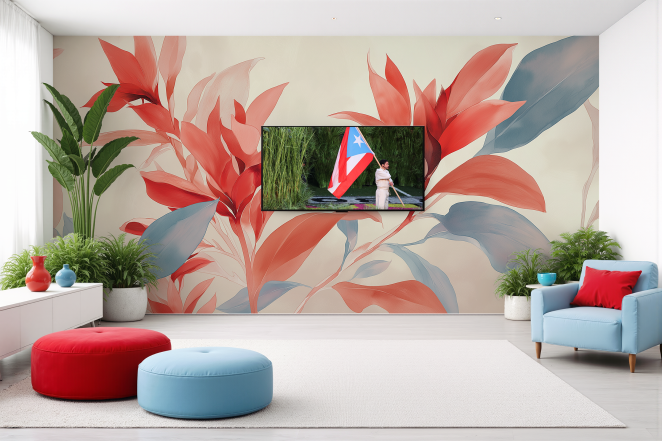
In his performance, Bad Bunny referenced countries across North, Central, and South America. However, the conceptual core of the show was clearly rooted in celebrating his homeland — Puerto Rico — along with Caribbean culture and Latin American identity. This is the aspect I want to focus on. In my practice, I work with textile and wallpaper companies producing everything from apparel to large-scale mural walls, and I see cultural events like this as valuable sources of visual and conceptual direction for applied design.

Letting go of stereotypes to find something new
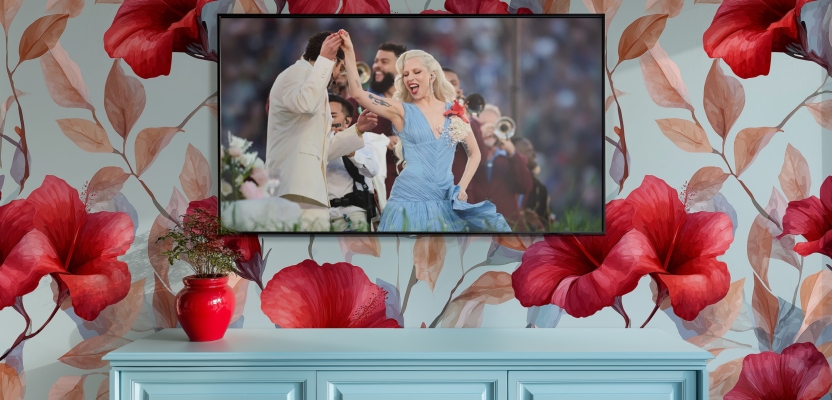
One of the key visual resources here is nature — not in a simplified or stereotypical sense (bananas and coconuts), but as a complex system of color and form. It is a layered palette of greens and blues that creates visual depth. The sky blue, in particular, deserves special attention: it references the sky, the sea, and the flag of independent Puerto Rico. This color logic was also echoed in Lady Gaga’s outfit, through the combination of sky blue, white, and red directly associated with the island’s flag.

Botany as a source of ideas
A significant visual accent was the Flor de Maga flower on the singer’s dress. From a professional perspective, this serves as a clear reminder of the potential of regional botany as a source for new decorative solutions — from textile patterns to fashion prints. The national flowers of Latin America — hibiscus, orchids, erythrina, and many others — offer a rich visual language shaped by diversity of forms and colors.

Why designers need to understand context
As a botanical and floral illustrator, I am convinced that working with such sources requires a conscious and respectful approach. In-depth research into a region’s flora, fauna, and cultural context allows us, first, to move beyond clichés and avoid superficial borrowing. Second, it enables the creation of truly authentic work with real visual value, rather than secondary or derivative aesthetics.

What we can take into our own work
I’m curious what professional insights you took away from this performance in relation to your own practice. Which visual or conceptual elements do you find applicable in your field? Let’s continue the conversation.