
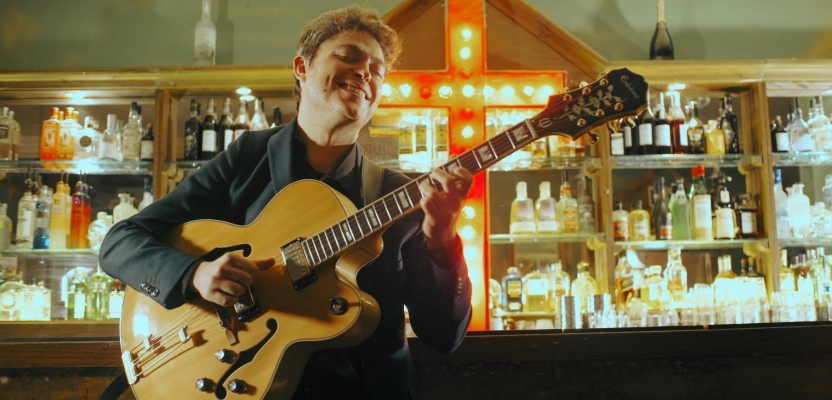

Embarking on his filmmaking journey by persistently knocking on production company doors, London-based director and videographer Lorenzo Gorini has transformed his passion for storytelling into a distinguished freelance career. With over 15 years of experience, Lorenzo's unique creative process—drawing inspiration from music, photography, and daydreaming—has led him to craft impactful visuals that resonate deeply with audiences.
How did you first get into the industry?
I literally knocked on production companies doors until one hired me for an internship.
Then after 6 months, with a bit more knowledge and some contacts, I decided to go freelance.
Where are you based now and who do you work for?
I am based in London, UK and I work for myself as a freelance.
What is your personal background and what role did it play in your career?
I went to Arts School, I have a background in music and have always had a natural inclination for creativity. My father was an avid reader and would tell me imaginative stories he made up before I fell asleep. These things have truly helped my professional growth and shaped the way I think and create stories and images.
If you weren’t in your current industry, what would you be doing?
Probably music or writing, or anything creative or artistic. Or probably a pilot. I love aeroplanes or anything that flies.
Can you explain your creative process? What makes it unique?
There are three main ways my creative process works. The first is watching photography or still images while listening to music. For some reason, I prefer still pictures and sound to think about moving pictures and visuals. The second is walking or running, exploring, and paying attention to small details in daily life.
The third is daydreaming (probably the one that happens the most): I literally zone out from reality and start imagining sequences of images and sounds in my head. It makes me look like a weirdo sometimes, but it's the most powerful way for me to get creative.
How would you describe your style?
Dirty but unique.
Which individuals do you gain inspiration from? Do you have any heroes in the industry?

Thinking about film directors, definitely Andrei Tarkovsky, Werner Herzog and Wong Kar Wai. I also really like Hayao Miyazaki and Studio Ghibli in general. Or Jan Švankmajer.
A cinematographer I really love is Cristopher Doyle. In advertising, I love the Directors of MEGAFORCE. They are on another planet.
What tips would you give to aspiring creatives looking for work?
Never stop creating or producing while looking for work. Every day is a creative day. Every moment is an opportunity to think, create, and shoot a video or write something down. Also, send that email. DM that person. Do it with good manners and don't worry about the outcome. You reap what you sow.
What tips would you give to other professionals to get more clients?
I guess my previous answer. And the classic ones: use platforms, attend events, networking is your friend.
What kind of tools/kit/software could you not do without?
Tools: My head. Software: Davinci Resolve and After Effects.
What’s your secret to staying inspired and motivated?
Realising that inspiration doesn't fall out of the sky. There is no Hyperuranion, no realm of ideas sending you hints. It's a muscle; you need to train it and feed your mind consistently. Same for motivation. You go running regardless of the time, weather, or your feelings, you just go running.
What’s the work achievement you’re most proud of?
Making it as a freelancer in a world of corporations.
As someone with experience in the industry, what trends do you foresee shaping the future of creativity?
The obvious one is AI, but if used creatively in a mixed environment of craftsmanship and automation. The best results we can already see are a fusion between the two, where AI is used to either speed up slow processes to focus on real innovation or to enhance creativity with unthinkable solutions.
What do you think sets apart truly exceptional creatives from the rest of the pack?
They don't follow trends. They either create them, or go completely against them, making them truly unique.
How do you think technology has influenced the creative industries and how have you adapted to these changes?
I think that creativity and technology have always had a 50/50 relationship.
Sometimes creative ideas drive technological innovation when they encounter limitations; sometimes limitations drive creative ideas as a workaround, and sometimes new technology inspires different ideas and breeds genres.
Like the electric guitar: it created a new sound, and therefore a new genre; musicians were still using the pentatonic and the blues structure, but the electric drive made it 'different'
What is the one thing that you would change about the industry?
This is a tough question because it opens up a range of complex ideas. To keep it simple: I'd change the mode of access to resources, and the way Social Media is shaped.
Access to resources has always been determined by purchasing power, meaning those with an advantage (like more money or resources) will always stay one step ahead. New technology (software, AI, internet, etc.) has helped somewhat, but it quickly became part of the same system. This is a systemic issue.
As for social media platforms, they don’t foster innovation or creativity. Their goal is to commodify ideas, pushing for repetition (and plagiarism) to feed algorithms and drive views. The result is a cycle of sameness that often overshadows true creatives who refuse to play the game.