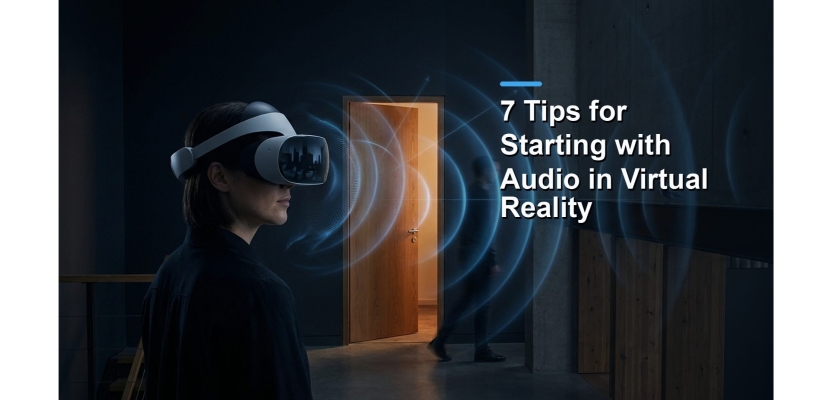

A door appears three metres away, but its sound feels trapped inside the listener’s head. A character walks behind the audience, yet the voice barely changes. Every object makes noise, so nothing tells people where to focus.
The world is visible, but the body does not believe it.
This usually happens because audio is treated like a film mix placed inside a headset. The hinge is to stop designing from the speakers inward and start designing from the listener outward.
If you are beginning with sound design for virtual reality, these seven tips will give you a practical foundation.
First, define the listener’s relationship to the world.
Before choosing sounds, decide what moves and what stays stable. Is the listener standing, seated, walking, or teleporting? Does the sound field rotate naturally when the head turns? Which elements belong to the environment, and which ones should remain attached to the listener?
A menu confirmation may stay head-locked. A bird in a tree should not. Make those rules explicit before implementation, because inconsistent movement breaks presence quickly.
Second, create orientation before emotion.
Build a stable environmental bed that establishes the size and character of the space. A room, forest, station, or street needs enough continuous information for the body to understand where it is.
Match the reflections to the apparent architecture. Keep important anchors stable. If the audience cannot locate the space, the brain spends energy solving geography instead of following the story.
Third, choose carefully what needs spatialization.
A sound with a visible or believable source should usually come from that source. Doors, footsteps, machines, voices, and moving objects gain meaning through position.
But spatializing every layer as a separate object can create instability and technical overhead. Broad ambience may work better as an Ambisonic sound field, which captures sound around the listener in every direction. Specific events can then sit inside that field as positioned objects.
The goal is a legible world, not the highest possible object count.
Fourth, design distance with more than volume.
Lowering a sound does not automatically make it feel farther away. Distance also changes detail, frequency balance, reflections, and the relationship between direct and reverberant sound.
A nearby footstep may contain sharp contact, weight, and texture. Farther away, those details soften, high frequencies reduce, and the room becomes more noticeable.
Test distance transitions carefully. Sudden changes in loudness or tone can make a source feel as if it has teleported.
Fifth, use sound to guide attention before the important moment.
In virtual reality, you cannot assume everyone is facing the same direction. If something important happens behind the audience without preparation, many people will miss it.
Create a believable cause before the event: a latch moves before the door opens, a branch cracks before someone enters, or a machine changes rhythm before it fails.
The cue should give people enough time to turn and locate the source. Avoid making every guidance sound loud or exaggerated. The strongest cue is often the one that feels like part of the world.
Sixth, control density and reserve silence.
Count how many meaningful events compete for attention at each moment. Ten technical layers may behave like one texture, while three unrelated foreground sounds may already be too much.
Decide which sound leads, which sounds support it, and which ones can disappear. After an intense moment, lower the density so the audience can process and reorient.
Silence in virtual reality rarely means total absence. It may be a stable room tone with no new demand. Treat that space as part of the design rather than a gap waiting to be filled.
Seventh, test inside the headset with real movement.
A mix can sound excellent on studio monitors and fail as soon as someone turns, crouches, walks, or looks away. Test head rotation, elevation, distance, occlusion, and transitions between spaces.
Watch the body as well as listening to the feedback. Where do people turn? What do they miss? When do they hesitate? Do they describe a source as near when it should feel far? Do they remove the headset because the experience became uncomfortable?
Protect hearing and comfort. Avoid using extreme level, harsh frequency content, or surprise as shortcuts for attention.
Then listen to the language in the debrief. “I knew where it was.” “I turned before it happened.” “I felt the room open.” Those phrases tell you more about presence than a compliment about sound quality.
Because the listener controls the frame, I would choose clear spatial rules over a more impressive mix, and the virtual world becomes easier to inhabit.
-
Start with the listener.
-
Establish the space.
-
Place only what needs a location.
-
Build believable distance.
-
Prepare attention.
-
Manage density.
-
Test in motion.
Then ask one final question:
Does your audio merely accompany the virtual world, or does it help the body believe that the world is there?
Best wishes,
Billy.
PS_ If you came this far, thank you! Let me introduce myself:
I design spatial audio systems for VR, XR, and immersive media, building the sonic environments that shape where audiences look, what they feel, and how long they stay present.
I’m Billy Mello. 30+ years across broadcast, interactive, and immersive media. Emmy-nominated. Peabody Award-winning.
Based in Spain, working with studios and teams across Europe, Latin America, and Asia.
✅ WHAT I BRING TO YOUR PROJECT:
I don’t just deliver audio, I build systems that make sound a structural part of the experience.
My work spans:
-
→ Spatial audio direction and implementation for VR/XR (binaural, Ambisonics, real-time environments)
-
→ Wwise, Unreal Engine, and Unity pipeline integration
-
→ Immersive soundtracks for games, education, healthcare, and branded XR content
-
→ EmotiTone™ — my proprietary methodology combining music theory, psychology, and neuroscience to generate predictable emotional responses in listeners.
???? RESEARCH-BACKED RESULTS:
In partnership with Erasmus University (Netherlands), I developed AI-based audio solutions validated to reduce stress markers and increase cognitive focus, translating emotional design into measurable outcomes.
This is not theory. It is what separates intentional audio from background sound.
❓ WHO I WORK WITH:
VR studios and XR companies who need more than a sound designer, they need someone who understands experience architecture.
Indie filmmakers and producers building immersive narratives where audio must carry emotional weight without dialogue.Brands and institutions ready to treat sound as a strategic asset, not a production checkbox.
If you’re building something immersive and want audio that changes how people feel inside it.
Let’s talk!