

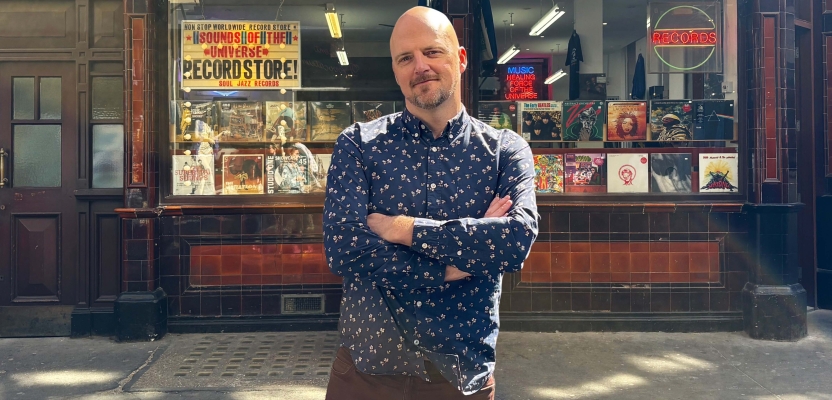

Cory Eisentraut doesn’t do “typical.” As Executive Creative Director at bandstand, his work has taken him from the desert heat of Saudi Arabia to the scaffolding of a London build site—sometimes in the same week. Whether he’s guiding global campaigns or encouraging junior teams to take the brief no one else wants, Cory thrives on the unpredictable rhythm of creativity.
From humble beginnings in a Toronto band with more ambition than fans, to award-winning ideas for brands like Pepsi and SickKids, his career is a testament to curiosity, grit, and the belief that the best ideas don’t just survive—they persist.
Tell us a bit about your role! Is there a “typical” day?
The best thing about my job is that no two days are ever “typical.” My role, at its core, is to help lead the creative department, present our ideas to clients, and guide the work as it’s produced and launched.
But even within that broad description, every day is different and exciting. Just a few weeks ago, I was in Saudi Arabia taking a brief from a client on a Tuesday, and by Thursday, I was with another client touring an active construction site in central London. That kind of rollercoaster is exactly what keeps me energised and inspired.
What was the biggest challenge in getting to your current position?
I think everyone, to some degree, suffers from imposter syndrome. (Unless, of course, you’re a narcissistic megalomaniac.) Starting my career in Toronto, I had this idea that other creatives in larger markets held some secret key to creativity that I didn’t.
Having then had a chance to work in Chicago, New York, and now London, I’ve realised that no matter where you go, every creative faces the same struggles. We’re all tackling the same kinds of problems, often in very similar ways. Once I got past my innate Canadian self-consciousness, everything started to feel a lot easier.
What is your personal background and what role did it play in your career?
Growing up, I was obsessed with two things: music and film. During University, while getting my film degree, these passions led me to start a band. We weren’t any good, but what we lacked in skill, we also lacked in fans. Now, twenty-five years later, it’s not lost on me how lucky I am to be able to bring those two passions together, sometimes even with a bit more success.
What is your biggest career-related win? What is your biggest loss?
I’m still very proud of the Pain Squad app, a project my colleagues and I designed and launched with the Hospital for Sick Children in Toronto over a decade ago. Thanks to the brilliant research team at SickKids, this pain-tracking mobile app had the potential to change many young lives. And, as it went on to win numerous global awards, including at Cannes Lions, the Clios, and the Webbies, it ended up changing my life as well.
My biggest loss is much more recent. A couple of years ago, I created a character for Pepsi Mexico to celebrate their NFL sponsorship: the Snack Ref. Our iconic, blue-striped referee would crash football-watching parties and issue penalties for “party fouls.” He debuted in a Super Bowl spot featuring NFL legend Eli Manning. When the World Cup rolled around, our ref switched sports and handed out red cards to households serving the wrong snacks.
But just before our third NFL season, as often happens, the client team changed and wanted to explore a new creative direction. So our ref was retired far too early. I believed then, and still do now, that we had an idea with the potential to run for years and become a true cultural icon in Mexico.
Which individuals and/or agencies do you gain inspiration from? Do you have any heroes in the industry?
I started my career at an independent agency in Toronto called Cundari. At the time, the most celebrated work in Canada was coming out of the big network agencies. But a few years into my career, a wave of independent shops like Taxi and Rethink began making serious noise, winning bigger assignments and picking up global awards.
Today, Rethink, led by Aaron Starkman, is still killing it. But they’ve been joined by a new cohort of standout independents: Courage, headed up by former Rethinkers Daval Bhatt and Joel Holtby; Angry Butterfly, run by Brent Choi; and Zulu Alpha Kilo, led by the brilliant Brian Murray. Together, they’re proving that geography doesn’t determine creative impact.
Just Google any of these four agencies and you’ll find some of the freshest, smartest work being made anywhere in the world. I’m so inspired and proud to see my hometown and so many former colleagues and friends shaping the industry I love.
What advice would you give to your younger self?
Move to London. I was fortunate to start my career in Toronto, and later had the opportunity to work in Chicago and New York. But deep down, I think I always wanted to be in the UK. I grew up obsessed with English music, film, television and, of course, advertising.
Moving here in 2019, has been an incredible boost to my creative life. And beyond work, my family and I have loved immersing ourselves in London’s history and energy, not to mention its close proximity to the rest of Europe.
If you weren’t in your current industry, what would you be doing?
This is a tough one. I’m not exactly sure what I’d be doing, but I know it would be something creative, maybe opening a restaurant or a boutique hotel. Whatever it is, it would have to be dynamic, because I’ve learned I’m definitely not cut out for the 9-to-5, regimented work world.
What’s your one big dream for the future of the industry?
I’m hoping marketers will start trusting their instincts again. I know it’s cliché to hear a creative push back against testing, but right now, I believe it’s being misused. Instead of being a tool to strengthen an idea, it’s often used by CMOs to decide which campaign to run, or worse, as a reputational safety net if the work doesn’t deliver. “Well, don’t blame me, it tested the best.”
The best campaigns in history, the legendary work we still reference today, would never have survived the kind of testing we rely on now. Just watch a few ad breaks today, and it’s easy to see the result: a much safer, far less interesting landscape.
What are your top tips for aspiring creative professionals?
1. Be curious.
2. Be indispensable.
The first one is easy: be a student of life. Go to the museum. Watch the documentary. Read the plaque. Absorb every tiny morsel of inspiration the world throws at you.
The second is about being helpful. Check in with senior teams before you leave for the day, see if they need a hand. Volunteer for pitches. Take the brief no one else wants, and make them wish they had. It sounds obvious, but my advice to young creatives looking to land a permanent role? Be the person they'd miss if you were gone.
What are your top tips for other creative leaders?
Listen more than you speak. When I first started to lead a department, I thought I had to have all the answers. That mindset made me rush to give my thoughts and opinions. These days, I focus on asking my teams what they think. I keep asking more questions, even when I think I know the answers, and I challenge myself to stay open to being wrong.
When you think about your team, what is the thing that matters to you the most?
What matters most to me is that my teams feel supported in doing their best work. To be happy at work, I believe people need three things: autonomy, mastery, and a sense of belonging. I hope my teams feel that I’m helping them achieve all three of these principals.
How do you approach collaboration with other creatives or teams and what do you believe makes for successful partnerships?
I think open collaboration is one of the most important factors in a successful creative company. But it can’t thrive unless the environment is built to support it. Jealousy is the natural enemy of creativity.
Every team member needs to feel they have a real chance to create something great at any time. That’s why I’m a big believer in always having at least one collaborative project going in the department. I love to get the work from the Macs up onto the walls. Let’s have a discussion about it. With everyone.
I also encourage every team to keep at least one proactive idea in motion. These creative beacons act as life rafts we can cling to when our other projects start to wear us down.
What industry trends do you foresee taking hold in the coming months?
A trend I’m excited about is the resurgence of longer-form content. I appreciate a clever 6-second pre-roll as much as the next person, but I love seeing brands take chances with longer, more emotive storytelling. With the growth of CTV and more engaged audience interaction, I believe the time is right for brands to embrace telling richer stories that tap into the full palette of emotions: humour, sadness, inspiration.
What do you think sets apart truly exceptional creatives from the rest of the pack?
Fortitude. Not a sexy answer, but an honest one. Every agency I’ve worked at, across five different cities and three different countries, has been filled with incredibly creative people. The most successful creatives are the ones who don’t give up on an idea. You have to view each “no” as a speed bump, not a wall. When we’re in the weeds during a complex approval process, I tell my teams: “Just think how the good the story will be when we finally get this made and launched.”
How do you think technology has influenced the creative industries and how have you adapted to these changes?
At the risk of boring your readers, I’ll say that the single biggest leap in technology for my career has been AI. From using ChatGPT for research and proofreading, to generating comps with Midjourney or Leonardo, to relying on my Teams notetaker, so many mundane tasks that used to take hours are now done in an instant. This ultimately gives me more time to be creative or to motivate and guide my teams.
Even this answer? While AI didn’t write it, it did proofread it.
How do you prioritise self-care and maintain a healthy work-life balance?
I work right in Soho in London, so I make the most of it. After six years, I’m still very romantic about my new home. The hours in advertising can be long, so I take my lunches and pop into galleries, museums, and boutiques.
With so much inspiration and beauty at my doorstep, so I tend to blur the lines between life and work. My wife often comes into the city after work, and we’ll have dinner or just go for a walk through Covent Garden or one of the parks. To me, that’s self-care.
How do you handle creative blocks or burnout?
A find few things in life can’t be fixed with a long bike ride. I set off on most rides with a few problems I’m trying to negotiate and more often than not, I get off the bike with at least one or two options for how to move forward.
Can you describe a moment when you had to think outside the box to overcome a creative challenge?
Early in my career, I had BMW Canada as a client. Like most automotive brands, their goal was always to save money on photoshoots by using photography from the global image bank.
After several campaigns that simply placed headlines over generic driving shots, things started to feel stale. So for the launch of the new 5 Series, the most technologically advanced car at the time, I took a different approach.
I explored the historical archives of major Canadian cities, Toronto, Vancouver, and Montreal, and found a series of recognizable cityscape photos from the 1930s and 1940s. I then Photoshopped new driving shots of the BMW 5 Series into these vintage scenes, along with the headline: “Suddenly everything else on the road is decades behind.”
I’ve worked on bigger campaigns since, and many that have won more awards, but I’ll always remember how fun and creatively rewarding it was to take a strict client limitation and find a way to bend the rules, without breaking them.
Do you have any websites, books or resources you would recommend?
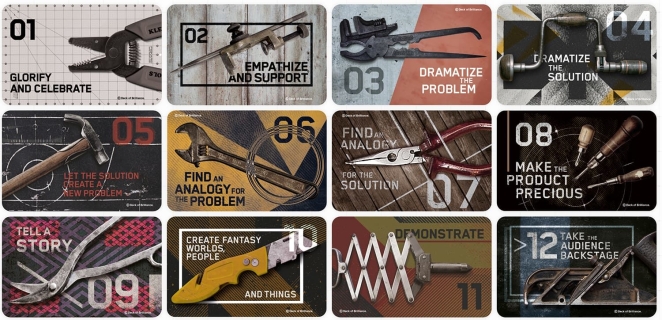
When I’m looking for a quick hit of inspiration or feeling stuck on an assignment, there are two great websites I turn to. The first is DeckofBrilliance.com. Created by Juggi Ramakrishnan and Todd McCracken, this site organizes creative solutions by theme and showcases brilliant campaign examples that embody each one. The chapters range from “Make the Product the Precious” to “Find an Analogy for the Problem,” and over fifty more. Just a great way to jumpstart your thinking.
Most creatives know about Love the Work, the Cannes Lions site that houses all the award-winning case studies from their shows. But two creatives, Quynh Tran and Toan Mai, believed inspiration shouldn’t sit behind a paywall, so they built lovetheworkmore.com, a curated collection of (almost all) the winning case studies gathered from free public sources.
Lastly, when I need a tactile hit of inspiration, I flip through my copy of The History of Graphic Design. This incredible resource, published by Taschen, spans 130 years of design, from the late 19th century to today. It’s so inspiring to see how designers have tackled similar business problems across decades, often in bold and timeless ways. It really is remarkable how many of the works in this book still feel remarkably fresh and contemporary.