
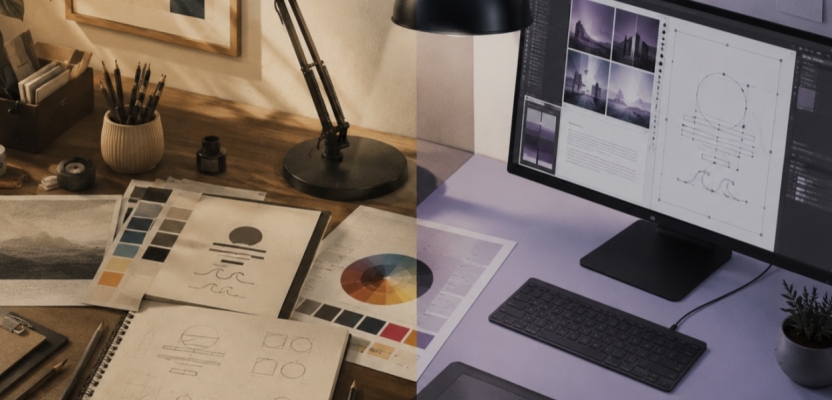

A graphic designer's honest account of working alongside AI tools — not a manifesto, just what actually happened.
Two years ago I started using AI tools seriously in my design practice. Not experimentally — seriously. As in: I changed how I work, I changed what I charge for, and I changed what I tell clients their money is actually buying.
What I didn't expect was how clarifying it would be. Not about AI — about design itself.
Here's what I've actually learned.
What AI does in my workflow now
Let me be specific, because vague takes on AI and creativity aren't useful to anyone.
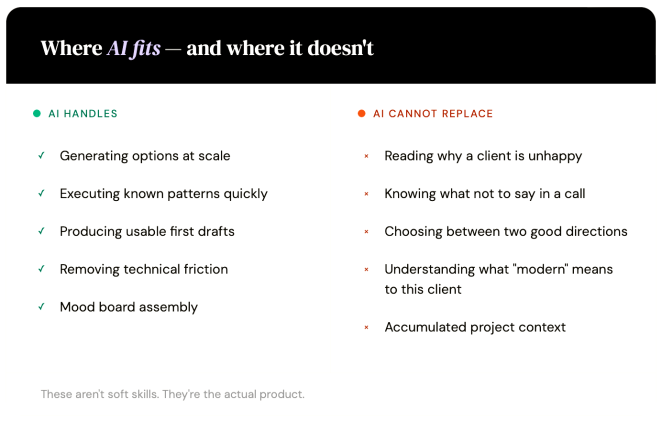
- Mood board assembly — what used to take 2–3 hours of searching, screenshotting and arranging now takes 20 minutes. I describe a direction, generate reference imagery, select what resonates, and move on.
- Client presentation visuals — rough environment mockups, lifestyle contexts, brand-in-use scenes. AI generates a working version; I art-direct it into something that accurately represents the direction without pretending the final photography is ready.
- Copywriting scaffolding — brand voice documents, tagline options, positioning statements. AI produces the raw material; I edit for truth and specificity.
- Layout variations — for print formats with strict constraints (business cards, brochures, signage), AI can generate structural options quickly that I then evaluate and refine.
Combined, this amounts to roughly 30–40% of my previous time on tasks that weren't the core creative work — they were the infrastructure around it. That time now goes somewhere else.
What AI cannot do — and I say this without defensiveness
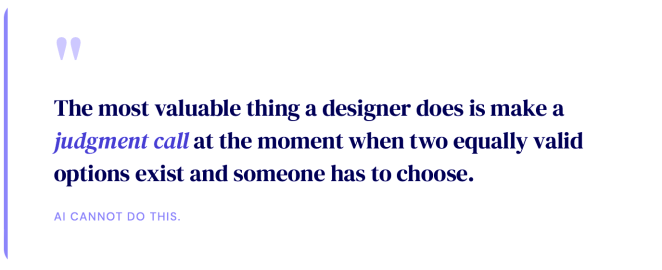
Not because it lacks capability in some abstract sense — but because judgment is contextual, relational, and accumulated. It depends on everything that happened in the previous three weeks of a project: what the client said nervously, what they said confidently, what they showed you that they didn't intend to show you.
The real shift: from executor to strategist
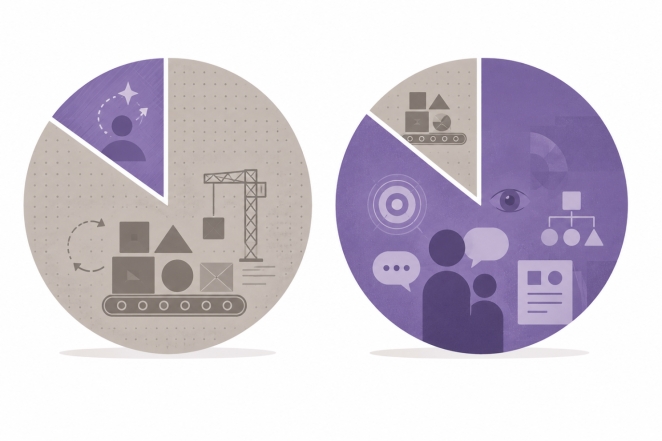
The honest effect of AI on my practice isn't that I work faster. It's that the proportion of my working time spent on execution versus thinking has inverted.
Before: significant time on building, assembling, iterating on presentation materials. The thinking happened in the gaps.
Now: the thinking is the work. More time on brand strategy conversations, more time on presentation structure and narrative, more time understanding the business before touching any tool.
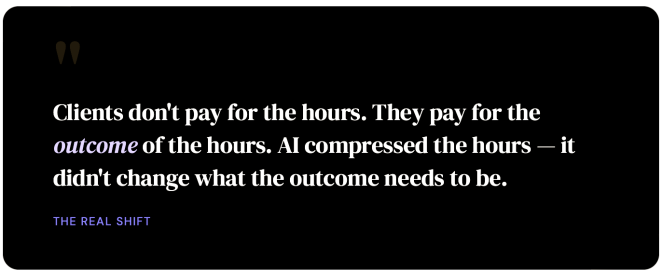
This is where I think the "AI will replace designers" conversation goes wrong. It treats design as execution. But execution was always the least defensible part of the job — it just used to be the most visible.
A practical framework for designers integrating AI
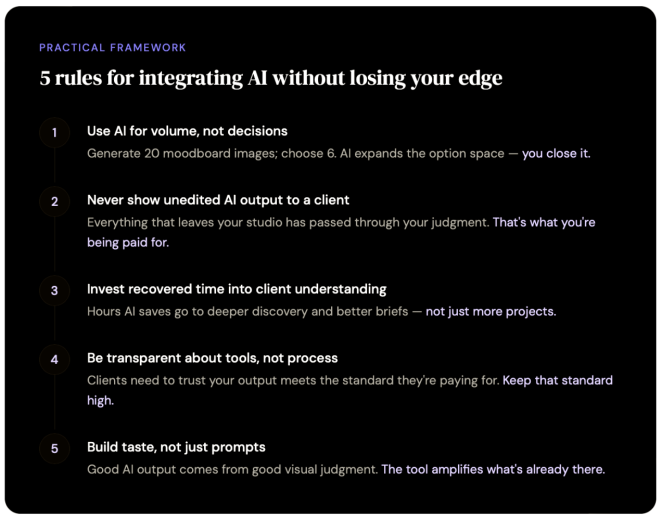
After two years of trial, error, and adjusting what I tell clients, here's the operating model that works for me:
Where this leaves us
AI is the most significant shift in design tooling since desktop publishing. That's not hyperbole — it genuinely changes the economics and the workflow.
But it doesn't change what good brand work requires: a deep understanding of a business, its market, and the people it's trying to reach — translated into a visual system that holds up across every touchpoint, from a phone screen to a printed sign outside a door.
That translation is still a human skill. For now, and for a while.