
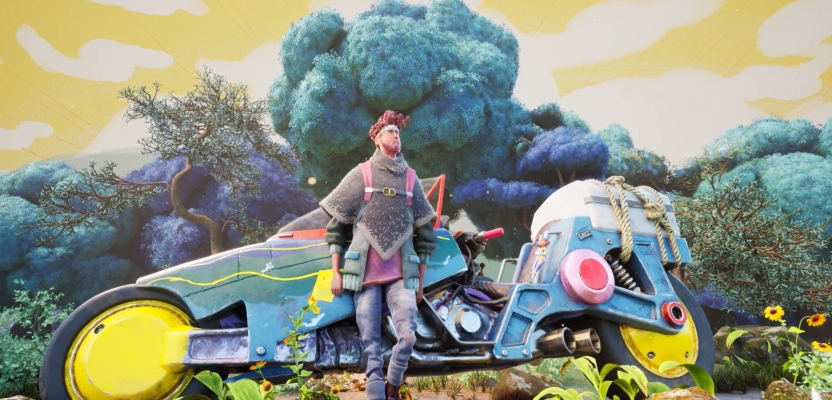

The creative industries are constantly evolving, shaped by new technologies, changing audience expectations and the growing possibilities of digital art. For Alex Franks, a London-based 3D Generalist and solo game developer, staying relevant means being adaptable, embracing new challenges and understanding what each project needs. With experience spanning video games, animation, marketing art and independent game development, Alex has built a career around exploring different creative disciplines rather than limiting himself to one particular style or specialism.
In this Creativepool interview, Alex shares his journey into the creative industry, from teaching himself 3D art and securing his first professional opportunities to working with major names including Sony, Ubisoft and King. He also discusses his creative process, the importance of experimentation and professional relationships, and the lessons that have shaped his approach to making work that resonates with audiences. Looking ahead, he offers his perspective on AI, the future of creative careers and what he believes separates exceptional creatives from the rest.
How did you first get into the industry?
 My university course touched upon 3D art, but nowhere near enough to be ready for a professional job. So I spent a couple of years teaching myself and found poorly paid or unpaid freelance work, to put myself ahead of those without professional experience when applying for proper junior roles.
Where are you based now and who do you work for?
I'm in the London area. My work falls into three categories, between which the content can vary quite a bit:
1 - Solo-developed narrative games, under the name Out of Time Interactive.
2 - Paid work for clients. Nexus Studios has been my most regular client in recent years, but previously I worked a lot in games (mainly marketing art) for Sony, King, Ubisoft etc.
3 - Portfolio work, done to develop skills and demonstrate ability to potential employers.
What is your personal background and what role did it play in your career?
When I was at school, I dreamt of doing creative things when I was older, but I didn't know how I could go about starting. We didn't have YouTube back then. When I reached university, I discovered that it was possible to get art software and tutorials for free, and I just kept going with it.
If you weren’t in your current industry, what would you be doing?
 I'd probably get into an industry that's safe from A.I. for another decade or so, like being an electrician.
Can you explain your creative process? What makes it unique?
I analyse the needs of the project and adapt accordingly. I'm officially a 3D Generalist, but in reality I've successfully taken on a hugely diverse range of roles, and I think the key is putting the needs of the project first, rather than trying to make it fit what I already know.
For instance, when I worked in marketing for FGOL (Ubisoft London), Ubisoft wanted to explore making a series of animated shorts based on the Hungry Shark game characters, but someone in-house needed to plan and direct them. So I decided to step up, and they all reached over 25 million views on YouTube in the end. I feel the key was that I created some extremely rough 3D animatics first to test what would work and determined that, in these dialogue-free shorts, a high degree of clarity was essential in every action and joke.
How would you describe your style?
I don't consider myself to have a style, as I analyse the needs of the project and develop a style accordingly (see above). But, in my portfolio projects, I think my strongest work tends to be 3D stylised character art that doesn't quite conform to an existing common style.
Which individuals do you gain inspiration from? Do you have any heroes in the industry?

I don't have an interesting story about a hero, so I'm going to answer a slightly different question: Where have you gained inspiration from recently?
I recently concluded that often creative people get better results when forced to come up with alternatives to what they'd really like to do, because of certain restrictions, most commonly commercial constraints. For instance, even Mulholland Drive, one of the most successful arthouse movies of all time, was the result of David Lynch having to turn a failed TV show pilot into a movie. It wasn't what he'd have done, given full freedom.
Likewise, I was asked to make a PlayStation 3 dynamic theme (animated menu background) for a series of retro SEGA games. They gave me almost no assets to work with, so I was forced into the idea of creating a 90s bedroom with each of the games playing on a TV (they load randomly), and it was far more popular than what I'd have done with good assets. It was one of the most downloaded items on the EU PS3 store, and one SEGA fan claimed to have cried with joy, because it was just like his teenage bedroom.
What tips would you give to aspiring creatives looking for work?
That's tough right now, because of A.I. I can't recommend learning the things I've been doing for 20 years, because it's likely that a lot of it will change. I'm not even confident that any humans will have jobs in ten years!
So, I'd recommend learning to do something you enjoy, or believe has value, without pressuring yourself into making money out of it. To focus solely on the positive of A.I.: It's likely that making your dream projects reality will become much easier than in the past.
Secondly, I think one of the most important skills to develop is being able to view your work as though you hadn't made it, in order to determine whether it's good. One of my most hard-earned pieces of wisdom is that feedback from others is generally unreliable. The combination of people not expressing their views accurately, people being too busy, people wanting to tell you something positive, people wanting to tell you something negative, being on- or off-trend, getting online algorithm luck or not getting it, means that, although you should consider feedback, if you're relying on it to determine if your work is good, you'll often end up confused.
What tips would you give to other professionals to get more clients?
1 - Whether clients are looking at a CV, LinkedIn, portfolio, or showreel, your first aim is to separate yourself from the probably-huge number of candidates who aren't remotely qualified, ideally within a few seconds. So a clear, high-quality banner or intro montage is good. Shamelessly name-drop anything that sounds impressive (e.g. famous former employers) right at the start.
2 - Honestly, most times I've been hired, knowing someone there has played a role. However, it's never been someone I knew well, and I think they were genuinely able to vouch for my ability. So, I'd say it's worth keeping in touch with colleagues.
3 - More of a practical point: I always include links to my past projects on my LinkedIn and CV. So when someone's reading about it, they can click to see it.
Can you share a memorable experience from your career journey that shaped your approach to creativity?
 In my first proper, long-term, 3D art job, I was working on one of the final PS2 games. To start with, they gave me the most basic task available, which was creating some logs for a wood-chopping mini-game. Enthusiastically launching myself into my new career, I made the logs as interesting as they could reasonably be. There was one with a twig and leaf, a fat one, a thin and lumpy one.
When the external Art Director came down from Sony, I overheard him say "These logs have so much character!" A couple of years later, I was applying for a job at Sony I thought I had little chance of getting, so I decided to suggest they ask the Art Director for a reference, and I got the job. He later claimed he warned them not to hire me, but I think he was joking.
So, I guess the moral of the story is: If you find somewhere to add some creativity or interest, you never know who might appreciate it.
What kind of tools/kit/software could you not do without?
I'm not really an Apple person, but I splashed out on an iPad Pro a few years ago, and I use Photoshop on it all the time for my 2D artwork. It's great to be able to get away from the desk for part of the day, and the Creative Cloud workflow is useful. I can draw/paint something on the iPad, then when I need to export or use some PC features, it's right there in my PC Photoshop.
What’s your secret to staying inspired and motivated?
For my current game project (The Faraway King), one of the best things about creating it on my own is the number of different types of work that are needed. So, I keep several to-do lists, and I can usually do something that fits my current mood or level of focus. At the most mentally challenging end of the spectrum are “coding” (Unreal blueprints, in my case) and 3D pipeline stuff. At the more relaxed end are 2D art and some of the writing. If I feel I've earned a treat, I'll let myself spend time daydreaming and loosely planning my next game.
For commercial work, my answer is: I'm more interested in the final product than most people. There tends to be the feeling that it’s uncool to be excited about the release of projects you worked on, but I like to feel that, in some small way, we're helping to create a worthwhile experience for people.
What’s the work achievement you’re most proud of?
 My original dreams when getting into creative work were of one day making something narratively substantial that would mean something to people. So I'm proud of my two currently unfinished game/interactive projects. I released Obreno: Chapter One on Steam, which was a game/novel hybrid. Some people loved it and some hated it, but I decided to abandon it just because I saw no way of getting it to more of the people who would like it. So, I moved onto something more marketable that could also merge with my professional 3D career more, which became The Faraway King. The Early Access version is available, but I think the final version should be much stronger. So, I’m proud because most people never find the chance to make the things they really want to, and I’m partway there.
As someone with experience in the industry, what trends do you foresee shaping the future of creativity?
A.I., obviously. It's hard to say how far it'll go.
It's likely that the number of jobs in our industries will drop as roles are taken over by A.I., but I'd expect the same issue with any job based on brain work, such as doctors, architects, investment bankers, accountants. So it would be a part of a massive social change.
I think there'll still be areas where people value knowing that something was made by a real human, though. Currently, knowing whether art is A.I. is important for many people, and I think in some fields it will become more accepted, and in others it never will.
What do you think sets apart truly exceptional creatives from the rest of the pack?
I think a good creative wants to understand what value the work should have for the audience and work out how they can deliver that experience.
For an exceptional creative, the same applies but they aim to overdeliver. So, deliver something the audience hadn’t even considered they could want.
The rest of the pack doesn’t bother with any of that and just sets about making something the way they’ve been taught.
How do you think technology has influenced the creative industries and how have you adapted to these changes?
 In general, technological progress is a process of making things easier, with less manual work required. My decision to start work on my current game, The Faraway King, was influenced by the release of Unreal Engine 5, where some of the work that previously made it difficult for a single person to make a mid- or large-scale 3D game was automated.