

By Wedidit Creative — Bid Visual Specialists
There is a conversation happening in bid teams across the UK right now, and it goes something like this: "Do we really need to print this? Can't we just submit the PDF?"
It is a fair question. Portals are faster. Couriers are expensive. Print deadlines add pressure to an already pressured process. And yet, time and again, we see printed bid submissions outperform their digital equivalents in competitive tenders: not occasionally, but consistently. After more than two decades producing bespoke bid documents, proposal submissions and tender responses for clients across construction, property, infrastructure and service sector, we feel we have earned the right to say this plainly: print is not dead in bidding. In many contexts, it is still the most powerful tool you have.
This is not nostalgia. This is strategy.
The Digital Default is a Race to the Middle
When procurement portals became standard (and they are now standard for most public sector ITTs, PQQs and framework applications) bid teams understandably adapted. Documents got optimised for screen. PDFs replaced printed volumes. Interactive presentations replaced physical leave-behinds. All of that is entirely rational, and in portal-only submissions, it is simply the requirement.
But something got lost in that transition: differentiation.
When every bidder submits a PDF through the same portal, opens in the same PDF reader, and sits in the same evaluator's downloads folder, the playing field is not level: it is flat. Flat in the sense that the medium itself is doing nothing to help you stand out. The design still matters enormously in digital submissions (layout, typography, infographics, information hierarchy) but the physical experience of receiving and handling your bid? Gone. And with it, one of the most powerful psychological levers available to a bid team.
A digital PDF is a commodity. A bespoke printed submission is an experience.
What Print Does That Digital Cannot
Let us be specific, because this is not about sentiment.
Print creates a physical event. When a printed bid submission arrives (well-finished, well-structured, produced with genuine craft) it creates a moment. The evaluator picks it up. They feel the weight of it. They notice the cover. Before they have read a single word of your response, you have already communicated something about how you approach your work. You have told them, without saying it, that you take this seriously. That is an impression no PDF creates, because a PDF never arrives. It just appears.
Print forces creative decisions that improve the bid. Working with a specialist bid design agency on a printed submission forces your team to make decisions about information architecture, hierarchy and narrative structure that digital submissions often sidestep. You cannot hide behind a 40-page Word document when it is going to be printed, bound and put in a box. You have to edit. You have to prioritise. You have to make it readable. Clients who have worked with us on both digital and printed submissions consistently tell us the printed process produced a better, tighter document: even when the printed version itself was not the primary deliverable.
Print is tactile, and tactile is memorable. Cognitive science is fairly consistent on this point: physical interaction with an object deepens memory encoding. An evaluator who handles your printed submission, turns its pages, and moves through a considered visual and physical sequence will recall it more readily than one who scrolled a PDF for six minutes before closing the tab. In a competitive tender where scores may be close, being the bid that is most easily recalled during moderation is not a small thing.
Premium print signals commercial credibility. This is particularly true in property development, infrastructure and service sector tendering, where the contracts being competed for are often significant in value. If you are asking a client to trust you with a £10 million project, the quality of your bid document is part of the evidence base. A meticulously produced, professionally bound submission says: we deliver. A poorly formatted PDF says: we will get to it.
We See It Every Time
We do not have to imagine the difference print makes. We witness it in person, repeatedly, at client meetings.
Our process is always the same: we present the electronic bid first, then the printed version last. Without exception, the moment the printed submission comes out, something shifts in the room. Clients who were attentive become animated. Engagement that was polite becomes genuine. They lean in, they pick it up, they pass it around. The conversation changes. The energy changes. You can see, in real time, the connection forming between the client and the work in a way that simply never happens with a document on a screen.
Consider what that means. These are our samples, produced to demonstrate capability, not a bid written specifically for that client or that opportunity. And still, the printed version commands the room every single time. Now imagine that reaction directed at your client, receiving a submission crafted specifically for them, speaking directly to their project, their priorities, their decision. That is not a marginal advantage. That is the difference between a bid that is read and a bid that is felt.
The Objection: "Evaluators Don't Have Time for That"
We hear this regularly, and it deserves a direct answer.
Evaluators who are short on time are precisely the audience for well-designed printed submissions. A document with strong visual hierarchy (clear section openers, well-crafted infographics, structured pull-out pages) can be navigated far faster than a text-heavy PDF that requires scrolling and searching to find key information. Good bid design, in print or digital, is about reducing cognitive load for the reader. Print simply gives you more tools to do that: paper stock, binding, tabbing, foldouts, gatefolds, UV spot finishes that draw the eye to a critical page.
The evaluator who says "I don't have time to look at a nice document" is the same evaluator who unconsciously spends longer on the one that is easy to read. Design works whether or not the reader is paying attention to it.
When Print Wins, and When It Doesn't
We believe in honest advice over blanket prescriptions. So here is the reality as we see it across different tender types.
Print still wins decisively in:
- Competitive frameworks and negotiations in construction, property development, infrastructure and service sector, where physical submissions are either specified or permitted and the relationship with the client is central to the evaluation.
- Presentations and interview stages, where a printed leave-behind or presentation document reinforces the in-person pitch and gives the panel something to return to.
- High-value private sector bids, where there is no portal restriction and the client is sophisticated enough to recognise and value the investment.
- Any context where you are one of two or three shortlisted bidders and the scores are close. This is exactly when the physical impression of your submission can tip the balance.
Digital is the right choice when:
- The portal explicitly restricts physical submissions or sets strict file format requirements: compliance always comes first.
- Speed is the overriding constraint and the bid value does not justify the additional cost and lead time of print production.
- The client culture is clearly digital-first and a physical submission would feel incongruous rather than impressive.
The key word in both lists is context. The worst bid design decisions we see are not about choosing print over digital or vice versa: they are about applying the same approach to every bid regardless of what the opportunity requires.
The Hybrid Approach: Getting the Best of Both
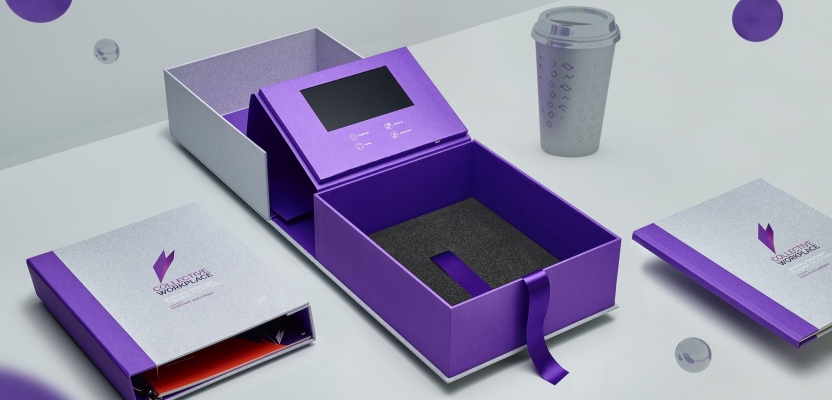
In practice, the most effective bid submissions we produce are hybrid. A beautifully produced printed document (hard cover, quality paper, professionally bound) submitted alongside a well-structured, accessible PDF through the portal. The digital version ensures compliance and accessibility. The printed version creates the impression and the memory.
This is not duplication of effort. With the right bid design process, the printed and digital versions are developed in parallel, sharing the same visual language, the same information architecture and the same strategic intent. The additional investment is smaller than most bid teams assume, and the return (measured in win rate) is consistently positive.
A Note on Sustainability
The sustainability question comes up, and it should. Print has an environmental footprint and we take that seriously. The answer is not to abandon print but to be intentional about it: responsibly sourced papers, print runs sized to the submission requirement, and materials that can be produced with minimal waste. We work with suppliers who share that commitment, and we build sustainability into the production specification from the outset, which, as it happens, is often worth noting in the bid itself.
What This Means for Your Next Bid
If you are preparing a competitive tender submission and the question of print versus digital is on the table, here is our honest recommendation: do not let logistics make the decision for you. Do not default to digital because it is easier to arrange. Ask instead what impression you want to make, what the client will be expecting, and whether the physical experience of receiving your submission is an asset you are leaving on the table.
In a crowded market where being good is the standard, being extraordinary is what makes you win. A well-conceived, beautifully produced printed bid submission is one of the clearest ways to demonstrate, before anyone reads a word, that extraordinary is what you deliver.
Digital has changed procurement. But it hasn't changed people. And until it does, printed bid submissions will continue to hold an advantage where it matters most: in the moment your bid is actually being read.
If it's a must-win, you know where we are.
Wedidit Creative are bid visual specialists based in London, producing bespoke bid documents, proposal submissions, tender responses, PQQs, ITTs and presentation materials for clients across the UK and internationally. We manage the entire process from concept to print and fulfilment.
www.wediditcreative.com
Get in touch to discuss your next submission.
Related reading: