
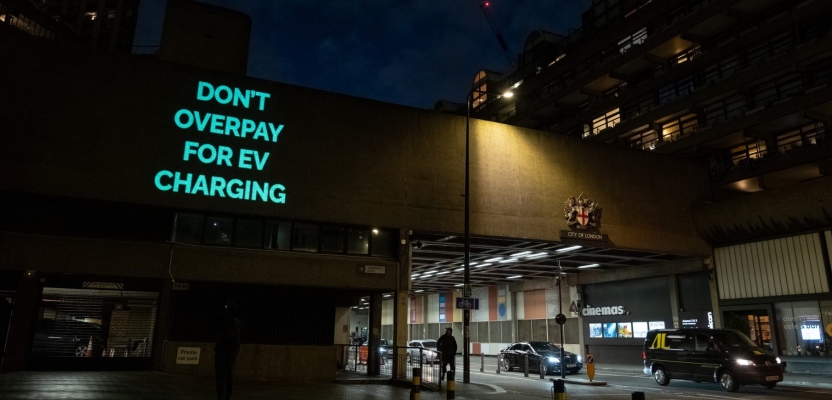

For too long, flat residents with electric vehicles (EVs) have been locked into higher costs and limited options when it comes to charging. But ChargeGuru’s latest campaign is breaking down barriers, illuminating—literally—the advantages of affordable, at-home EV charging for those living in apartments.
In collaboration with The PHA Group, ChargeGuru has projected a powerful message onto iconic London apartment buildings, highlighting their Fully Funded Solution (FFS), which covers installation costs for EV infrastructure. This campaign tackles a critical gap in the EV market, ensuring flat residents have equal access to convenient, cost-effective charging options and helping lead the charge toward a sustainable future.
This interview dives deep into the vision, challenges, and creative process behind the campaign, offering a behind-the-scenes look at how ChargeGuru and The PHA Group brought this impactful initiative to life.
What was the brief?
The goal was to raise awareness that people living in flats and driving EVs are often overpaying for charging. Charging an EV at home is, on average, three times cheaper than using public stations, providing both cost savings and convenience.
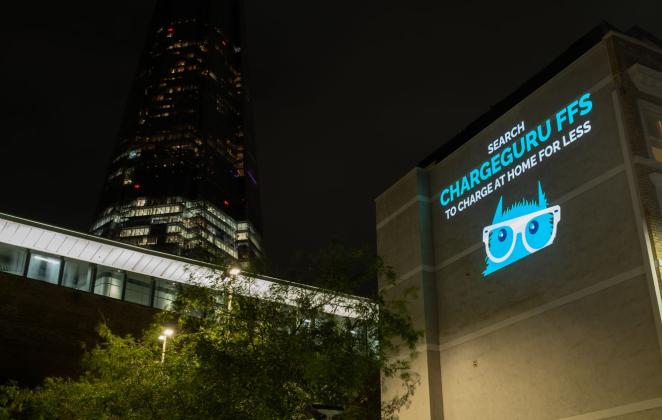
ChargeGuru's Fully Funded Solution (FFS) covers the installation costs of EV infrastructure in apartment buildings, making it easier, fairer, and more affordable for flat residents to access home charging. The brief aimed to maximize ChargeGuru’s visibility in the UK media, combining innovative strategies and key insights about issues in the EV industry to engage consumers and attract new leads.
How did the initial pitch/brainstorming phase go?
During the pitch and creative development phases, we focused on amplifying key data points around at-home versus public charging for flat residents. Our goal was to create a compelling narrative that positioned ChargeGuru as a solution to overpaying for public charging.
The challenge was identifying the best approach, refining our messaging, and determining optimal locations and timing. We evolved the concept from initial ideas, exploring creative references and sources of inspiration along the way.
What was the process behind ideating the concept?
Upon deciding to project an animation on buildings across the capital, we brainstormed three concept routes:
-
Route 1: A direct, eye-catching approach emphasizing the lack of charging points in apartment buildings, with the Fully Funded Solution (FFS) as the hook. The design drew inspiration from Nike's "Winning Isn’t for Everyone" campaign and Charli XCX's promotional art, featuring bold text on apartment building walls.
-
Route 2: This approach emphasized the inconvenience of traveling to distant, potentially costly charging stations, using motion-based iconography and a battery illustration to drive the message home.
-
Route 3: Inspired by a McDonald’s campaign, this concept mapped out the journey to the nearest public EV charger, tailored to specific apartment buildings to highlight the inconvenience involved.
Ultimately, the final concept combined elements from Routes 1 and 2, which were handed off to the in-house design team for animation execution.
What was the production process like?
This project was a collaborative effort between the ChargeGuru team and our creative and design teams. Once the concept was approved, we developed a script focused on cost savings, adding a playful touch by abbreviating Fully Funded Solution as "FFS."
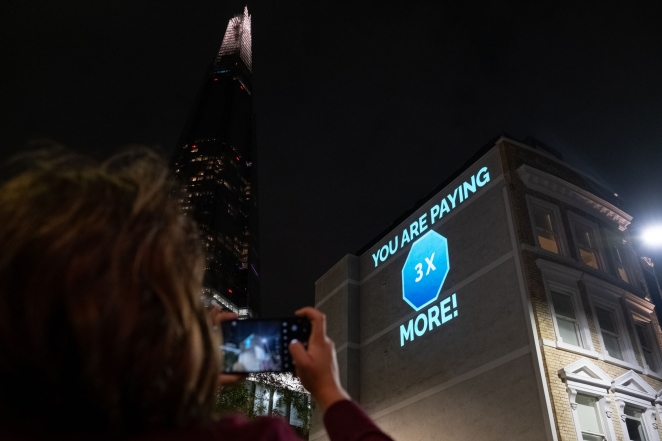
Our motion designer, Isabelle Blake, crafted a storyboard that brought the script to life, projecting the animation onto building facades in large scale. We coordinated closely with our projection partner, Immersive-me, to ensure the colors displayed crisply on each surface.
What was the biggest challenge during production?
Finding suitable projection sites was our biggest challenge. We balanced media visibility, iconic London backdrops, and residential flats with parking but no EV charging solutions. After several site visits, we selected Cromwell Tower in the Barbican, Talisman Tower in Canary Wharf, and a high-visibility spot at London Bridge Station, capturing iconic London visuals under The Shard.
What kit/tools/software were used to create the project?
The project involved Adobe After Effects, Premiere Pro, and Illustrator for animation and video. A 20,000-lumen laser projector, which uses 75% less energy than lamp-based projectors, was paired with various projection lenses, MadMapper software for projection mapping, a 6000W Battery Bank, and the Sony A7S III and Fuji XH2S cameras for capturing video and photography.
What is one funny or notable thing that happened during production?
Using a guerrilla-style projection tactic, we set up quickly, projected, and moved on, generating public excitement and candid reactions for the campaign video. At one location, we were asked to leave, with the police even called. Fortunately, we captured all necessary footage before needing to pack up—no laws were broken!
What’s the main message of this project and why does it matter?
Flat residents urgently need accessible at-home EV charging. Currently, nearly 70% rely on costly public charging stations, paying up to £780 more annually than at-home chargers.
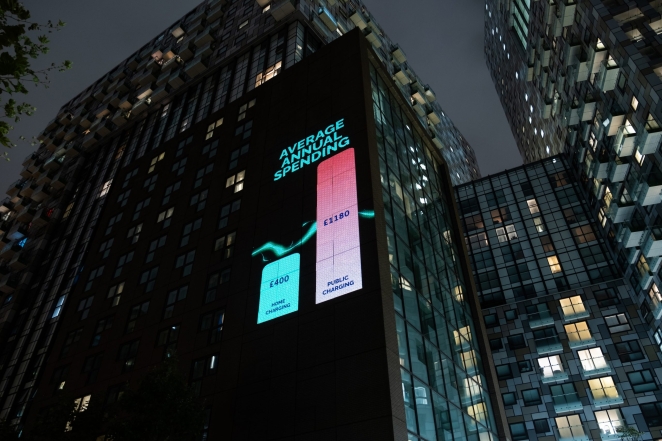
With over half of flat residents planning to switch to EVs by 2029, there’s a critical need for infrastructure to support this shift. This campaign addresses a vital issue for both consumers and environmental progress.
How long did it take from inception to delivery?
We began discussions with ChargeGuru in March, with concept development evolving over several months and creative development beginning in August. The campaign went live on October 4th.
Can you describe the creative spark or inspiration behind the initial concept?
Our audience was primarily flat residents and apartment building owners, so simplicity was key. Rather than overcomplicating, we projected our message directly onto the walls of their residences, effectively reaching our target audience.
How did you ensure that the concept aligned with the brand's values, goals, and target audience?
We focused on ChargeGuru's mission of accessible EV charging, crafting a message around affordability and convenience. Grounded in consumer insights, we aligned our strategy with ChargeGuru’s values, bridging the gap between the brand’s vision and the audience’s needs.
Can you discuss any collaborative or interdisciplinary aspects of the ideation process?
Collaboration was key. Working closely with the ChargeGuru team ensured alignment with their objectives and insights. The creative, media, and social teams contributed ideas, and our partner Immersive-me supported technical execution.
What role did consumer research or market analysis play in shaping the concept and its execution?
Consumer research anchored the campaign, with a survey gathering insights on EV charging access in apartment buildings.
This informed the launch story and campaign narrative, helping position ChargeGuru’s Fully Funded Solution as the solution to identified challenges.
How did you ensure that the concept remained innovative and stood out in a crowded marketplace?
We aimed to deliver a striking, unexpected visual experience using projections over traditional advertising. Bold messaging and a unique aesthetic helped ChargeGuru stand out, reinforcing the brand’s innovative spirit.
What do you hope it achieves for the brand?
The goal is to boost ChargeGuru's brand awareness in the UK, increasing inquiries from flat residents and property owners about the Fully Funded Solution, driving engagement and conversions.
Credit List
- Agency: The PHA Group
- Creative team: Mike Chivers, Tudor Crockford, Isabelle Blake
- Media team: Helen Salvin, Grace Page, Sarah Poynder, Jack Quinney, Francine Clark
- Social team: Parth Depala, Imogen Cook
- Creative partner: Immersive-me
- Project Manager: Nina Thoene
- Projectionist: Rupert Rose-Antonie
- Driver: Jouna Lansman
- Photographer: Henry Howe
- Videographer: Kit Powis Page
- ChargeGuru Brand Team: Elizabeth Davidson, Denis Watling, Harry MacGregor