


In a creative industry increasingly preoccupied with what AI can generate, automate and optimise, Daniel Wigham, Associate Director of Strategy and Sustainability at StudioXAG, argues that one of the most valuable human skills is also one of the hardest to define: taste.
Here, he makes the case that taste is not simply personal preference or aesthetic snobbery, but a form of judgement shaped by friction, instinct, contradiction and lived experience. As AI tools flatten creative output towards the familiar and the average, Wigham suggests that the ability to know what to keep, what to reject and when to push an idea too far may become not just a strategist’s most-used tool, but one of creativity’s last truly human advantages.
Taste is how we communicate identity. It's a deeply human impulse. And in an age of AI, it might become one of our most valued qualities.
It’s a strange thing that is clearly not inherent. We all know someone with zero taste. But then again, can someone really have "no taste"? Perhaps they have a specific taste, an unusual taste, a taste that refuses to conform.
How does one acquire taste?
My mind went to the Grand Tour, the ritual where wealthy upper-classes would travel through Europe as an educational rite of passage, learning languages, absorbing new cultures, studying classical antiquity and Renaissance art. Even the most privileged in society weren't born with taste, they had to earn it: through encountering the unfamiliar, the uncomfortable, the culturally alien.
That's precisely what makes taste so resistant to automation. The Grand Tour was designed to challenge our tastes. AI works in reverse, trained to find the middle ground, to reflect our tastes back to us, averaged out and smoothed over.
Yet it's ‘bad taste’ that fascinates me most
There was a recent retrospective at the BFI in London entitled The Wildest Films You've Ever Seen, and John Waters, the Pope of Trash, was interviewed as part of it.
He commented that "I'm so respectable I could puke." His point was that bad taste has become acceptable, appreciated even, worthy of a serious exhibition at a serious institution.
In a similar vein, Miuccia Prada repositions the ugly as beautiful and rarified. She is the pioneer of "ugly-chic", someone who challenges clichés of good taste, embraces banal eccentricity, and subverts convention by celebrating it. Her point of view directly contradicts everything we believe about good design. Yet she moves culture forward precisely because of it. Tastes change over time, but only through those brave enough to challenge them.
As a strategist, taste is my most-used tool, even when I don’t realise it
The job is essentially to filter thousands of pieces of research and information down to a single, sharp point of view. People lean on you to edit, to refine, to challenge, to know when something isn't right yet.
But the deeper version of that skill is knowing which brief to push back on, which trend to ignore despite client pressure, which cultural reference is already exhausted and overused. That's not analysis, that's taste. And it's something we rarely discuss or prioritise, probably because it's slippery, subjective, and stubbornly difficult to articulate.
We've spent years worrying about AI replacing creative skills, but the skill most under threat might be the one we've never formally trained anyone in.
Taste isn't just a preference, it's a position
It requires contradiction, eccentricity, and flaw. Things which AI can’t replicate, not because it lacks processing power, but because it lacks the courage to be wrong.
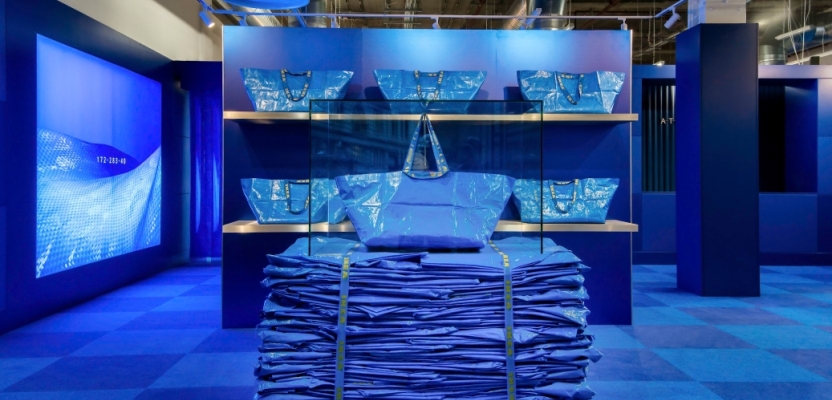
When we designed IKEA's Hus of Frakta experience, we took the everyday 75p bag and applied its bright blue colour, its checkerboard pattern, and its crinkly texture to every single touchpoint of the space. It was wonderfully bizarre, utterly compelling, and it broke the internet. It worked because the team had the taste to know how far was too far, and the confidence to go right up to that edge. That kind of judgment can’t be replicated with a prompt.
When every team now has access to the same AI tools, the same trend reports, the same generative imagery, what differentiates the work? Taste. It's one of the only things I can confidently say I have, and for once, I don't feel arrogant saying it. As the saying goes: AI could never.