Sherlock Communications
São Paulo
ABOUT
Our Client:
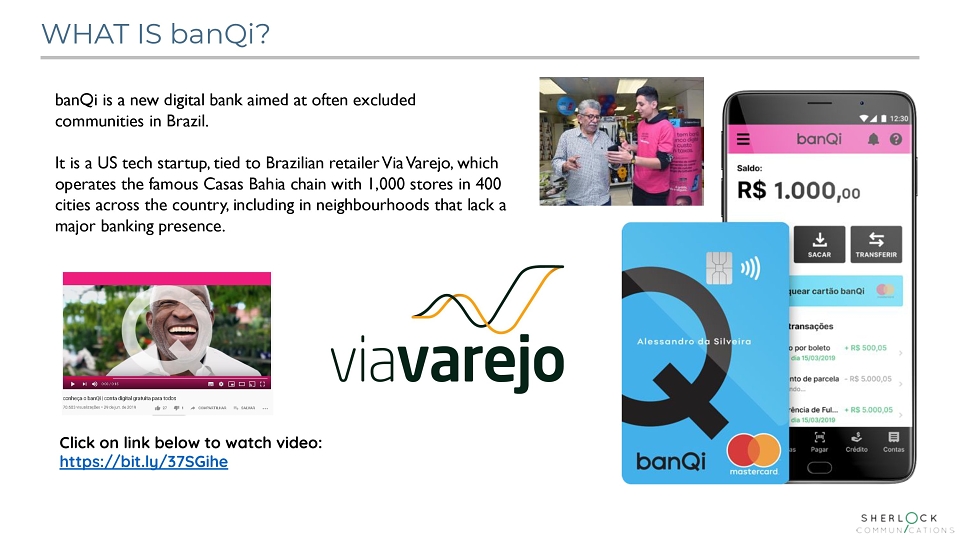
BanQi is a new digital bank aimed at often excluded communities in Brazil. It is a US tech startup, tied to Brazilian retailer Via Varejo, which operates the famous Casas Bahia that have more than1,000 stores in 400 cities across the country, including in neighbourhoods that lack a major banking presence.
Our Brief:
Sherlock Communications was brought on board with a brief to build a profile of potential target audiences for banQi, as well as preparing key messages that could have genuine cut-through in communities often ignored by media and advertisers. We would also introduce the client to an already crowded market, using PR to ensure banQi stands out from the other fintech services.
A Challenging Audience:
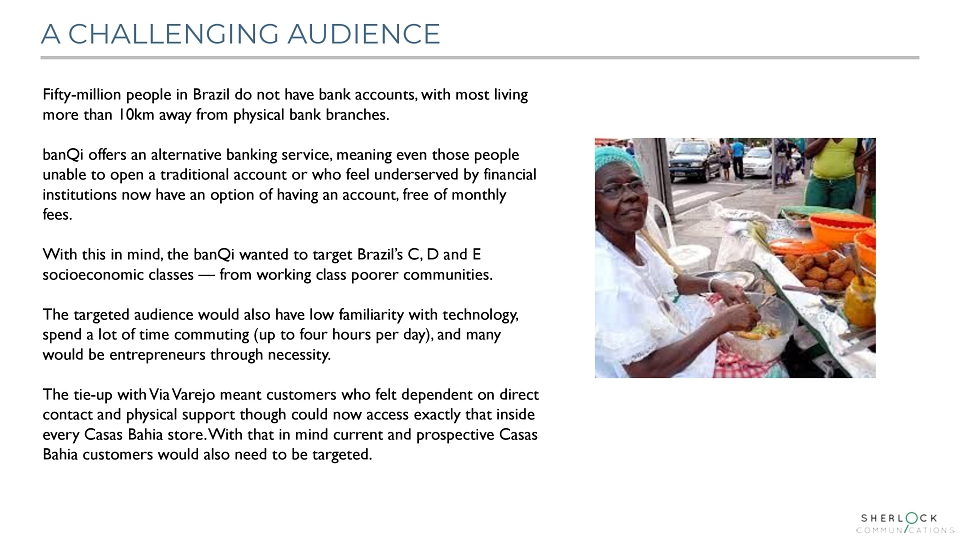
Fifty-million people in Brazil do not have bank accounts, with most living more than 10km away from physical bank branches. banQi offers an alternative banking service, meaning even those people unable to open a traditional account or who feel underserved by financial institutions now have an option free of fees. With this in mind, the client wanted to target Brazil’s C, D and E socioeconomic classes — from working-class poorer communities.
The targeted audience would also have low familiarity with technology, spend a lot of time commuting (up to four hours per day), and many would be entrepreneurs through necessity. The tie-up with Via Varejo meant customers who felt dependent on direct contact and physical support though could now access exactly that inside every Casas Bahia store. With that in mind current and prospective Casas Bahia customers would be targeted.
Strategy:
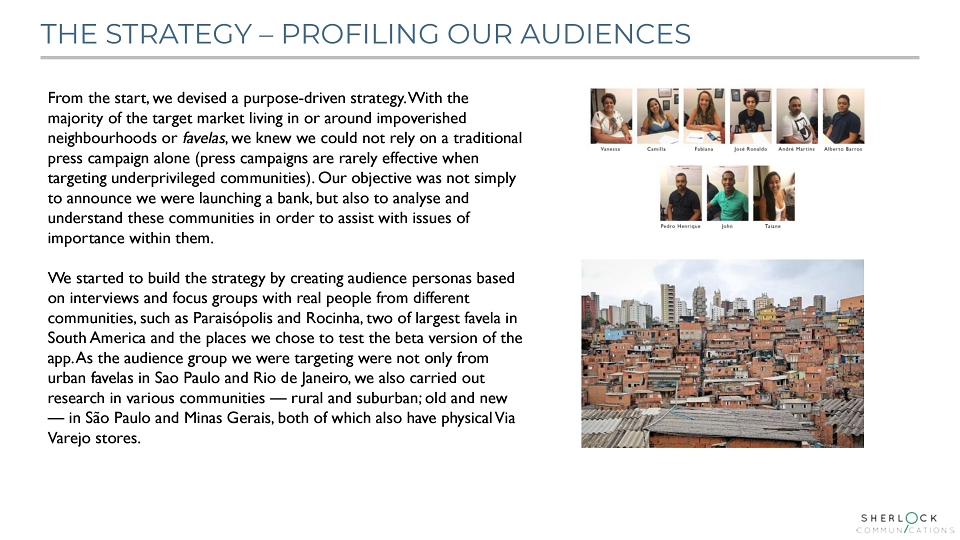
From the start, we devised a purpose-driven strategy. With the majority of the target market living in or around impoverished neighbourhoods or favelas, we knew we could not rely on a traditional press campaign, which are rarely effective when targeting underprivileged communities. Our objective was not simply to announce we were launching a bank, but also to analyse and understand these communities in order to assist with issues of importance within them.
We started to build the strategy by creating audience personas based on interviews and focus groups with real people from different communities, such as Paraisópolis and Rocinha, two of largest favela in South America and the places we chose to test the beta version of the app. As the audience group we were targeting were not only from urban favelas in Sao Paulo and Rio de Janeiro, we also carried out research in various communities — rural and suburban; old and new — in São Paulo and Minas Gerais, both of which also have physical Via Varejo stores.
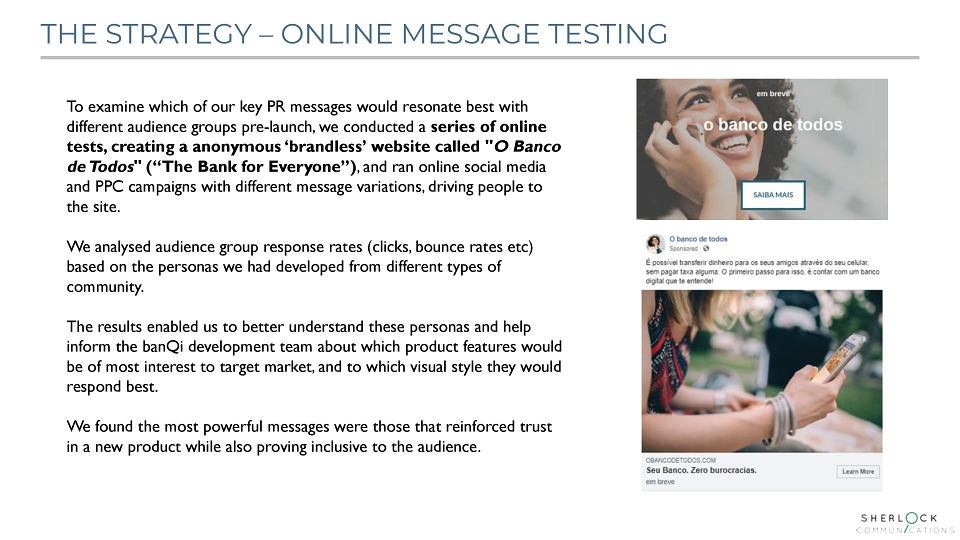
To examine which of our key PR messages would resonate best with the different audiences pre-launch, we conducted a series of online tests, creating a ‘brandless’ website called "O Banco de Todos" (“The Bank for Everyone”), and ran online campaigns with different messages. We then analysed group response rates based on our personas from these different types of communities. The results enabled us to better understand the personas and include more detail when informing the banQi development team of the main features that would interest the target market and with which creative style they were more likely to interact.
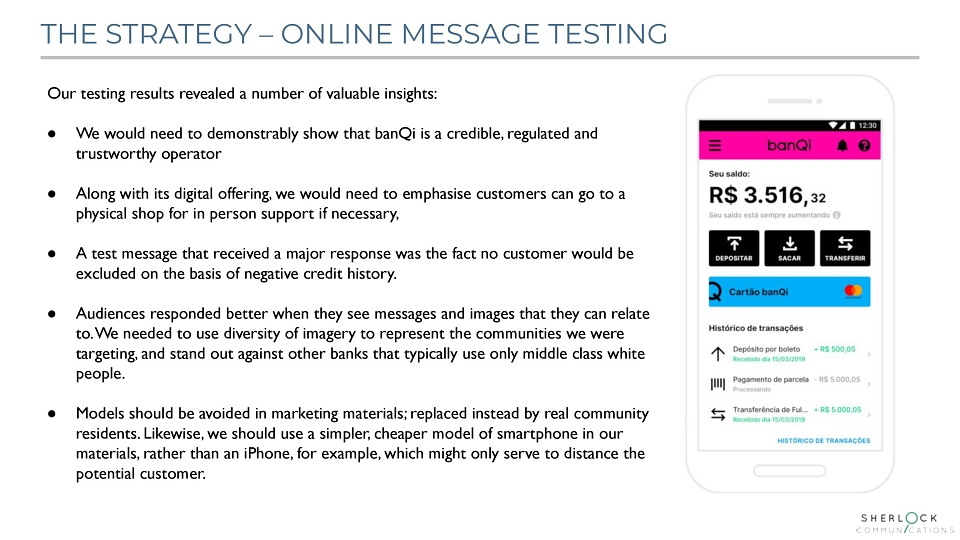
We found the most powerful messages would be those that reinforced trust in a new product while also proving inclusive to the audience. That meant demonstrating that banQi is a credible operator and that customers can go to a physical shop for support if necessary, while also driving home the fact no customer would be excluded on the basis of negative credit history. Another key observation was that the audience responds better when they can relate. We needed to use diversity to represent the communities and stand out against other banks that typically use only middle class white people. Models should be avoided; replaced instead by community residents. Likewise, we should use a simpler, cheaper model of smartphone in our materials rather than an iPhone, which may only serve to distance the potential customer.
The Execution:
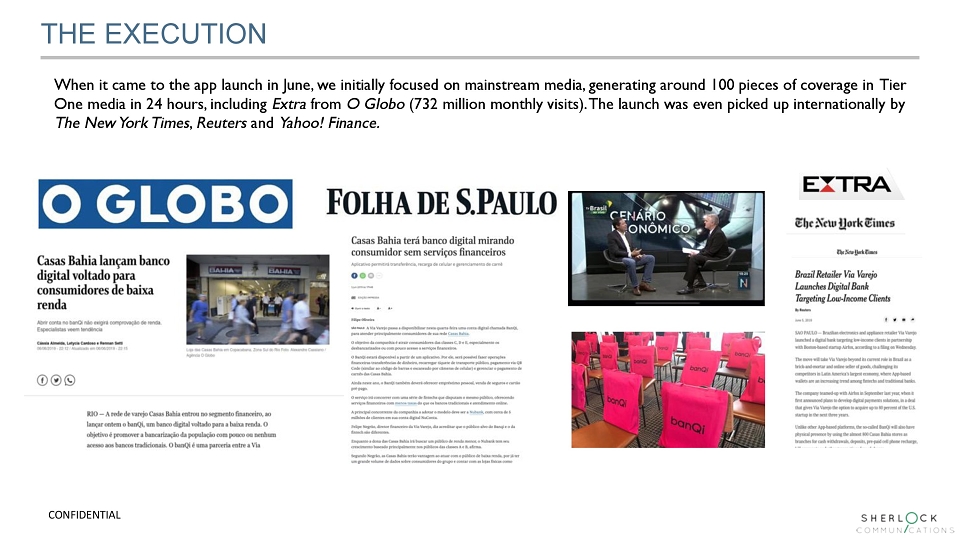
When it came to the app launch in June, we initially focused on mainstream media, generating around 100 pieces of coverage in Tier One media in 24 hours, including Extra from O Globo (732 million monthly visits). The launch was even picked up internationally by The New York Times, Reuters and Yahoo! Finance.
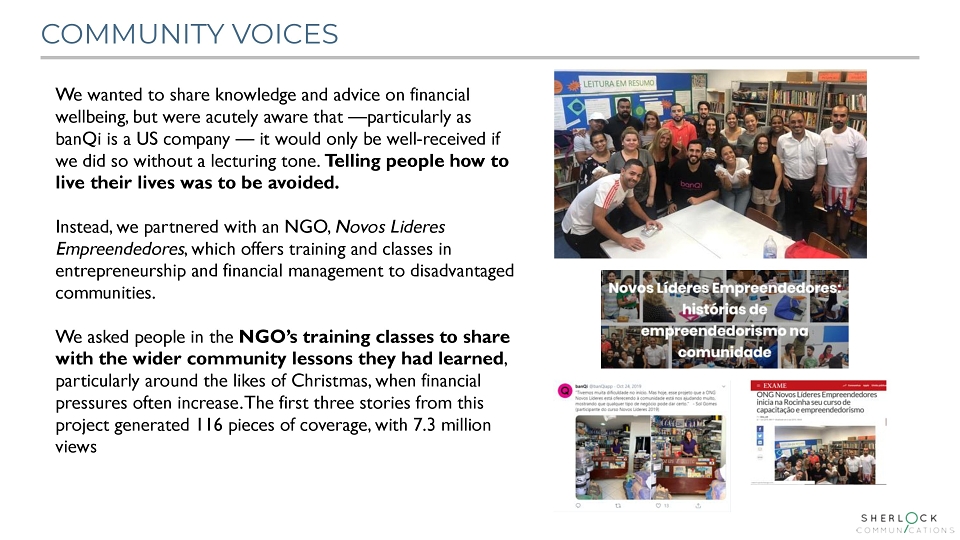
We wanted to share knowledge and advice on financial wellbeing, but were acutely aware that —particularly as banQi is a US company — it would only be well-received if we did so without a lecturing tone. Telling people how to live their lives was to be avoided. Instead, we asked people in the NGO’s training classes to share with the wider community lessons they had learned, particularly around the likes of Christmas, when financial pressures often increase. The first three stories from this project generated 116 pieces of coverage, with 7.3 million views.
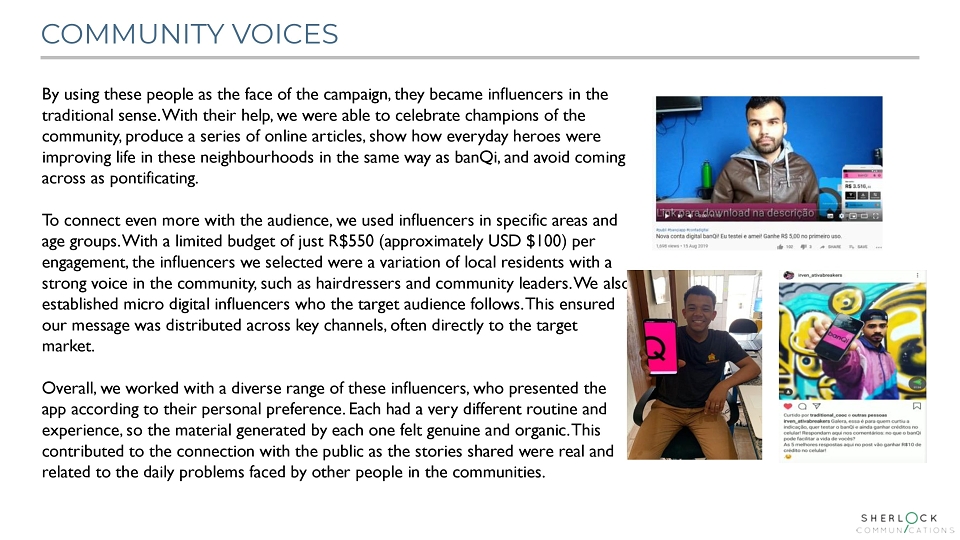
By using these people as the face of the campaign, they became influencers in the traditional sense. With their help, we were able to celebrate champions of the community, produce a series of online articles, show how everyday heroes were improving life in these neighbourhoods in the same way as banQi, and avoid coming across as pontificating.
To connect even more with the audience, we used influencers in specific areas and age groups. With a limited budget of just R$550 (approximately USD $100) per engagement, the influencers we selected were a variation of local residents with a strong voice in the community, such as hairdressers and community leaders. We also established micro digital influencers who the target audience follows. This ensured our message was distributed across key channels, often directly to the target market.
Overall, we worked with a diverse range of these influencers, who presented the app according to their personal preference. Each had a very different routine and experience, so the material generated by each one felt genuine and organic. This contributed to the connection with the public as the stories shared were real and related to the daily problems faced by other people in the communities.
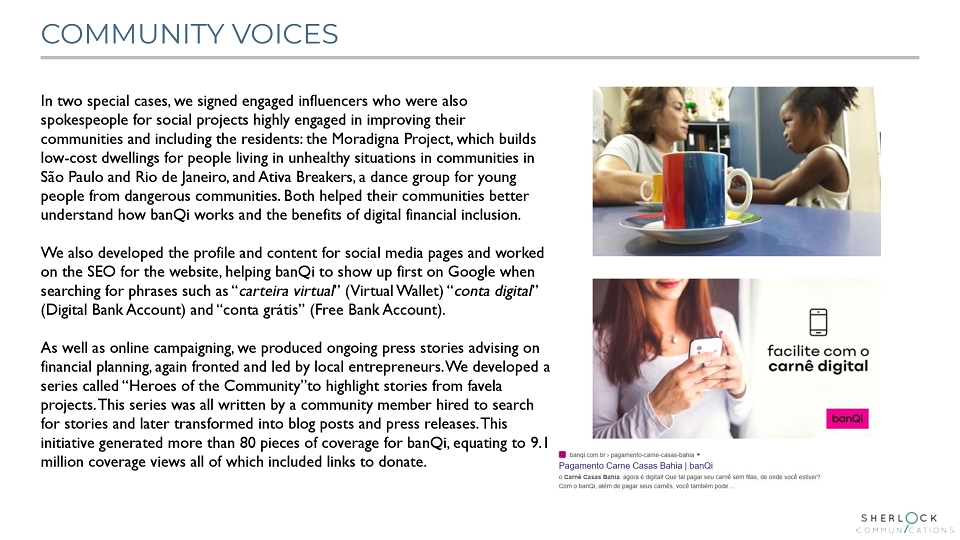
In two special cases, we signed engaged influencers who were also spokespeople for social projects highly engaged in improving their communities and including the residents: the Moradigna Project, which builds low-cost dwellings for people living in unhealthy situations in communities in São Paulo and Rio de Janeiro, and Ativa Breakers, a dance group for young people from dangerous communities. Both helped their communities better understand how banQi works and the benefits of digital financial inclusion.
We also developed the profile and content for social media pages and worked on the SEO for the website, helping banQi to show up first on Google when searching for phrases such as “carteira virtual” (Virtual Wallet) “conta digital” (Digital Bank Account) and “conta grátis” (Free Bank Account).
As well as online campaigning, we produced ongoing press stories advising on financial planning, again fronted and led by local entrepreneurs. We developed a series called “Heroes of the Community”to highlight stories from favela projects. This series was all written by a community member hired to search for stories and later transformed into blog posts and press releases. This initiative generated more than 80 pieces of coverage for banQi, equating to 9.1 million coverage views all of which included links to donate.
Results and Reaction:
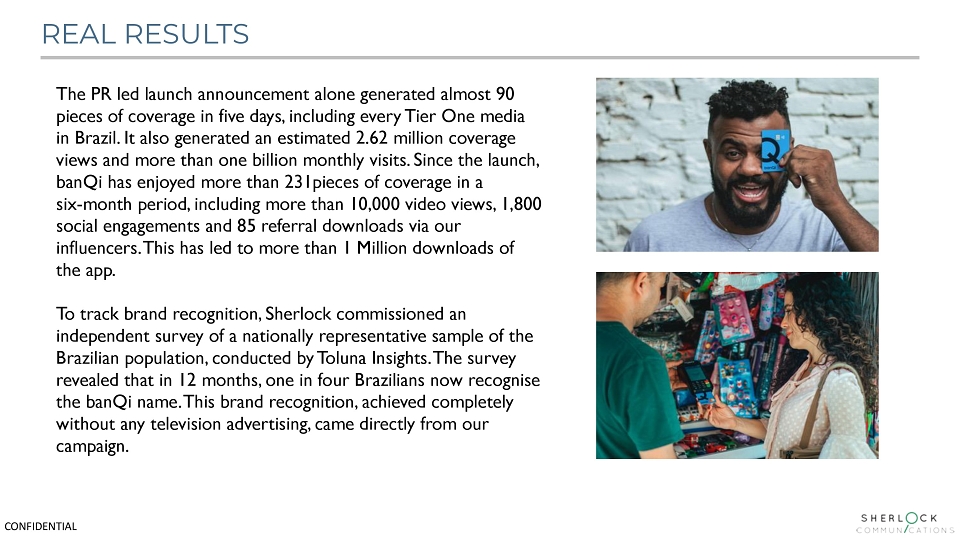
The PR lead launch announcement alone generated almost 90 pieces of coverage in five days, including every Tier One media in Brazil. It also generated an estimated 2.62 million coverage views and more than one billion monthly visits. Since the launch, banQi has enjoyed more than 170 pieces of coverage in a six-month period, including more than 10,000 video views, 1,800 social engagements and 85 referral downloads via our influencers. This has led to more than 500,000 downloads of the app.
To track brand recognition, Sherlock commissioned an independent survey of a nationally representative sample of the Brazilian population, conducted by Toluna Insights. The survey revealed that in 12 months, one in four Brazilians now recognise the banQi name. This brand recognition, achieved completely without any television advertising, came directly from our campaign.
“The Sherlock Communications team goes out of their way to help us, even if the tasks are last-minute or exceed the scope,” said Cathy Melnikow, marketing manager. “ They know our customer base and do not shy away from critical feedback. Our company is better off today because of Sherlock Communications. They are an invaluable member of our team.”