
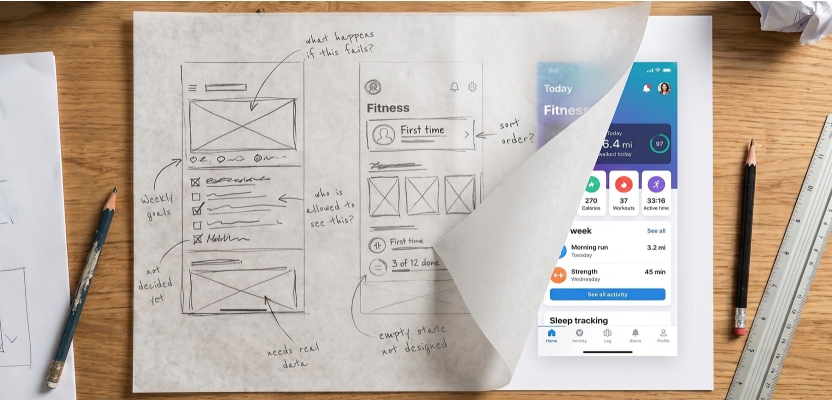

Bill Buxton built a career on a distinction the industry has stopped observing. A sketch is disposable and unfinished, and its purpose is to ask something. A prototype answers. The two objects look like neighbors in a process and behave like opposites, because one invites a client into an unsolved problem while the other announces that the problem has been settled.
Every creative discipline evolved its own version of that distinction. Architects have trace paper. Editorial designers gray out body copy so the client argues about a layout rather than about prose.
The signal was free because fidelity was expensive. Making something look finished used to take weeks, which left roughness as the natural condition of any work in progress. That economics has now inverted. A studio can produce a running application over a weekend in Lovable or v0, and producing something that looks deliberately unfinished has become the option that costs extra. Nobody pays a premium to appear less capable in front of a client, which is why the sketch has quietly left the pitch room.
The demo has no holes in it
Buxton's formulation was that you have to leave holes big enough for the imagination to fit into. A client looking at a wireframe fills those holes personally, and the filling is where a creative team earns its latitude. Someone who is imagining is someone still negotiating. The client operating a working build has nothing left to imagine, having been handed a conclusion.
The Nielsen Norman Group described the downstream effect years before any of the current tools existed. Polish invites an executive to decide the thing looks good and should go live, where rough work gets treated as rough. That observation was uncontroversial when they published it. It has become unusable, because the fidelity dial no longer has a low setting anybody can afford to choose.
Watch what happens to the feedback. Anyone reviewing a sketch questions the concept. The same client, handed a build that responds to their own clicks, questions the button color. Strategic authority has been traded for applause. The applause arrives first, which is what disguises the trade.
None of this argues for slower tools. A build that took a weekend genuinely would have taken a quarter, and a studio refusing that speed will lose the work to one that accepts it. The question is what gets shown and under what description. A tool producing finished-looking output has not thereby earned the right to set the tempo of a client relationship.
What the client cannot see, and neither can you
Underneath the surface there is a second absence, and engineering already has a name for it. Any build that runs before anybody has examined how it runs accumulates obligations that come due later, and the bill arrives on the day a client asks to put the demo in front of real users.
Those obligations are rarely cosmetic. Veracode ran more than a hundred large language models through a battery of coding tasks in 2025 and found that 45% of the code they produced carried a vulnerability from the OWASP Top 10. An insufficient row-level security policy in Lovable left data from hundreds of generated projects readable by anyone who understood where to look, catalogued as CVE-2025-48757.
Each of those projects had passed the only test its author knew to run, which was whether the thing behaved properly when they used it themselves. A demo cannot show you its own absences. That property is precisely what makes it persuasive.
Putting the holes back
The repair is craft rather than paperwork. Fidelity has to become a decision again instead of a default, and the decision belongs to the studio rather than to the tool.
Some teams have started degrading their demos deliberately. Placeholder data goes in where real data belongs, announcing itself as placeholder. A screen nobody has thought about properly is left gray and labeled as unresolved. The exercise gives a client somewhere to put their imagination, and that is what a studio is being paid to provide.
Paperwork follows from craft. A scope document naming the deliverable as a demonstration of the concept converts an invisible absence into a line item the client can approve or decline. Production readiness becomes a separate engagement rather than an assumption. That sentence protects a working relationship far better than any quantity of technical explanation offered afterward.
Creative teams spent a decade arguing they belonged in the room where product decisions get made. The argument has been won, and it was won by a tool that answers every question before anybody present has managed to ask one. Recovering the questions is the harder discipline now, and it is the one worth charging for.
Bill Buxton, Sketching User Experiences: Getting the Design Right and the Right Design, Morgan Kaufmann.