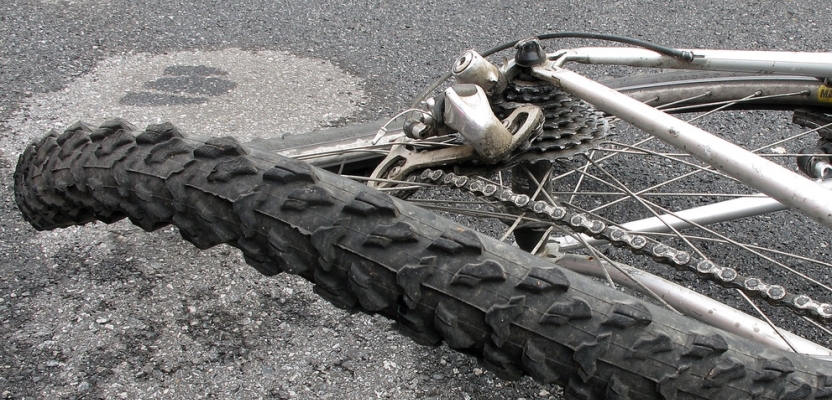


When the cyclist Mark Cavendish was riding for the unstoppable Team Sky, I recall one of the managers, remarking on yet another sprint for the line smash up (of which Mark has quite some form) that he was never overly worried, as Mark “bounces well” - which I thought was a remarkable sanguine observation about crashing into the ground at 40+ miles an hour.
Cavendish himself seems to regard it as an occupational hazard, but I’m not sure I’m reconciled to hitting the deck as something that routinely needs to happen, when cycling or metaphorically while sat on may arse in front of a computer as a project crashes apart. Odd turn of phrase that. But I guess things do ‘crash apart’. At least that’s usually the outcome. Anyway.
The neat thing thought is that with experience (and what I really mean is ‘age’) the metaphorical slams and smashes hurt a good deal less than the ones where, as an elder cyclist, falling with style really doesn’t result in a speedy bounce back.
Being physically and mentally resilient (or as I much prefer as a description, ‘bounces well’) in equal measure I’m not sure I ever personally experienced. The elasticity of the mind versus the body ran away in inverse proportions is my learning.
But I think that suffering less when work-stuff goes wrong - not because I don’t care; I do, otherwise I wouldn’t be in this line of work - is important. And while it’s something that usually takes time to learn and accustom your mind (and body) too, there’s plenty of good advice to start building more bounce right away. And you should start right away.
Plus it sounds a lot more fun, and more human, way to spring back into shape, plus the root of the word is from ‘bunsen’ - ‘to beat’ and ‘bound’ – “to leap upward”’. Next time someone tries to throw you on a project, you’ll be able to get right back up, and none the worse for the wear.