Woodrow Communications LTD
London
ABOUT
“Fly-tipping” – the illegal dumping of waste – is a daily drain on rural communities. Every morning, the CLA’s phone lights up with calls from panicked farmers discovering fridges, rubble and even asbestos dumped in their fields, facing clean-up bills running into the thousands, and damaging crops.
Together with the CLA, we wanted to stop this crime. That meant taking on the loophole helping criminals walk free.
Our research pointed to one weak spot: the waste carrier license system. This is the register meant to show the public who has been vetted to safely remove their rubbish. In theory, it’s meant to stop fly-tipping. In practice, it was actively enabling it. Criminals were being handed licences to collect waste with zero background checks. The system designed to stop fly-tipping was licensing it.
The challenge was how to make government and the public care about reforming waste carrier licensing; a system so dull it seemed designed to defeat attention. We knew we’d need to make it visual, make it real, and use humour to make a serious point.
So, we decided to submit a spoof application to the Environment Agency. The twist? The applicant was a cow.
We called her “Beau Vine”. And three seconds later, she was approved. Making her the UK’s first cow approved to clear household waste.
Together with the CLA's director Ann Maidment, we staged a ‘photoshoot’, conducted a formal 'press interview' with Beau, and cut vertical video assets for social, before selling the story into the Daily Mail.
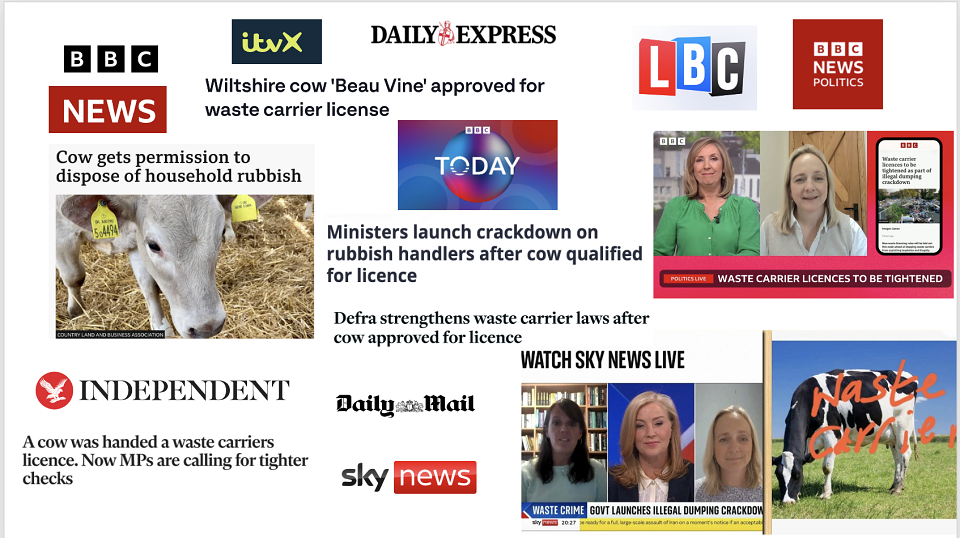
The impact was swift and concrete. The story was picked up across the BBC, ITV and The Express, amongst more. Our 'interview' with Beau was even reposted in LBC coverage.
And just one month later, government announced it was changing the law. Proper checks and verification will now be required for all waste carriers, making it harder for criminals to exploit the system.
The campaign saw a second wave of media interest, with Beau receiving her fair share of credit. Featuring on the Today program and credited across 70 pieces of coverage linking her directly to the law change, she was even mentioned by name by the government Waste Minister, who said that under the new system "Beau Vine would fall at the first hurdle because she doesn't have a digital identity." A creative PR campaign had closed a loophole that years of lobbying had failed to touch.
The first government “moo-turn” showed how good creative thinking can turn a dry regulatory issue into a national story. The campaign, in total, cost just £184 to cover the application fee for the license (a cost later refunded when Beau’s license was revoked following press attention).
Serious policy change doesn't always need heavy-handed campaigning. Sometimes, a lightness of touch lands the hardest blow.
Beau is now retired. The law is not.
MADEIT CREDITS


Annual 2026 GoldBeau Vine: the cow that changed the lawLow Budget
Annual 2026 BronzeBeau Vine: the cow that changed the lawPR