OmnicomMediaGroup UK
London
ABOUT
Concept
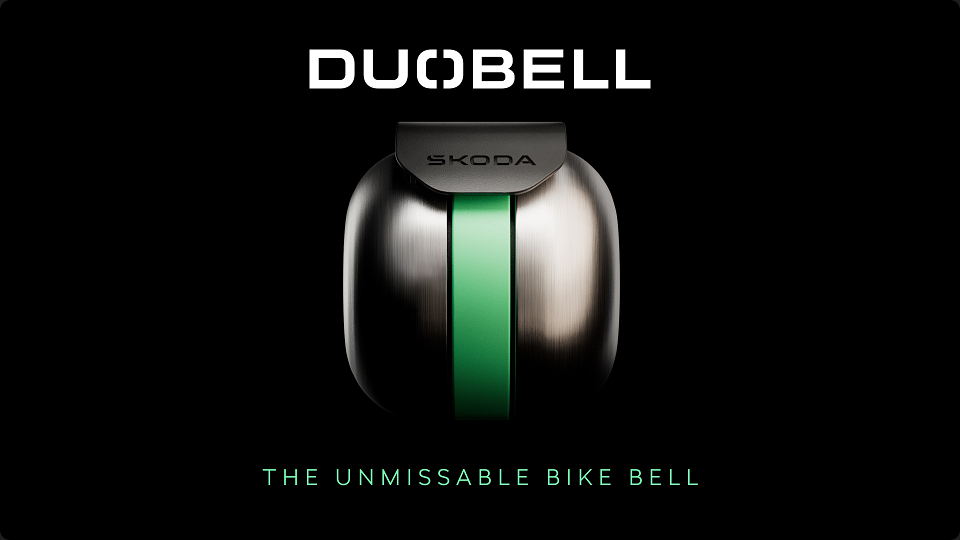
Bicycle bells have existed for over a century. They haven't changed much. The world around them has. In cities where up to half of pedestrians now wear active noise-cancelling headphones, a conventional bell is increasingly useless — swallowed by algorithms designed to erase exactly that kind of sound. Škoda, working with AMV BBDO and scientists from the University of Salford, set out to fix that. UNIT9 built the prototype: a fully mechanical bell engineered to defeat the digital systems that silence it.
Execution
The University of Salford conducted acoustic research to identify how ANC algorithms operate and where they fail. Testing revealed a narrow frequency band — 750 to 780 Hz — that ANC filters consistently fail to suppress. DuoBell was designed around that gap. A dual resonator system (hence the name) targets that frequency, while a specially designed hammer mechanism produces rapid, irregular strikes that generate sound waves ANC algorithms cannot process quickly enough to cancel. No electronics. No connectivity. An analogue solution that outsmarts a digital one. UNIT9 developed the physical prototype to Škoda's Modern Solid design language — materials, colours, and surface finishes drawn directly from the vehicle range. Real-world testing was conducted on the streets of London in February with Deliveroo couriers. The couriers wanted to keep the bells.
Results
Pedestrians wearing ANC headphones had up to 22 metres of additional reaction distance when DuoBell was activated — a meaningful safety margin in urban traffic. Škoda has made the underlying research publicly available to support broader industry discussion. The bell is the first of its kind: designed not to be louder, but to be heard differently.
MADEIT CREDITS
-

SkodaClient
-
UNIT9Head of Hardware Development -

OmnicomMediaGroup UK -

UNIT9 -

Valerio RossiHead of Hardware Development