


I came across Alan Moore in the late 90’s, but it was only later that I looked into him and his craft. I used to attend Comic Cons in the early days and he was unmissable. A six foot figure with hair much like Leslie West out of the Band Mountain, usually sporting a cane, with some mythological figure on it. You couldn’t but notice his presence. But the story doesn’t begin there. It begins in Cumbria where I was a mature student taking up Media Studies. I happened upon an illustrator called Stephen Parkhouse. Parkhouse whose history also needs some mention, was making a name for himself in the comic and media industry both writing and illustrating. Over the passage of time he introduced me to some of his work. This work had been worked up with Alan as the script writer to the characters that he had drawn. The title of the work was: The Bojeffries Saga. The first Bojeffries tale – “The Rentman Cometh” – appeared in black and white form in the British Quality Communications anthology Warrior No. 12 (Aug 1983). Comedian and high-profile comics-fan Lenny Henry (who wrote the introduction to the 1992 Tundra Press collection) described the series as “weird,” recalling that the series’ arrival in Warrior was ‘a breath of fresh air,’ bringing an anarchy and weirdness to comics similar to the kick up the arse that The Young Ones brought to television. It was different. Alan Moore and Steve Parkhouse had created a group of people you wouldn’t want to be in the same universe as – let alone the same room. (Wikipedia). I can testify that on reading The Bojeffries Saga, I felt the same way. The Britishness of the strip was underlined by its setting – a council house in Northampton. Coincidentally the hometown of writer Alan Moore.
Having met Stephen Parkhouse, I got a glimpse of how the both of them worked and how the darkly written text introduced by Alan Moore made Stephen Parkhouses illustrations come to life and vice versa, it was a dark brew and one I hadn’t seen used in a contemporary way before. This was to be a hallmark Alan would continue with throughout his career, teaming up with illustrators and contributing his dark voice to the page.
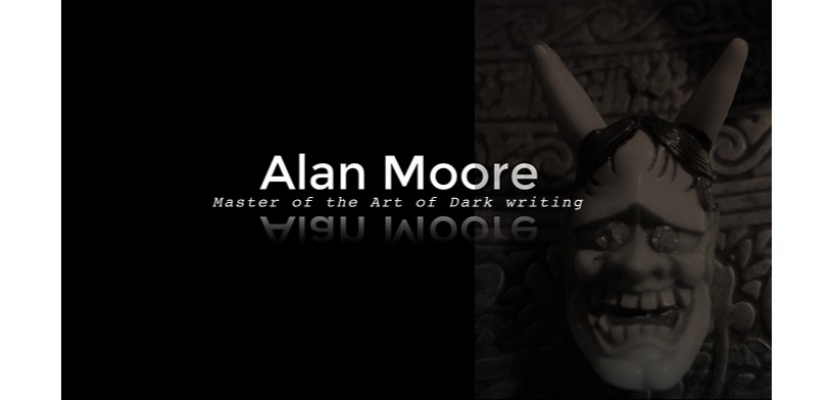
You’ll notice in the banner accompanying this article I’ve included a Japanese ‘‘Oni.’ Traditionally Oni’s were devils, but in recent times, they come to mean something else. In modern Japanese colloquial terms, it’s now regarded as a kind of protector, by that I mean. Should you find yourself harassed or persecuted, then you might want to summon an ‘Oni” to protect you. I think this sums up Alan Moore’s reinvention or as some would say deconstruction of the Superhero. His Superhero’s bleed, they question societies values, much like he does. He‘s what I’d would call a ‘tree-shaker.’ Someone who is constantly challenging, even taunting societies values, a defender of integrity, someone you might want to have on your side, a Western representation of the Japanese ‘Oni’, only in words instead of just brute force. From video clips I’ve watched and articles I’ve read, I’ve never found him to be ‘preachy’. Instead he uses Satire as one of his weapons of choice, another very British tradition. The man from Northants has done good.