



Quick disclaimer: If you’re skimming between client calls, feel free to jump to the “One Thing You Can Do Today” section at the bottom.
This “Taxonomy deep-dive” won’t be Jacques Cousteau-level expedition into the Mariana Trench of marketing theory. More like a casual snorkel: you’ll still see the surface above, maybe swim through a kelp forest, definitely spot some flashy fish, and then head back to the hotel bar. Wait, should we bail out of the office now and hit the bar…?

I took this picture on my last dive trip. My brother photoshopped in the shark and sent it to my parents. About gave them a heart attack.
THREE NAMES, ONE IDEA
If you’ve been in advertising or entertainment long enough, you’ve heard at least three different words for the same thing: transmedia storytelling, 360 storytelling, storyverse.
Which one’s right? All of them, kinda. Welcome to advertising, where we invent three names for the same thing so we can sound smarter in pitch decks.
- Transmedia storytelling: The OG term, courtesy of Henry Jenkins and expanded by Houston Howard. Unfortunately it comes with some baggage due to bad PR and branding. I like the term personally, but it risks making you sound like you just printed out a slide deck from 2015. Also, Shout out to the team at Guild26 for getting me hooked on this madness over a decade ago!
- 360 storytelling: The new agency buzzword. It makes clients feel safe: “Don’t worry, we’ve got every channel covered.” This sometimes gets confused with 360 video as AR and VR become more popular. It also sounds a little corporate-y.
- Storyverse: Moreso a vibe than a label. It suggests world-building over bullet points. Less jargon, more glow up.
Truth? All three point to the same thing. But “storyverse” is the one that sounds the coolest to me. Especially when your role is “Storyverse Architect.”
TAXONOMY BREAKDOWN
 Foundational Narrative
Every storyverse has a Foundational Narrative. It’s the spine, the gravitational core, the one-sentence idea that everything else orbits. Without it, you’re just throwing shiny objects into the void. With it, even your dumbest TikTok feels connected to something bigger.
Think of it like the hub of a wheel. Every spoke (content node) should eventually guide your audience back to the center.
A Foundational Narrative can come to life in many ways, but the most important thing is that HAS TO BE COOL. If your foundational narrative is boring (“Our toothpaste has fluoride!”), don’t waste everyone’s time building an elaborate journey just to lead people to a shrug. Your audience will hate you for it.
At a Film?TV studio:
- Your foundational narrative is probably the film or series.
In Advertising:
- A PR spectacle
- Ashort film, or a mini-doc (Ford’s John Bronco gets bonus points).
- A new innovative immersive website (it better not be your features and benefits page on the website…)
- Experiential Activation
Quick real-world example:
 A few years back, alongside my company at the time Sweatpants Media, I directed a ton of content around the launch of the Toyota TRD Pro truck series- the hardcore off-road versions of Tacoma, Tundra, and 4Runner. Basically, its foundational narrative was in so many words: “TRD PRO can handle anything.”
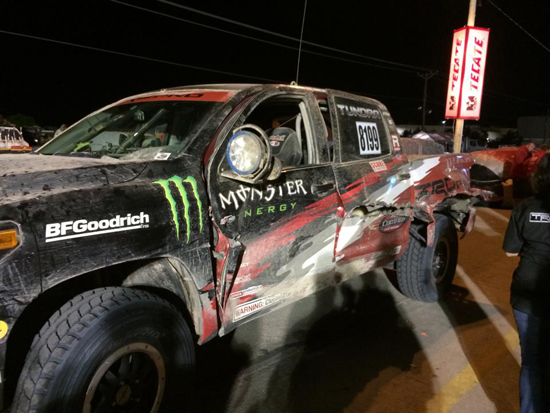
So we leaned into it. Toyota sent a stock-ish Tacoma and had us run the Baja 1000. A grueling 1,200-mile desert race and yes, it’s as insane as you’d expect. And holy shit, I wouldn’t have guessed it, but the Tacoma won its class and then drove itself back to the starting line. *Yep, that's me hanging out of the helicopter*

The truck was so incredibly beat up after the race, but it still ran. So, the marketing team pushed it further. Next came OOH campaigns and even a traveling experiential tour. Dealers and car shows nationwide got to see just how hammered and heroic the stock truck had become.
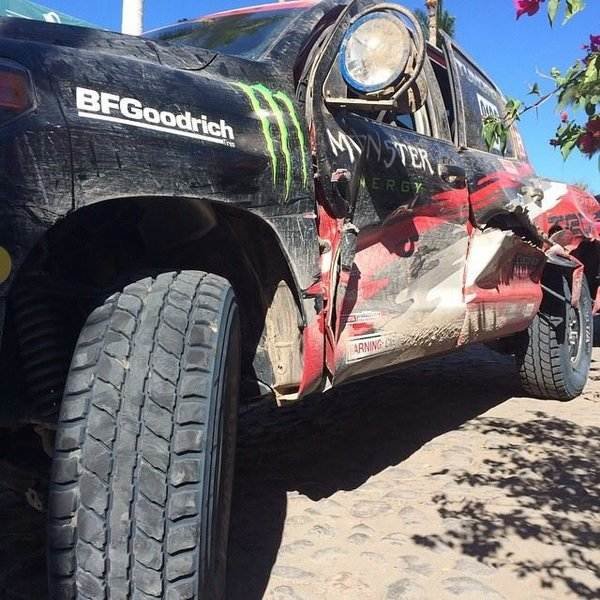 The point is: everything we did traced back to that narrative. Each “node” from race coverage, OOH, to an impromptu experiential roadshow, connected back to “this thing can handle anything.” If that Foundational Narrative wasn’t cool, no amount of TikToks or microsites would’ve stuck. But because it was legit, every piece connected, and the world we built felt earned.
Blueprints, Nodes & Audience Migration, Oh My!
Here’s where most campaigns go off the rails. Brands make stuff (lots of it) but none of it connects. That’s why you need a Blueprint.
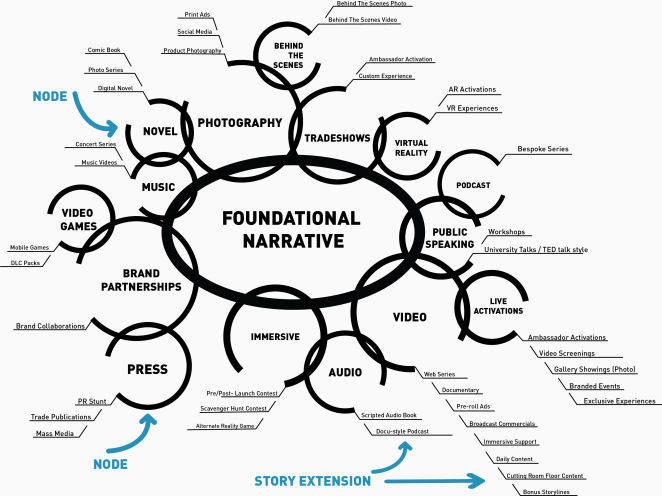
A Blueprint is exactly what it sounds like: A map that connects all the nodes and shows how audiences are meant to travel between them.
Without a Blueprint, you’ve got a bucket of disconnected deliverables. With one, you’ve got an ecosystem where every piece makes the next piece stronger. Within a Blueprint, you have 3 things.
- Foundational Narrative = the backbone tying every node back to the same emotional core.
- Nodes = the big storytelling buckets: PR, public speaking, partnerships, novels, video games, photo, music, film. Each one has different scale and weight in your Blueprint.
- Story Extensions (or content, if you must) = The specific executions: a TikTok duet, a single-page ad spread, a panel at SXSW, a branded podcast episode.
The goal here is to build a Blueprint that motivates Audience Migration across platforms as a way to follow a storyline and continue through the overall narrative within a transmedia Blueprint.
- i.e. A cliffhanger at the end of a video that points to a microsite, an AR filter that drives to the hero film.
We’ll dive deep on building Blueprints in a later article. For now, here’s the takeaway: Blueprints aren’t sexy, but neither is wasting half your budget on TikToks no one remembers.
Platforms vs nodes vs story extensions
Yeah yeah, you know what a platform is. But apparently not everyone does, because more often than my sanity can handle, I hear stuff like: “TikTok is our strategy, we’re just making TikTok content for the launch of our new (insert product here).
Nope. Wrong. I’ve heard it too many times, and every time, my soul dies a little. Social media and all of its forms are (great) distribution platforms, but not nodes.
The Campfire, the Tiers, and the Funnel
Now let’s talk tiers. I like to explain them using the campfire metaphor: tinder, kindling, fuel. Each burns differently, but together they create the fire that keeps people gathered around.
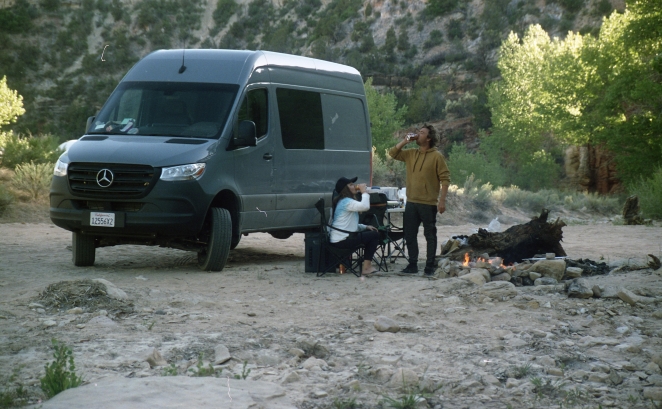 Camping trip with my brother and sister in-law. There’s a campfire in the photo- what more do you want from me?
Tier 4 – Discovery (Tinder): The sparks. Viral stunts, teaser drops, OOH spectacles, quick-hit TikToks. Designed to stop the scroll and make people curious.
Tier 3 – Maintenance (Kindling): The oxygen. Social clips, behind-the-scenes snippets, character profiles, GIFs. This is the daily engagement that keeps the flame alive.
Tier 2 – Exploration (Logs): Interactive experiences, AR filters, hidden microsites, mini-docs. This is where people invest time and build deeper context.
Tier 1 – Experience (The Big Log): The crown jewel. The hero film, the experiential event, the high-production piece that anchors the storyverse.
And here’s the kicker: these tiers also map neatly to the content funnel and customer journey.
- Tier 4 is your awareness stage.
- Tier 3 is consideration / nurture.
- Tier 2 is deeper engagement / evaluation.
- Tier 1 is conversion / loyalty payoff.
Now, yes, I’ve read the “Content Funnel is Dead!” articles. And they’re not wrong. People bounce all over the place now. They binge out of order, skip steps, or jump straight to the end. The funnel isn’t dead. It just evolved.
A storyverse is how you adapt to the evolution.
Why This Is Worth Your Attention?
Here’s how you’ll sound smarter in a creative meeting:
- “That TikTok teaser is a Tier 4 discovery node. Where’s the tollgate that brings people to our Tier 2 interactive content?”
- “We need a Blueprint so we don’t blow all the budget on Tier 1 with nothing left for discovery.”
Suddenly, your peers start nodding because you’re thinking bigger than an ad campaign… You’re a “world builder.” Oooh la la.
One Thing You Can Do Today
Grab a napkin (or a Moleskine if you want to look more pretentious in the office). I personally prefer sketching it out with pen and paper first, but do whatever works best for you. My nieces and nephews love telling me that “Millennials are old!”
- Describe your Foundational Narrative in one sentence and circle it.
- Draw lines out from the circled Foundational Narrative and create some Nodes.
- Label those Nodes with your tiers: Discovery → Maintenance → Exploration → Experience.
Congratulations, you’ve just built the rough outline of a storyverse.
Final Thought
Yes, this is intense, but you don’t need to memorize all the jargon. You just need to know enough to start thinking a little differently.
Hopefully this gave you some inspiration and made the whole thing a little less scary.
Insert relatable ad agency battle cry here!
*I couldn’t come up with one so left it open to interpretation.