Felipe Braz Costa
Executive Creative Director
ABOUT
Brief
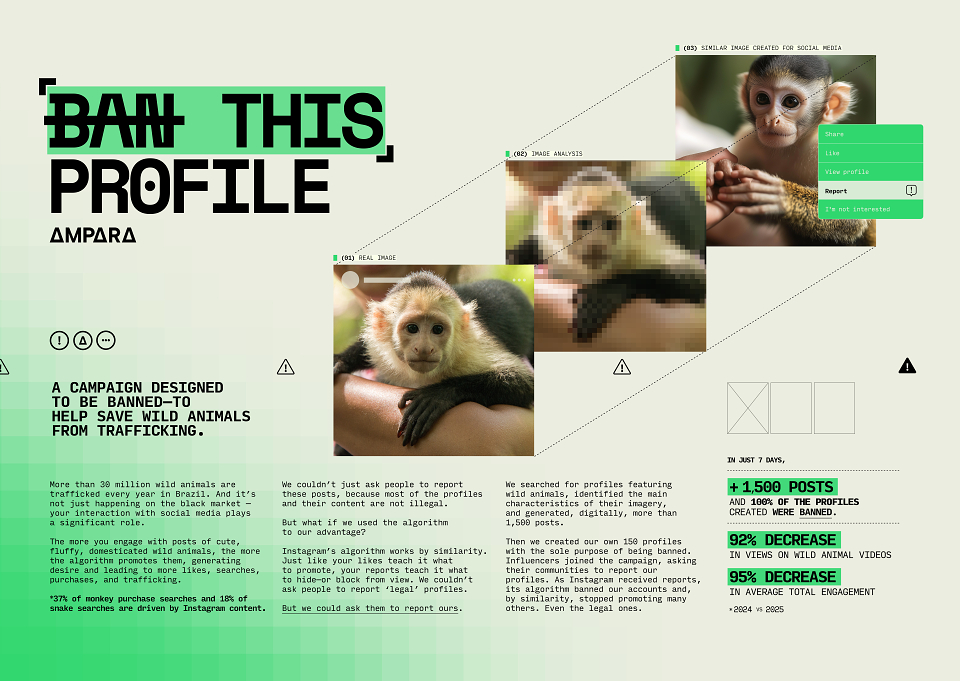
Ampara Silvestre asked us to create a campaign that would reduce the influence of social media in driving demand for wild animals as pets. The goal was not just to raise awareness, but to directly challenge the normalisation of this type of content online. We needed to expose how seemingly harmless posts such as monkeys in clothes or snakes in living rooms create desire and ultimately drive trafficking. The campaign had to be digital, scalable, and behaviour driven. Instead of confronting traffickers, we focused on the audience unknowingly supporting them and used the platform's own logic to suppress harmful content.
Strategy
In Brazil, 30+ million wild animals are trafficked every year. Social media plays a growing role in fuelling this illegal market. Our strategy was built on a clear behavioural and cultural insight: cute, humanised wildlife content on Instagram does not just entertain, it creates desire. And desire drives demand.
Research revealed that 37 percent of monkey purchase searches and 18 percent of snake purchase searches are directly influenced by Instagram content. Yet most of these posts are technically legal and widely accepted.
We understood that a traditional awareness campaign would not be enough. We needed to work inside the system, using the same dynamics that spread this content to suppress it.
The strategy focused on digitally native audiences, especially Gen Z and Millennials, who shape what becomes popular online. By understanding how they interact—and how algorithms respond—we turned insight into a creative action that challenged the problem at its core.
Solution
Wild animals dressed, accessorised, and treated like pets are going viral on social media, fuelling the exotic pet trade in Brazil. While most of this content is legal, it causes real harm. Instead of using traditional awareness tactics, we made the platform work against itself.
BAN THIS PROFILE, a campaign designed to be banned—to help save wild animals from trafficking.
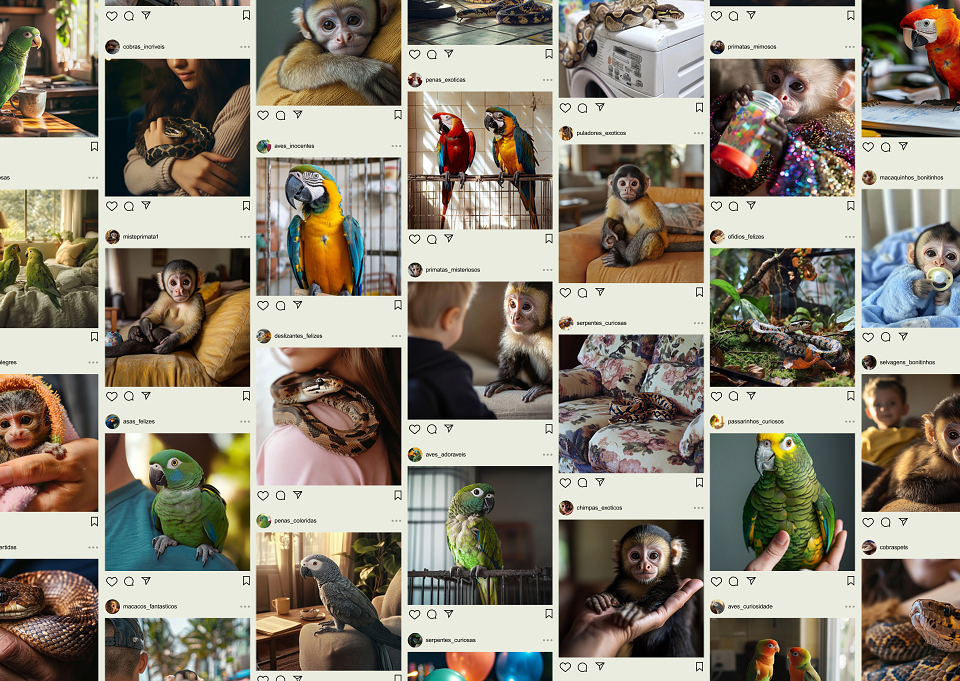
We created 150 Instagram profiles featuring over 1,500 AI-generated posts that mirrored popular wildlife pet content.
Then, using our own social media channels and a group of influencer allies, we encouraged people to report the profiles, turning passive engagement into meaningful action.
Each report trained the algorithm to suppress similar content. Our profiles were removed first. Then real ones followed, even those considered legal.
A campaign that was not made to go viral, but to disappear.
An intervention that turned the platform’s own rules into a tool for change.
Execution
We conducted deep research to identify the most common visual patterns, aesthetics and behaviours in popular wildlife pet content on social media. We used artificial intelligence to simulate over 1,500 posts, recreating the exact type of content that fuels demand.
These images were published across 150 newly created Instagram profiles, each built to be reported by users. The more reports, the more the algorithm would learn to deprioritise similar content.
We launched the campaign through our own social channels and activated a squad of influencers aligned with animal protection causes. They helped amplify the profiles and encouraged their communities to take part.
Instagram was chosen as the core platform for its central role in spreading this content and its relevance to the target audience, primarily Gen Z and Millennials.
The campaign scaled rapidly, adapting in real time as the algorithm responded, reducing visibility even for real and legal content.
Results
The campaign targeted video content across TikTok and Instagram in both English and Portuguese, focusing on mentions of endangered animals like parrots, monkeys, and snakes.
Using tubular, a social video intelligence platform, data was gathered from 10-16 April 2025, with comparisons made to the previous 7 days (2-9 April 2024).
In just 7 days:
1500 posts and 150 profiles created were banned and 100% of the profiles created were banned
92% decrease in the number of views on wild animal videos*
92% decrease in average engagement*
95% decrease of total engagement*
36% decrease on the volume of mentions*
* 2024 vs 2025
MADEIT CREDITS
-

AmparaClient
-

Edelman -

Felipe Braz CostaExecutive Creative Director -

Albert Botelho BernardoACD - Art Director -

Marcelo CondeGlobal Swat Team - Copywriter