
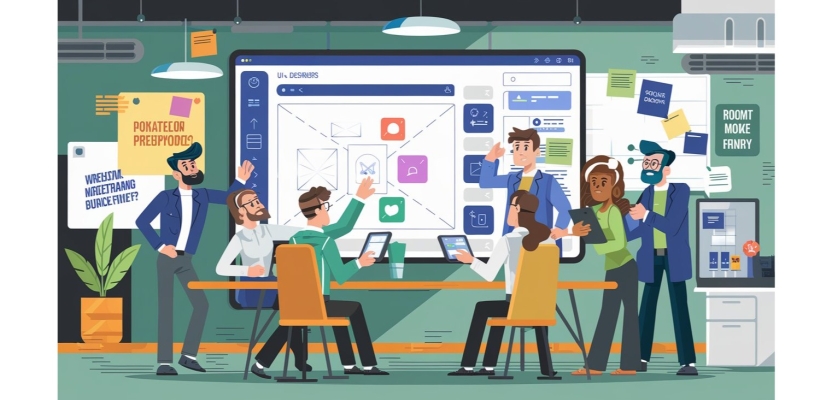

Imagine this: you are working in a startup, creating a new digital product. Your team members include - multiple developers, business managers, UX experts, and quality assurance specialists. Unfortunately, no one on your team has a user interface (UI) design or development background. You choose not to hire any UI design talent because the budget is tight.
So, you go for the obvious solution - assign your two best developers to the task. These coding experts have a strong command of the technology. They have a great track record of communicating ideas and getting things done. After the two developers spend days sketching on their whiteboards and coding, you hold a meeting. In this meeting, they are asked to present their first UI design proposal to the team.
How good do you think their initial UI design will be?
While this is a purely hypothetical situation and there are no right or wrong answers, from our experience in creating digital products, here’s what we think will happen.
Their initial design won’t be very good, Even though the developers have worked hard, they will make common beginner mistakes like
-
Designing for themselves
-
Focusing on technology and features instead of user goals and tasks
-
Their page designs will be confusing, overly technical, and nonstandard
-
The UI pages will look like they were designed by programmers (because they were)
Why Technical Developers Struggle with UI Design (and Why Experts Are Essential)
When developers are tasked with designing a user interface (UI) without formal training, the results often fall short - even if they are highly skilled programmers. When their technical expertise and ability to explain their work in meetings might make their design presentation compelling, the actual UI design will likely fail to meet user needs. Here’s why this disconnect happens, and why startups need dedicated UI experts to bridge the gap.
Developers Design for Themselves, Not Users
Developers instinctively prioritize technical logic over user psychology. For example, they might design a form that mirrors how data is stored in the database (requiring users to input raw codes like CUST-0456) instead of using intuitive labels (something like ‘Enter your customer ID’).
Users do not care about backend structures- they want clarity and simplicity. UI designers focus on user mental models, translating technical processes into workflows that align with how people naturally think and behave.
Over-Reliance on ‘Explaining Away’ Problems
Developers can verbally justify their design choices in meetings (‘This dropdown has to be here because the API returns 50 options’). However, a good Ui should not require explanations - it should be self-explanatory. Users won’t sit through a meeting to understand your product, If the Ui is not intuitive at first glance, they will leave.
Given this, UI designers eliminate the need for explanations by creating interfaces that communicate visually and contextually, like using autocomplete suggestions instead of overwhelming dropdowns.
The ‘Curse of Knowledge’ Blind Spot
Developers deeply understand how the technology works, which makes it hard to see the product from a novice’s perspective. For instance, they might design a dashboard filled with technical metrics (for example, CPU load: 72%) instead of actionable insights (for example, your server is at risk - upgrade now).
Users do not share the developer’s technical context. UI designers act as ‘user advocates’, filtering out technical noise and prioritizing what users actually need to know.
Prioritizing Features Over Goals
Developers often focus on building features rather than solving user problems. They might add a complex settings page with every possible customization option, assuming flexibility is a win. In reality, users just want to complete tasks quickly.
Overloaded interfaces paralyze users with choices. UI designers streamline workflows by hiding advanced options behind progressive disclosure (For example, ‘Advanced Settings’ links) and guiding users toward their goals.
Missing the ‘Language’ of UI
Human communication is natural and empathetic (‘Let me help you reset your password’), but UI communication often defaults to technical jargon (‘Error 404: Invalid Credential’) in the hands of developers. Developers might use terms like ‘SSO authentication’ instead of ‘Sign in with Google’.
Users feel alienated by impersonal, tech-centric language. UI designers craft interfaces that ‘speak’ the user’s language, using plain text, microcopy, and visual cues to create a conversational experience.
Why Even Skilled Developers Can’t Replace UI Experts: 5 Key Reasons
While skilled developers excel at coding, they often lack the specialized expertise of UI designers. Here’s why skilled developers can’t fully replace UI experts:
-
Developers are trained to solve technical problems, not psychological ones; UI designers study how users think, behave, and make decisions.
-
Developers default to exposing backend logic (‘Here’s how it works’). While designers focus on user outcomes (‘Here’s how it helps you’)
-
Explaining a design in person is not equal to embedding empathy into the UI; designers use tools like personas and journey maps to simulate user perspectives.
-
Developers often overlook principles like contrast, spacing, and typography - critical for guiding user attention.
-
Developers tend to add complexity (‘Let’s build in just in case’), while designers subtract it (‘Let’s simplify what’s essential’).
Why Prioritize UI Development Services Early On
Now that we know why startups should not give technical developers UI-related responsibilities, but hire experts who specialize in UI creation- let us see why they should make that hire as early as possible.
First Impressions Are Unforgiving
Early focus on UI development ensures the product communicates with users. Simple choices like using plain language over jargon or prioritizing visual hierarchy can turn a confusing interface into one that feels effortless.
Users form opinions about digital products in as little as 50 milliseconds.
To make this impression positive, startups must prioritize creating an intuitive and aesthetically pleasing UI for their product from the outset.
Avoiding Early User Abandonment
When users encounter interfaces that require them to decode complex information, they are likely to abandon the product altogether. This results in lost conversions, wasted marketing efforts, and negative reviews that can tarnish a new brand’s reputation.
UI specialists play a crucial role in bridging this gap by translating technical workflows into user-friendly experiences. This alignment enhances usability and drives early adoption.
Bad UI Creates Hidden Technical Debt
Startups often underestimate the long-term implications of poor UI design choices on scalability. A UI developed by engineers without design expertise may rely on quick fixes - such as cluttered layouts or inconsistent button styles—that require constant maintenance.
These Band-Aid solutions can hinder feature updates and complicate future development efforts. Fixing these issues later can cost 5 to 10 times more than implementing effective design practices from the start.
By establishing a scalable design system early on (incorporating reusable components and style guides) startups can avoid these pitfalls and ensure their products evolve smoothly over time.
UI Shapes Brand Identity and Trust
A startup’s UI acts as its digital handshake with potential customers. A polished interface conveys reliability and professionalism, while a poorly designed one suggests amateurism.
For example, a fintech app plagued by inconsistent fonts or broken links struggles to gain user trust in an industry where security is paramount.
UI experts ensure visual consistency across all elements (colors, typography, spacing) and design for emotional resonance tailored to specific industries. This attention to detail enhances brand identity and fosters trust among users.
Early UI Investment Saves Time and Resources
Contrary to the belief that deferring UI work saves money, neglecting this aspect often leads to internal conflicts within teams and user backlash post-launch. Without a clear UI vision, teams may waste time debating design choices or scrambling to address user complaints after launch.
Engaging UI expertise early in the development process streamlines decision-making and reduces friction among team members. Tools like Figma allow teams to test interfaces before coding begins. It enables them to identify issues early when they are less costly to fix.
Conclusion
Prioritizing UI development from the outset is not a luxury—it is a necessity for startups aiming to build successful digital products. Sub-par, non-professional UI development results in wasted resources, frustrated users, and opportunities lost to competitors.
A well-designed UI fosters trust, enhances user adoption, and prevents costly redesigns down the line. By investing in UI development services early, startups can create intuitive, scalable, and visually compelling experiences that drive growth and long-term success.
The choice is very simple for startups!